Spring 2020. Working from home, board game nights canceled, rec centre closed, no commute, no social activities. New free time. As the sun set later, I rambled further into the hills on my walks with Poe.
I listened to podcasts at first. The Omnibus, Radiolab, How to Save a Planet. By the new year I had sifted the archives of episodes that interested me, and was ready for something else. Sabrina told me to get Libby. That was in February 2021, nearly 300 hundred plays, novels, epic poems and short story collections ago.
Frequent Authors
This is very unfair. I would have liked more Eliot, Woolf, Faulkner, Dostoevsky, and a lot less Galsworthy. Ann Radcliffe is completely absent despite my repeated searches. This is just what my libraries have in English audiobooks. Another reason for this distribution is that I’m going through these books in a vaguely oldest-to-newest order. The further back in time, the more dominated by white men.
| Author | Number of Titles | Median Rating | Favourite |
| William Shakespeare | 38 | 6 | Hamlet 9/10 |
| John Galsworthy | 11 | 6 | Flowering Wilderness 7/10 |
| Thomas Hardy | 9 | 7 | Far from the Madding Crowd 8/10 |
| Oscar Wilde | 9 | 6 | The Importance of Being Earnest 8/10 |
| Laura Ingalls Wilder | 9 | 6 | These Happy Golden Years 7/10 |
| Lucy Maud Montgomery | 8 | 7 | Anne of Green Gables 8/10 |
| Mark Twain | 8 | 7 | A Connecticut Yankee in King Arthur’s Court 7/10 |
| George Bernard Shaw | 8 | 6 | Pygmalion 7/10 |
| Jane Austen | 7 | 7 | Northanger Abbey 8/10 |
| Earnest Hemingway | 6 | 7 | The Old Man and the Sea 8/10 |
| Fyodor Dostoevsky | 5 | 8 | Crime and Punishment 8/10 |
| Leo Tolstoy | 5 | 8 | Anna Karenina 9/10 |
| George Eliot | 5 | 8 | Silas Marner 8/10 |
| Elizabeth Gaskel | 5 | 7 | Wives and Daughters 8/10 |
| E. M. Forster | 5 | 7 | A Passage to India 8/10 |
| Edith Wharton | 5 | 7 | The House of Mirth 8/10 |
| Rudyard Kipling | 5 | 7 | Kim 7/10 |
| Louisa May Alcott | 5 | 6 | Turbulent Tales 8/10 |
| The Brontës | 4 | 8 | Wuthering Heights 9/10 |
| Pearl S. Buck | 3 | 8 | The Good Earth 8/10 |
| William Faulkner | 3 | 8 | The Sound and the Fury 8/10 |
| Virginia Woolf | 3 | 8 | A Room of One’s Own 8/10 |
| Liu Cixin | 3 | 8 | The Dark Forest 8/10 |
| Herman Hesse | 3 | 7 | Steppenwolf 8/10 |
| James Joyce | 3 | 6 | Dubliners 7/10 |
| Anthony Trollope | 3 | 6 | The Way We Live Now 7/10 |
| Wilkie Collins | 3 | 6 | The Woman in White 7/10 |
| W. Somerset Maughan | 3 | 5 | Of Human Bondage 6/10 |
| Anton Chekhov | 3 | 4 | The Three Sisters 5/10 |
Libby is just Audible but for the library, so if you have a library card, you can borrow from the catalogue of audiobooks and ebooks. It’s incredible. I linked my old Ottawa and Sudbury cards and my parents’ Edmonton one.
This is my first experience with audiobooks and it felt like cheating. That feeling revealed something I didn’t like to admit: that I don’t always read because I enjoy it, rather because I think of myself as a reader and need to prove it. But I haven’t read all that many books since university. Every year, the internet takes more and more of my attention.
At some point I came to realise that there are more – many more – great books than can be read in a lifetime, even if 80% of my reading hadn’t gradually migrated to a computer screen. I felt guilty about this, and guilty about my bookshelves, something that used to be a source of comfort and pride.
Listening to Shakespeare seemed justified. When would I realistically ever read his 3rd tier plays? Besides, his plays weren’t meant to be read. They ought to be performed, so audio books seem more appropriate anyway. This logic helped get me started, and it held for oral epics like The Odyssey, The Canterbury Tales, and Beowulf. By the time I had finished these, it was early summer, I was over the snobbery, fully enjoying the stories.
The walks refilled me. The exercise, the companionship of my dog, the forest, the flood of language and ideas – all of it gave me energy. I didn’t like every book, but I loved enough of them. Some I might never have read any other way.
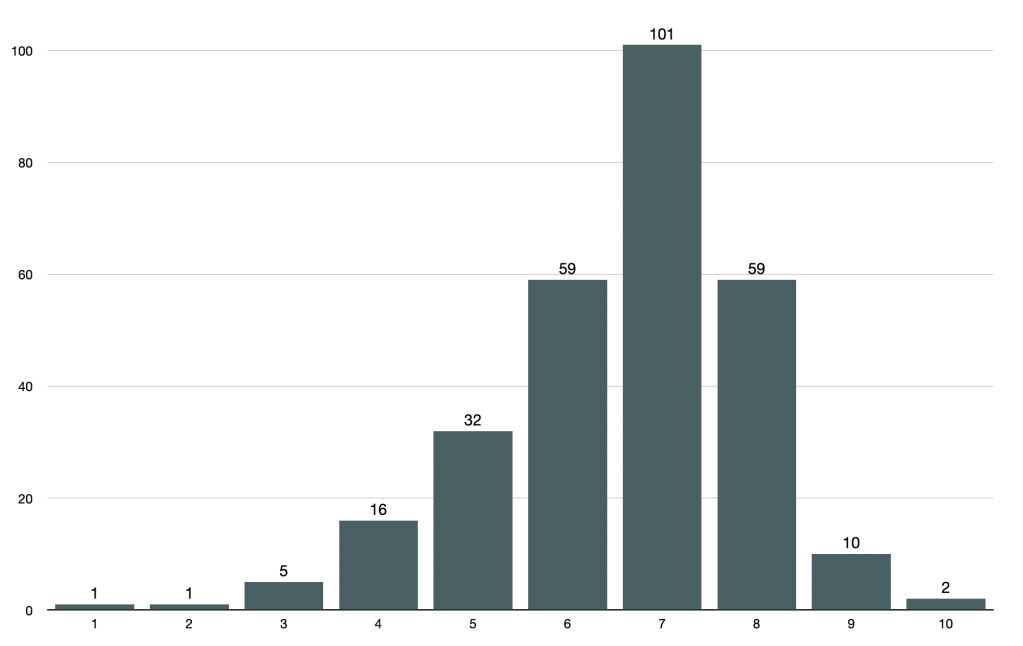
Eventually I started keeping a list with a rating. Here are my favourites. I don’t really know what the ratings mean. Maybe just how glad I am to have read them. They are subjective, and while I’ve tried to be honest, I’m probably fooling myself and letting fame tip the scales here and there.
Top 50
- Beowulf Translated by Maria Dahvana Headley 10/10
- Crime and Punishment by Fyodor Dostoevsky 10/10
- Anna Karenina by Leo Tolstoy 9/10
- The Trial by Franz Kafka 9/10
- War and Peace by Leo Tolstoy 9/10
- Hamlet by William Shakepeare 9/10
- The Brothers Karamazov by Fyodor Dostoevsky 9/10
- Wuthering Heights by Emily Brontë 9/10
- Othello by William Shakepeare 9/10
- Rebecca by Daphne Du Maurier 9/10
- Macbeth by William Shakepeare 9/10
- Far from the Madding Crowd by Thomas Hardy 9/10
- Invisible Man by Ralph Ellison 9/10
- Jane Eyre by Charlotte Brontë 8/10
- Vanity Fair by William Makepeace Thackeray 8/10
- Three Men in a Boat by Jerome K. Jerome 8/10
- The Good Earth by Pearl S. Buck 8/10
- The Old Man and the Sea by Earnest Hemingway 8/10
- The Cossacks by Leo Tolstoy 8/10
- Twelfth Night by William Shakepeare 8/10
- Don Quixote by Miguel de Cervantes 8/10
- Silas Marner by George Eliot 8/10
- King Lear by William Shakepeare 8/10
- Wives and Daughters by Elizabeth Gaskell 8/10
- The Mill on the Floss by George Eliot 8/10
- The Death of Ivan Ilyich by Leo Tolstoy 8/10
- The Diary of a Young Girl by Anne Frank 8/10
- Under the Greenwood Tree by Thomas Hardy 8/10
- The Importance of Being Earnest by Oscar Wilde 8/10
- Much Ado about Nothing by William Shakepeare 8/10
- Paradise Lost by John Milton 8/10
- Gilgamesh Translated by Stephen Mitchell 8/10
- The Tenant of Wildfell Hall by Anne Brontë 8/10
- Northanger Abbey by Jane Austen 8/10
- Dead Souls by Nikolai Gogol 8/10
- The Sound and the Fury by William Faulkner 8/10
- Pride and Prejudice by Jane Austen 8/10
- A Passage to India by E. M. Forster 8/10
- The House of Mirth by Edith Wharton 8/10
- An Immense World by Ed Yong 8/10
- Anne of Green Gables by Lucy Maud Montgomery 8/10
- A Room of One’s Own by Virginia Woolf 8/10
- The Ugly Duckling et al. by Hans Christian Andersen 8/10
- The Machine Stops by E. M. Forster 8/10
- Tess of the D’Urbervilles by Thomas Hardy 8/10
- The Princess and the Goblin by George MacDonald 8/10
- To the Lighthouse by Virginia Woolf 8/10
- The Order of Time by Carlo Rovelli 8/10
- A Doll’s House by Henrik Ibsen 8/10
- The Picture of Dorian Gray (Dramatized) by Oscar Wilde 8/10
The Start
February 10, 2021
The end of January brought a brutal cold snap. Winter crawled down from its seat in the arctic and seeped over the prairies. For two weeks the air hurt to breathe and I hardly stirred from our cozy little house. But winter could not hold back the jet stream forever. The warm Pacific air broke through, as it always does, and rushing through the teeth of the Rocky Mountains, it drove winter out of our valley. On February 10th, I downloaded my first audiobook, leashed an overjoyed Poe, and started to explore.
It was icy and dark and I rarely walked for more than an hour. I went slowly until I found my footing. I wasn’t used to listening to audio books. These first few were part of a series called Shakespeare Appreciated, popular in high schools. They were training wheels for me. If my attention wavered for too long and I lost the thread, I was always saved by Joanne Walker’s helpful interjections. They were always enthusiastic; never condescending. After listening through with the notes, I re-listened to the play without, and could enjoy it even more.
Othello 9/10
Of the great 4 tragedies, this was the one I hadn’t yet read. Iago is a magnetic personality. It’s a pleasure to see a truly competent person doing something at the highest level, and for Iago, that is lying. Having Shakespeare write your lines will make most characters sound clever, but it feels like the playwright is putting forth all of his powers to conjure convincing proofs out of empty words.
The play is called Othello, but it’s all about Iago. All the other characters are caught up in his schemes, their futures deflected by the words he whispers in another’s ear. Who is he? Just an uncommonly wicked and skillful dissembler, or the Devil himself? The ingenuity he shows in manipulating Roderigo and Othello, and the cold blooded murder of Cassio feels almost supernatural. But then the way he is simply and suddenly undone by his wife, who has presumably survived years of marriage to this monster And kept her morality intact, points to a very common foible: underestimating women.
Throughout the play we get an ugly glimpse of Iago’s contempt for the other sex. Like all liars, he doesn’t believe anyone else is honest. This double blind spot leads to his downfall in one perfect moment.
I listened for “problematic” tones since it deals with race and is over 400 years old. Yes, some of the minor characters throw jealous slurs at Othello, and the villain Iago uses a stereotype about Moors to try to sway another character, but I never felt like Shakespeare believes it, or is inviting his audience to such views.
Julius Caesar 6/10
Remarkable for the rhetorical battle in the middle of the play between Brutus and Marc Antony. No doubt political speech writers have for centuries been mining these speeches for techniques. Also interesting is the falling out between the conspirators as the people turn on them. The end is a bit tedious and Caesar himself is a flat, dull character who, happily, doesn’t make much of an appearance in his own play.
Twelfth Night 8/10
A real surprise and delight! It starts funny with the melodramatic and downright emo Duke Orsino. Fun for Olivia to fall in love with Viola. The famous Shakespearean gender bending of men playing women playing men comes off well here, and I believe I detected a winking attitude towards homosexuality, from the subtle (the Duke pouncing on Viola as soon as society permits it after secretly being attracted to her in thr guise of a manservant), to the explicit (the sea captain playing sugar daddy to a reluctant Sebastian).
This play would be merely enjoyable, but the Malvolio subplot pushes this into the ranks of elite Shakespeare for me. Malvoleo is a great parody of me, well read and confusing the clever passages he can quote for his own wit. Add in self importance without any self awareness, and the come-upance feels justified, even though it is pretty harsh. The Sir Topas bit is such a rich gold mine. Feste is my introduction to a top tier fool, and is the ideal foil for Malvoleo – no ego, but real brains.
In Stride
March 9
The library didn’t keep Shakespeare Appreciated in stock. A couple months after I started, they had disappeared and I had to pick through the various productions unaided. The BBC versions were uniformly excellent. The American theatre companies are more hit or miss.
At this time I decided to make a run at Shakespeare’s complete canon. It went quickly by then. I could often finish a play in one long walk or session on my climbing wall. The longer days drew me out further afield and the little feeling of accomplishment from completing books and discovering new paths in the hills converted this new practice from an experiment into a pleasurable routine.
King Lear 8/10
Half-remembered from high school English, this surprised me with how dark it is. Act I; Scene I: a fragile king commits his fatal blunder. Cordelia banished. His snakey children Edmund, Goneril and Regan plot against the remaining good guys and when it seems none are left, betray each other. There’s hardly a glimmer of salvation in the end as the returning heroine is swiftly captured and executed and Lear dies of that terribly common affliction, a broken heart.
Among all this evil, the rays of light, Cordelia, Kent, and Edward, are profound and memorable. Cordelia’s speech at the beginning, that so incenses Lear, is a surprising one from Shakespeare, who you’d think would be the last to deny the power of language to express love. Her sacrifice at the end ransoms the king’s mind, and though he dies miserable and undeserving of her, he sees the truth at last.
Even more astonishing is how Edgar behaves, at first simply naively out of his own goodness. But then Kent reduces himself to the position of servant to help the king he loves, and Edgar outdoes him by descending still further into obscurity after he and Lear are driven into the wilderness. To comfort his mad king, he willingly dons insanity himself, and, still as in the disguise of Poor Tom, works to save his blind and despairing father. Also, he kills Edmund, so there’s at least one thing we can feel good about in this play.
The Tempest 7/10
A nice palate cleanser after Lear. The good guys win, we get some proper wizardry, and the bad guys clown around. Caliban is a bit uncomfortable. Is he meant to be a “savage native” caricature? I’d be more interested in him if he was written sympathetically but it seems like we’re told he tried to rape Miranda and so we have permission to laugh at his woes. I read it in university and enjoyed it about as much as this revisit.
A Midsummer Night’s Dream 4/10
The arbitrary switching of who loves who quickly gets tiresome. I just don’t like any of the characters or believe in any of their motivations. The only bright spot is the theatre troupe. I’m a sucker for the bad acting bit. Always tickles me.
Romeo and Juliet 6/10
The prettiest language in all Shakespeare is paired with the most infuriating plot and the dumbest characters. Everyone just keeps making the foolish possible decisions from beginning to end. But the glittering speeches dazzle the ear and we don’t mind so much.
Can we talk about Friar Lawrence? Why is he such a meddler? He’s giving love advice, he’s working behind the scenes to solve political disputes, he’s secretly performing marriages, and he’s concocting wild schemes to fake a death using magical herbs. Is this his day job? Does he freelance these services to all who ask? Now, one of those Italian renaissance noblemen or maybe a cardinal I could see, but a humble friar up to his eyes in intrigue? Just bizarre.
Hamlet 9/10
This one has atmosphere. Ghosts and madness, banter with the skull of a jester, and a great many murders. We get not one but three different methods of poisoning but the most baroque has to be pouring poison into the ear of a sleeping king. What a metaphor. I find that I’m just listing stuff I loved in no particular order, so while I’m at it, one more: fighting literally inside the grave of the innocent Ophelia.
Hamlet himself is a tremendous anti-hero. Both brilliant and crazy and where does he find the energy? Unsurprisingly, given all the things I’ve mentioned and the many more I’ve omitted, the play is long. You could argue it’s too long. I wouldn’t complain if the whole bit about going off to England and getting captured by pirates was cut. Seems like a 5th wheel to me. I would not hear of cutting the play within the play, however. First of all, Shakespeare has a lot of fun ideas about the theatre, and second, it’s a wonderful bit of psychological tension.
I would read a short story from the point of view of the players. This manic prince is giving us a million directorial notes, clearly another courtier who secretly wants to be an actor himself, though this one might have some talent. The scene he orders is NOT going to play well but he’s the one paying us, so he’s the boss.
Henry V 6/10
This is the “band of brothers” play. Henry V has become a model of leadership. Courageous and inspiring. The Chorus extols his nobility and virtue. But war is not good, and this gilt English propaganda can’t fully coat what is underneath: the cruelty and thirst for blood necessary to prosecute a war of offense. I don’t think Shakespeare is subtly critiquing Henry or the English attack. I think that is projecting our modern values and giving him way too much credit.
There is some pretty language and strong speeches. I like the scenes with the common people. They are clear eyed and cynical and provide a bitter dose of realism to a play otherwise full of jingoism about good old England. But mostly it’s a 500 year old superhero movie. It’s simple and childish. The good guys are brave and win against all odds and they are gracious in victory and they are in the right because of course they are.
All’s Well that Ends Well 5/10
I’m of two minds on this one. The plot is fun and ingenious, and I like the resourcefulness of the heroine, but it’s just impossible to believe that any woman would try so hard to marry a thoroughly rotten man like Bertram. He humiliates her in court, he lies to everyone, he is sleeping around, and only agrees to marry her on penalty of death. All is not well at the end of the play, and I’m certain it will only get worse as the marriage goes on.
As You Like It 7/10
A merry romp full of wordplay and trickery. The characters are so cheerfully absurd – an exiled duke reigning in the forest, a court jester dragged along by an impetuous lady, a Very Strong Man, and my favourite, the lovesick gentleman and his truly awful poetry. There’s not a lot to chew on here, but it’s always lively and interesting.
Macbeth 9/10
We love a cackly witch with full on cauldrons and eyes of newt. We love that old world kind of prophecy where you can debate whether it would have come true if they hadn’t heard the prophecy. We love the waking nightmare that the MacBeths live in after the regicide that is capped off in wonderful style by a moving forest.
From the instant that Lady Macbeth turns her husband, every scene is on a tightrope. The dread and tension are sustained until the last act when we are finally given a full resolution, simpler and more satisfying than in Lear.
Almost a year later and I’ll admit I can’t remember which one was Duncan and which Malcolm but I do remember the mood of psychological horror. It’s the Tell-Tale Heart by Poe. It’s a shadow creeping up the stairs.
The Merchant of Venice 4/10
If the only thing you know about this play is the “if you prick us” speech, then you might think that Shakespeare was making a powerful case for racial equality. That is not how the rest of the play goes. Shakespeare plays Christians taunting Jews for laughs, and of course in the end, Shylock is tricked and doomed and this is portrayed as a happy ending.
There is a tacit admission throughout the play that the Christian domination of Jews is not altogether just, so I don’t think this is a simple case of pure anti-semetism like Oliver Twist. But on balance I have to dock a lot of points. It’s a shame because there are other praiseworthy parts of the play. Portia’s speech about mercy blessing both the giver and receiver is powerful, for example.
Intermission
April 3
Warm sun. Thin drifts of old snow, speckled with fallen needles. The understory is still dormant. This is the time of year that is easiest to follow game trails. A break from the bard provides an inner change to herald the new season.
The Odyssey 6/10
Oh, that rosy-fingered dawn and wine-dark sea. Had this not been narrated by the extremely capable Ian McKellen, this might have become tedious. It really is just one damn thing after another, but enough of the adventures are stories worth telling.
There is, charitably, just a touch of character development – sometimes the heroes are sad, for example. But this is Greek myth, where that sort of thing isn’t done. Each character has one trait (our hero Odysseus is “crafty”) and that will have to do them for their entire lives. If you want more , don’t look for a character to develop them, just add another character. By comparison, this is miles better than The Iliad. At least with The Odyssey we get a lot of new scenery.
Life’s Edge 7/10
In grade six we memorised the characteristics of life. If something ticked all the boxes, it was alive. Simple. It wasn’t until first year university that I started to appreciate the full messiness of nature. There are gradients to everything. When a species evolves into another, where exactly do you draw the line? Are quorum-sensing bacteria multicellular? Are viruses alive?
Nature doesn’t come with any categories. It just exists in all it’s chaotic glory and any attempts to systematise it to make it knowable is doomed to be incomplete at best and generally just wrong.
It’s a great premise for a book. Zimmer pokes at the concept of life from a few different angles – biogenesis, our intuition about viruses, and organoids grown in a lab. He puts on different definitions of life and notices things about the world that just don’t seem to fit right with any of them. It’s like trying to dress an octopus with the clothes in your closet.
Histories
April 15
In Canada, spring is merely a series of brief winter remissions that come and go March through June. First spring, second spring, fool’s spring, the slushening… Meteorologists estimate that there are 39 in total, same as the number of Shakespeare plays. The unwary will often think winter is dead at last, only to wake up to yet another April snowstorm.
Likewise, it was around here that I started realising first, just how many plays Shakespeare wrote, and second, why I had never heard of most of them. Many are just plain boring. Others have passages of clever language or a few interesting characters but I can’t say are worth the effort either as entertainment or history.
Henry IV Part 1 7/10
Falstaff is one of the great sinners of literature. The bawdy tavern scenes are such a contrast with the anxious meetings of Bolingbroke and his advisers, and so much more enjoyable, that it almost feels like a criticism of courtly behaviour. It’s somehow good to be reminded that audiences in the 1600s revelled in cheeky indiscretion much as today.
Compared to John and Richard II, this brings human-scale action. In those plays, the plot was entirely devoted to affairs of state and lofty speeches about abstract ideas regarding divine right. This being a history of a king (in name, anyway), there are some political scenes, but even those are brimming with personality. Glendower is a petty blowhard haggling over land while trying to intimidate the other lords by claiming to be some kind of Merlin-esque figure. Hotspur is as described on the tin, but with a strong noble side. Henry Bolingbroke, ostensibly the main character though he takes a back seat to his son, is harassed but competent, and the climax of the whole book is his emotional meeting with his son. Shakespeare, clearly fond of him, gives that son a fine redemption arc, taking him from loveable scamp to serious hero.
It’s a good mix of action, comedy, and feeling.
Henry IV Part 2 6/10
Kind of a sixth act to the last play. Not too much happens that would be of interest to historians, but the gap in content is easily filled by the girth of Falstaff. The title character does even less, but his scenes are emotionally interesting. He can’t seem to escape recollections of Richard II, and, beset by worries, he seems to fear that his fate will be the same. It’s not quite guilt, but perhaps a little bit of remorse. He is also estranged of his son, unable to make up his mind. His suspicious mind sees fault and treachery, but in the end he cannot deny his father’s heart.
Hal’s speech to his dying father struck me for its elegance and recalled the lawyerly skill of Iago, if Iago was explaining an honest mistake for once. I don’t believe the transition he makes. It seems too abrupt. Maybe the head that wears the crown truly is weighed down with cares.
Falstaff is probably the weakest part, just because he is in more of the play than he warrants. He’s amusing and awful and outrageous, but it’s just slapstick. It works better to have a fool that appears and disappears a regular brief intervals instead of commanding entire acts.
Cymbeline 5/10
This might be the most complicated play of all. The wicked stepmother tricks a servant into thinking poison is medicine but she was also tricked and it’s really a sleeping potion. There are long lost twin brothers and the princess Imogen dresses as a man and the rake Iachimo fails to seduce Imogen but succeeds in tricking Imogen’s lover into thinking she is unfaithful. You could say there are a lot of twists. The problem is that not all of them seem motivated. Why did Belarius give the king his sons back after all this time? Why did The king refuse to pay tribute and then pay it after winning the battle? And so on.
The Comedy of Errors 5/10
This play probably pushes the mistaken identity plot device the furthest of any in the canon, and in such rapid fire madcap style that it’s dizzying. The result is at first amusing and then just tiresome. It’s the same joke told over and over for no increase in the payoff.
Henry VI Part 1 5/10
Full disclosure: I almost instantly forgot what happened in which Henry VI. On a second listen, I’m startled to discover that this play has Joan d’Arc. Ah yes, scene after scene where some random nobleman is announced, says something stentorian, and then rushes off. It comes back with all the pleasure of stepping in something wet in the night. On top of a litany of squabbling Dukes, there were also Earls and Lords, none of whom I managed to keep track of. A passionate student of British history may have an easier time and find some enjoyment.
Somewhere in Act IV, the writing started to get a lot better. The speeches became a lot stronger. They started to talk in more heroic couplets, there was suddenly an emotional component to what used to just be stale exclamations, and a little irony. It’s not enough to recommend the play. The characters are mostly still just walking names from a history book, and I didn’t really like how they did Joan at the end.
Henry VI Part 2 6/10
The writing is Shakespearean from the start this time, and the characters have a bit of juice to them. This helps a lot in keeping all the noblemen straight, but it’s not enough. There are simply far too many, and even on a second listen, I kept losing track. I appreciate that there are some weird plot points sprinkled in to break up the squabbling court scenes like the whole necromancy thing, but these soon stray into excess. Not only is the central plot about the political factions on the complicated side, there is also a love triangle, trial by combat, assassination, popular rebellion, trial civil war, and finally real civil war.
These are all fine side plots, but it makes the play over-long and distracted. Cade’s rebellion is the most substantial of them. I guess this is political satire, and it’s interesting that the feckless mob is lampooned for being swayed as easily as a feather with pretty basic sloganeering. It’s also interesting to see that promises of cheaper or free stuff, and an anti-literacy (anti-elite) platform was considered the dumb easy way for hacks to gain followers even back then.
The way the rebellion ends is similar to the Cardinal, and the King himself. Not with a bang, but weak and grovelling. But we’ll get to that in the next one.
Henry VI Part 3 5/10
This is the worst for being an endless procession of dukes swearing oaths and arguing and running around. Everyone seems to have just finished reading The Iliad because for some reason they keep forcing references into their speeches. The title king is so snivelling and spiritless that every scene with him tries our patience as much as his wife’s.
Speaking of, Queen Margaret is the most interesting character. Dauntless, ruthless, able to command armies if not her husband’s energies. She emasculates York and I suppose the glass ceiling was pretty strong back then, or else she would surely have ruled England and headed off the rebellion somewhere during the last play. The only other highlight is our introduction to the young Richard III, who gets a thoroughly gnashing soliloquy near the end.
Richard II 6/10
He’s doing this thing where the characters are not only distinguishable by the words they say, but also the rhythm and rhyming patterns they use to say them. Half the play is spoken by the usurpers and other minor characters in blank verse; the other half by Richard is in heroic couplets and sweeping metaphors. His lines sing, and I mostly enjoyed this play on those grounds. This is near the pinnacle of Shakespearean language. The other half is more ordinary but still effective.
It isn’t that Shakespeare seems to be particularly pro-Richard and anti-Henry. The nobles accuse Richard of waste and indecision and oppressive taxation and there is no word in his defence. No word, that is, besides “and yet I am king.” Is being a king about your birth or your actions? Shakespeare lets us decide the question.
My first impression was that none of the characters were all that interesting, the courtly scenes are stuffy and the much more interesting lower class scenes are entirely absent from this play. Certainly the plot would benefit by spending more time on the usurper. We know he can write a conflicted anti-hero. Instead, this play remains locked onto the title character as he makes a series of catastrophic decisions and nondecisions.
Richard III 7/10
Far and away the best of the histories. We get a delicious anti-hero for the protagonist. Cunning and ambitious, a honey-tongued villain. The audacity of the scene with Lady Anne is absolutely something else. Shakespeare seems to be arguing that if only you can be eloquent enough, words are the strongest force in the universe: greater than reason, love, and hate. He of all people ought to know.
I don’t know what the politics of the time were, but I wish Shakespeare had always been as fearless in making his monarchs into such juicy characters. And he isn’t the only one. I also loved the profanity-laced appearance of Queen Margaret who is the only one who sees Richard for who he is.
The actual plot is pretty dull. Richard simply murders everyone, one after the other, until the entire country is disgusted with him and kills him back. It’s like the evil Romeo and Juliet where all of Shakespeare’s immense powers are bent on expressing deceit and wickedness instead of love, and this greatness is let down by the plot and characters.
King John 5/10
Poor John can’t catch a break. The French are retaking his towns, the nobles are conspiring against him and the Pope sends over a delegation to excommunicate him. Then, to cap it all off, a tragi-comic misunderstanding frames him for the death of a rival claimant to the throne. You’d think it couldn’t get any worse, until a random monk poisons him. Fin. It’s almost slapstick.
The first half is honestly just boring. They argue about who is the rightful king, citing laws and justice and family trees. Nothing is more deadly dull than family trees. When the Cardinal shows up, there is at least a little bit more interest. John scorns the excommunication, calling it a curse lifted by money. Zing!
Henry VIII 4/10
Hooo boy was this dull. Shakespeare is at his best inventing characters from far away lands or in the distant past. There he has the freedom to make them as mean or as inscrutable or as flawed as he likes. I guess these people are too recent. Some in his audience may have lived in their time and especially among high society patrons, being on the fashionable side of history was vital. Being too critical or praiseworthy of anyone in Henry VIII’s court was dangerous. And the result is this insipid, half hearted mess.
Instead of a court scene where Buckingham is unfairly tried, we simply hear it told about afterwards. Instead of hearing how the King and Anne fell in love at the dance, we are simply told about it afterwards. Instead of a dramatic climax where Wolsey’s letters to the pope are intercepted and he is revealed to be a traitor, we are told about it afterwards. It’s always a couple anonymous gentlemen giving a synopsis of what happened, which I guess is safe because he won’t make descendants and allies of court figures mad by writing lines for the historical characters directly; all we get is what these gentlemen have heard happened. Well, it also robs the play of all its drama and interest.
The argument between Katherine and Wolsey is sort of interesting, but that’s about it. And the wild praise of Elizabeth at the end was beyond satire. Stick to fiction buddy!
True Spring
May 14
By the end of this set, we had put in our garden, set up the hammock and I had at last exhausted my libraries’ supply of Shakespeare. I’m not sure what seeds it planted in me, but I do believe something will grow from it one day or another.
By now I was hooked and even as I finished my tour of Shakespeare’s canon, I kept finding more books to borrow.
Antony and Cleopatra 4/10
I was quite disappointed with this one. I was still in the throes of passion for history, and the fame of this play so far outstrips nearly all the other recent ones that I was expecting something at least as good as Julius Caesar. Unfortunately, this turns out to have the same problems as Romeo and Juliet – the main characters are all abominably stupid and selfish – without the benefit of above average language.
Much Ado about Nothing 8/10
The other big surprise was how good this one was! I enjoyed spending time with all the main characters, especially Beatrice. They are lively and distinct, and that classic medieval baddie, the bastard prince, is just the right amount of wicked. The plot is a well-worn formula, but it’s effective and has some nice little surprises along the way.
The double courtship is, as mentioned, packed with witty repartee and delightful little setups. I learned later that the title is a very apt play on words: nothing was pronounced “noting” in Elizabethan times, which meant eavesdropping. The stakes are high by the climax when it looks like poor Hero has been ruined by the dastardly Don John, but her friends believe her and there is enough time left in the play to sort it all out.
However, we are alarmed to see the entrance of a friar who – oh dear – hatches a scheme for Hero to fake her death. This did not go well in Romeo and Juliet, we recall. But this is a cheerful play, with characters who are reasonable and willing to forgive and see the best in each other, and this time it does all work out. Though overmatched by both circumstances and their love interests, Claudio and Benedick do show their good natures in their end and we get a double wedding after all, happily ever after, the end.
The Sonnets (Shakespeare) 7/10
I really have no ear for poetry. I can’t find the right frame of mind to appreciate it apart from prose. But even brutally flattened into prose, there are many lovely phrases and clever ideas to enjoy. I thought they were surprisingly uneven in quality. I understand poets wrote sonnets on commission, essentially, for aristocrats to pass off as their own during courtships, and any artist who has to satisfy a client will know the pain of compromise. Maybe that is what happened in a few of these. Or maybe Shakespeare just had an off day.
The Canterbury Tales 7/10
I should have expected all the fart jokes, but happily, I didn’t. Most of the memorable stories are funny, often taking the form of one occupation chirping another. The millers and the carpenters seem to hold a particular animus for one another. Some other tales sound like legends. The knight’s tale has all the touchstones of an Arthurian sidequest.
There is duplication. We have a story about a good priest, and another about a bad one. There are some unfinished tales that the other characters cut off out of boredom, and the entire collection is probably incomplete as well. All of this is assembled haphazardly, as though a bartender wrote down the stories shouted by drunken customers in between rounds, by no means systematically.
It’s unpolished, it’s uneven, it’s bawdy, it’s lively, and the overall effect is charming.
The Taming of the Shrew 2/10
One of the few that I simply detested. Shakespeare shows us a charming, vivacious young woman and in scene after scene, has the “hero” starve, beat, and intimidate her until she is broken and subservient. It’s presented as a straightforward happily-ever-after. The jacket notes try to spin this as extremely subtle irony. No chance. This was popular entertainment, a comedy, playing to the sensibilities of an audience of drunken men who paid a penny for a funny show. It makes light of common cruelty and instructs the audience to follow this disgusting example.
Pericles 4/10
This is starts as a straightforward quest to marry a princess. Periclese sees the trap (incest!) and escapes. And then a completely new story starts. I never got a satisfying resolution to the first, and the second is a bit of a mess too. There is some good material here but it badly needs rearranging and trimming.
Three Sisters 5/10
This was effective at presenting (and imparting) a frustrated restlessness. A modern species of depression. I can’t say I took any pleasure in the story, but I appreciate the unity of theme and tone.
The Lady with the Dog 4/10
I have a similar complaint/compliment again. The characters and the world feels real, but it’s unpleasant. I remember my stay in Yalta and Moscow as being drab, cheerless, grey. It left me cold and listless.
The Skin We’re In 8/10
First person journalism. Injustice is witnessed and interpreted for privileged white Canadians like me. It tried to make me see what has been happening in my periphery all my life, unnoticed.
There is a reporter’s attention to facts, but also raw emotion. A human reaction against systematic cruelty.
Policing Black Lives 6/10
Precise, densely sourced, almost legalistic journalism. It reaches deep into the past, when slavery was practiced in Canada and draws lines throughthis land’s history to the present. It also makes a wide search of modern Canada, interrogating every institution and building a powerful case against each in turn.
The argument is that racism is pervasive in Canada. It is the air we breathe and the material of the state.
This book is most effective as a resource for explaining racism to white acquaintances. Filled with facts and examples, statistics and studies. As a cover to cover read, it is dry and can feel repetitive, though really just exhaustive.
Legends
June 13
Waiting to let Poe cool her paws in the creek, listening to Dante. Kneeling in the garden, pulling weeds, and picturing Satan slipping into another garden to tempt Eve. Long days and long legends, still resonant.
The Divine Comedy 5/10
I love the idea that you need a poet to guide you along the dark paths. But in such a renowned classic about the deepest subject matter, I was surprised by just how petty Dante is. As he travels through the Inferno, he picks out specific sinners and names them as his rivals, solemnly describing their sins and punishments. Enemy cities are denounced and it is implied that his own is favoured by heaven.
At times it is tedious. Sin after sin, level after level, the damned parade by in endless succession. It’s not until we approach the bottom that we get to the interesting characters. But after the tour takes in the giant Satan ice sculpture and pops out on the other side of Earth, we realize we’re only a third of the way through and the most famous part is behind us.
The climb of the mountain of purgatory he western vs the eastern aspects are explained in great detail. I did not care. Then at last we ascend to the heavens and this is the most boring of all. Just empty numerology, a list of sums, an accountant’s paradise.
Paradise Lost 8/10
First, this is a fantasy novel, not theology. The title screen would artfully admit that it is “inspired by the events in the Bible.” But it would make an exhilarating summer action movie. It is cinematic. The central character, Lucifer, is brilliantly written with notes of – not sympathy per se – but recognizable motivations and emotions.
Milton imagines the answers to all the fun Sunday School questions like how do angels fight? More interesting is how he explores the questions no one in any church I’ve been in asked, like the family relationship between Satan, Sin, and Death, and what happens when they argue (Sin, the mother, mediates).
Not every part is enthralling. There are long speeches, and a host of names, most beings are just another angel with a superpower in lieu of characteristics. They are mentioned and rarely heard from again.
Beowulf (Maria Dahvana Headley) 10/10
This is a slam poem, pulsing with rhythm and energy. If words alone can have charisma, this translation is soaked in it. It has the authentic ring of proper legend, the unabashed sincerity and yearning for great deeds. It’s a song, a muscular groove compelling my attention punctuated by audacious riffs that made me grin like a fool.
The jacket notes advertise it as a “feminist retelling”. This makes it sound like it will be a radical departure from the source material. It isn’t. It faithfully follows, as best I can tell, every plot point and character. The only thing radical is the astonishing power of language it unleashes. Is it feminist? I have no idea what that question even means. Beowulf is the quintessential macho storey, and Headley’s translation celebrates the hero’s swagger at every opportunity.
Okay, I suppose this translation gives some thought to how Grendel’s mother feels about her child’s sudden death. Is that feminist or just good storytelling? After all, interesting villains make for great stories.
Headley clearly loves Beowulf. She found every ember of life in it, and set it roaring into flame after centuries of stuffy, milquetoast translations. I had read a traditional one in university and shrugged; I felt that as a story, it had good bones but failed to captivate. Headley made me realise – insisted that I realise – that the plot points don’t make it art. The words make it art.
Short Stories (Chekhov) 3/10
Looking back much about these stories have faded, including the reason I was glad they were short. I think they were just full of dull talk, no particularly interesting or novel characters, no compelling ideas. The one I remember the best is the one I despised the most, where a man gives an improbably bad lecture on smoking to an audience so apathetic that they don’t provide any resistance as he veers off and complains about his wife.
Norse Mythology (Gaiman) 7/10
This is a fine collection of stories, curated from the Edda and reimagined. It has no subtly. It telegraphs the characters’ feelings and motivations so transparently that it’s occasionally embarrassing. Those moments feel like being spoken to like a child.
The characters have just been flattened a bit too much into stock Hollywood types, and the dialog is a bit corny. Still, they are good stories, so I can put up with a few sins. This would probably be perfect for the YA set.
Gothic
July 6
There was one savory moment of synchronicity. A summer storm had dimmed the afternoon sky to a sullen purple and I was a long way from home and just a little lost. Meanwhile Heathcliff was wreaking his awful revenge on the younger Cathy in that weatherbeaten patch of moors.
Pygmalion 7/10
Shaw’s most famous play, I believe, and also my introduction to him. Well met. It’s also an oddball in this list, a play, a comedy, and a tone that feels modern. Appraising these relics with 21st century sensibilities, I am somewhat alert to how a work treats the lower classes, women, and other races. Shaw acquits himself well here, as do many other authors of even earlier periods. It belies the tired defence that “it was a different time.” And there is really no excuse for artists today.
The Scarlet Letter 6/10
I admire it more in retrospect, but at the time I think I was just kind of sick of the characters well before the book ended. It starts off as a delicious mystery with deep, intriguing characters. But by the halfway point we’ve guessed all the novel’s secrets and have to patiently wait for Hester, Roger, and Arthur to finish tormenting each other and themselves. There are some depths that we only peer into, and that lingered in my mind. Pearl is sometimes strange and inexplicable, as is Hester’s return at the end.
It’s a bold novel about big ideas and big motivations: love, guilt, courage, revenge. I take its thesis to be that any correlation between religion and morality is accidental. I do recommend it even though it is too long on both ends – the preface alone was totally unnecessary and took hours.
The Allegory of the Cave 4/10
I realise that I’m panning the foundation of western philosophy. I’m not saying it wasn’t important and influential, or that it isn’t thought provoking. It’s a good metaphor and has several tasty ideas. I’m saying that my experience with it was marred by one mistake by Plato and one mistake by Tantor Media. First, the Socratic dialogue is a drag – Glaucon merely nods along every few sentences. Either have him argue and question or do without. In the second case, the audiobook was read by a dead ringer for Dr. Marvin Monroe from the Simpsons. What’s worse, he had a long and unconvincing preamble full of praise for American philosophers and businessmen.
The Prince 7/10
I liked it for the history. Machiavelli gives an abundance of examples for every point he develops. “Recent” examples of Italian kingdoms and duckies squabbling, more distant examples from Medieval Europe, and still more remote examples from Roman history.
As for whether the advice is immoral or correct or useful, I would say no, no, and no. It aims to be amoral, scientific, realistic. It may be all that in the sense that it has the tone if the philosophy of Realism, but I doubt it was ever very true. The explanations, like so much punditry today, sound like just so stories. For every factor Machiavelli considers, a thousand others go undescribed. And even for factors he discusses, it is dar easier to be right about direction than magnitude.
The Art of War 4/10
The same criticism as above, but missing both history and nuance. It’s essentially just hundreds of statements in the form of, “all else being equal, A is better than B.” This is very monotonous, and also doesn’t feel even potentially useful because the subject cannot be boiled down into a series of dilemmas, or even a flowchart for decision making.
This is the same trouble with improving at chess. The coach has told me to control the centre, put rooks on open files, prefer an open position if I have the two bishops, keep my king safe, put my knights on outposts, etc. But which is the best plan in this position? What is the optimal tradeoff between allowing my opponent to do these things and accomplishing them myself? There can be no answer. Being better at chess just means having a better intuition about what features of a position are more important. And so it is (I believe) for war. Sun Tzu notes that manoeuvring will tire your army and you should occupy advantageous ground and not be enticed off of it, but also that you should keep your army mobile so the enemy doesn’t know where you are.
Jane Eyre 8/10
The novel opens in the enormous shadow of Charles Dickens. A good orphan is maltreated and sent off to an awful school run by Mr. Brocklehurst, a Dickensian name and a dead ringer for the beadle from Oliver Twist or the school master from Nicholas Nickleby.
The difference is that Charlotte Brontë writes these characters earnestly and is less certain of right and wrong than the flippant Charles Dickens. Even Helen Burns is viewed ambivalently, whereas I feel she would have been written as a pitiful, pure saint by Dickens.
As Jane grows up, these comparisons fade away and I’m more tempted to see Mary Shelley and Poe. There is a mysterious creature, a dark secret, psychological melodrama, and many key plot points take place at night.
But ultimately it’s a love story. What struck me was how intellectually it is described. Jane and Rochester’s match is contrasted with others and its merits argued. It is passionate, but this is firmly secondary to its strict moral justification. The courtship is poetic without becoming sappy.
Both Mr. Rochester and Jane are susceptible to moonlight (who isn’t) but the principled Jane will not succumb to wuvvy duvvy wooing. Their repartie is sharp and fun and makes Jane a particularly memorable heroine. She is no beauty, she isn’t greatly “accomplished”, she has sense rather than wit and practicality rather than sensibility. But she is tough and resilient, self assured, and moral to the core.
There’s something to be said about that too. Religion is refracted through each character differently. The Christ-like Helen Burns on one end of the scale to the comic hypocrisy of Brocklehurst on the other are not so interesting, but in between, Rochester, St John, Jane, and Eliza have their own interpretations.
Rochester is almost irreligious, appealing to a spiritual law of kindness that he believes supersedes what he calls “man’s law” against bigamy, and is scornful of outward appearances of righteousness. He swears in church, calls Jane an elf and even dresses up as a fortune teller.
St John is dictatorial and yearns for danger and adventure, but needs it to believe that he is doing it for pure and noble causes. Becoming a missionary is the perfect cloak for his flaws. Who could refuse his demands and criticise the way he is devoting himself so unsparingly to religion? Only Jane.
Jane has a balance between St John’s fervour and Rochester’s spirituality. She rejects the hollow pretences of religious forms that hide cruelty or selfishness. But when she is tested, though her reason is spun round by Rochester’s arguments and appeals to kindness, she holds fast to the religious principles she grew up on.
The Diary of a Young Girl 8/10
What kept hitting me was how ordinary Anne and her family are. They are petty with the people they are cooped up with. they are kind when they can forget themselves, they are scared more by small incidents than the situation overall, they are depressed for weeks, they are happy in moments, they develop miniature wars and love affairs in their hearts, they forgive, they miss feelings from the past, they hope in the future, they follow the war on the news, they develop new interests, they are terribly bored, they resolve self improvement, they relapse, they are just like everyone I’ve ever known and me.
Heroes 8/10
Stephen Fry has long been a favourite. Here he reassembles the Greek legends concerning people. Not quite ordinary folks, you understand, but only up to the rank of demigod. Fry interprets these stories in his own affable, lettered style, with plenty of asides to tell us that we get some English word from such and such Greek character’s name. These tellings are a few notches more subtle than Gaiman’s Norse Sagas, but Fry still limits his characters to simple, unambiguous traits and motives, which I assume is still more nuance than the original legends had.
This is the chronological sequel to Mythos, which is about the Gods and Titans from the beginning of the cosmos, and for my money Heros has the better stories and more interesting characters.
Wuthering Heights 9/10
Unlike Jane Eyre, which took until act two to become a ghost story, this one starts off fully committed to that genre. It’s done really well. We meet our guide, the affable Mr. Lockwood, and almost immediately, we are plunged into a nightmarish mystery that seems supernatural, but very gradually becomes more and more explicable. By the end, we can almost sympathise with Heathcliff, despite his inhuman cruelty.
But I get ahead of myself. What a conception Heathcliff is. Hate and cruelty are pressed into him as a foundling until his defining trait is implacable malice. We get a brief sketch of how this happens – the partiality of Mr. Earnshaw nurses his pride into a monster, which is constantly stung and goaded by Hindley and the unkind instincts of most to his birth and sour countenance. But before he was brought to Wuthering Heights, much more must have been done to poison his character, and this is left to our imagination. He appears to arrive at the moors already well on the road to being a fiend.
It’s not necessary to give a logical, grounded explanation of his character, as Elliot/Evans might have. Emily Brontë, through Nelly Dean, places Heathcliff somewhere on the spectrum between human and monster. And why not? There must really be ghosts in this story; besides all the minor characters who insist on seeing them, Heathcliff’s final days wouldn’t make sense if it was some trope like a sudden nervous breakdown. Oh no, he was definitely being haunted by Cathy and he was in some kind of tantric state of agony and ecstasy until his soul was released.
All the characters are brilliant. Old Joseph gets a small role, but is such a bizarre addition to the story. And the others just accept that the servant is a mad, tyrannical prophet.
I also wonder about Nelly and how reliable she really is. From her own telling she is full of common sense and a desire to do right, but there are odd omissions and she can’t hide that she was occasionally manipulative (though always thoroughly justified by herself). Not that I think she is very wrong – she generally has sympathy for everyone (except Lynton but for the trick he played on her I can understand) and is happy for Catherine and Earnshaw at the end, so even if she isn’t the rock of righteousness that she appears on the surface, I think her narrative is probably a justifiable version of the truth.
Mythos 6/10
As mentioned, the first in the set. We cover the absurd creation myths with the child eating and the father murder and the titans raping their mothers and gods born out of thighs and on and on. Fry treats it all with affable charm. He finds what logic he can, and develops what little character is in the material, but there’s no disguising the chaos and arbitrariness of these legends without completely reimagining them.
Ivanhoe 8/10
I just enjoyed the heck out of the plot. It’s a pure adventure story. Set in the same time as Shakespeare’s histories, it was interesting to dwell in that period when the good solid common people are still basically Germanic, speaking Anglo-Saxon, while the elites are French.
This story really has it all. It mixes history and legend, borrowing the most interesting bits and weaving a sweeping tale that has suspense and romance, deliciously wicked villains and even an antihero. The big climax has both a witch trial and a jousting duel for all the marbles.
For my favourite character it’s a tossup between the loveable oaf Athelstane, who is only ever either obstinate or hungry, and the jester Wamba, who survives purely on his considerable wits and is as brave as any knight he meets.
A word on the unfortunate stereotype of jews in the form of Isaac – sigh – the moneylender. Pretty much everyone in this novel is a stereotype. The chivalrous knight. The arrogant king. The damsel in distress. Friggin Robin Hood shows up. I recognize that even among all the other tropes, reinforcing the moneylender stereotype is harmful. What saves it, I’d argue, is that Isaac is a good guy. It’s the baddies, including the sinister Knights Templar, who are antisemitic. Isaac is written sympathetically, generally does the right thing, and puts his daughter above himself. Speaking of Rebecca, she is probably the single noblest character in the whole novel, and that is saying a lot, stacked up against the titular Wilfrid of Ivanhoe, Richard the Lionhearted, Friar Tuck and Locksley, and even Wamba, the fool with a heart of gold.
Emma 7/10
The title character is simultaneously the most interesting and the most obnoxious Jane Austen heroine. She is very clever and often funny, a role that Austen usually reserves for men or her wicked characters. But she is also terribly conceited and her unfortunate friend Harriet pays the price.
The plot is just a series of matchmaking mishaps, but one incident in the middle stays with me. Emma, typically careless of the feelings of others, unintentionally wounds a poor chatterbox named Miss Bates. Proud and self absorbed though she is, Emma immediately repents and tries to make it up. That won me over. Until then I was worried I’d have to root for a vain and shallow heroine.
As always in Austen novels, the wise but boring gentleman marries the heroine in the end, but Emma’s wit and (charitably) self assurance make it an unusually equal match for the aptly named Mr. Knightly. Miss Bates, the spinster, was my favourite character though.
The Tenant of Wildfell Hall 8/10
We start with a strange woman living in a ruined mansion, and very promising rumours that she is a witch. No such luck. There are several tiresome parts: long passages where the author makes her heroine recite entire pages or her personal and rather unorthodox theology. Outside those parts, the writing is absolutely first rate. I found the descriptions even more vivid than her sisters’ or really most other authors in this collection.
Our narrator Gilbert is in such puppy dog love with the mysterious woman, Helen, that it is alternately endearing and annoying. His pretty typical love story bookends the real meat of the novel: Helen’s diary explaining how she came to be a penniless single mother in a strange place.
There we meet her husband, a handsome, merry monster by the name of Arthur. Extraordinarily good humoured and vain, he is also an alcoholic in the exclusive company of several others. As his addiction deepens, a demon grows up. Mere selfishness becomes a burning need to satisfy his ego at any one else’s expense, and amusement at life twists and becomes amusement at the weak and the suffering. It’s a visceral portrait that must surely have come from some terrible personal acquaintance of Anne’s.
During Arthur’s descent, he casually relates a shocking act of cruelty to Helen, apparently thinking of it as just a funny anecdote. His sadistic cheerfulness at the harm he causes is really chilling, and we glimpse what is in store for Helen. When he does exercise his cruelty on her and their child, I believed it and I wonder how many other ladies of that period would recognize it from close experience.
Helen sacrifices much, acting on faith that it will work on Arthur and he can be redeemed in the end. So great is her religious fervour, that after she has risked everything to run away from him with their son – at a time when that was illegal for married women – when she hears he is dying from drink, she goes back and nurses him. That was beautiful, and the result – but what do you think? How does Anne end it: does Arthur repent, and does he live? What would be the true expression of these character’s and Anne’s own religious beliefs? And what would her 19th century audience be able to accept?
Northanger Abbey 8/10
My new favourite Jane Austen! Let me get my criticism out of the way: the ending is rushed right over. We are simply told, “all those loose ends? Oh, they get tied up neatly and now it’s happily ever after.” But that’s really my only complaint. The rest is a very funny send up of the novels of sensation and, to some extent, Austen’s repertoire..
Also, my favourite character from Emma returns, but this time she is called Mrs. Allen and she is even more delightfully oblivious. Our self-proclaimed heroine Catherine is in a difficult spot. She has promised to go on a walk with her Beau Henry, but her friends the Thorpes insist that she had promised to go see a castle with them. She looks to her dear guardian Mrs. Allen for assistance. Mrs. Allen is blissfully unaware. Catherine, desperate: what should I do? Mrs. Allen, placidly: just as you please, dear.
I think the main reason this is my favourite is that the “correct” suitor is finally a funny and lively person. He is self aware and satirical towards the social customs, isn’t a snob, and isn’t an old fossil. For once I feel I can root for the guy I like. Of course, I would like Henry because we share a vice. To put it charitably, I am quick to share my interests and gratified when I feel I have done it well. Maybe more accurately: I’m an overbearing know-it-all. Hence all of this..
Agnes Grey 5/10
I’m sorry, but Anne has to be one of the preachiest authors I’ve ever read, and this one indulges in that sin even more than Wildfell. What’s more, we have more governess stories here and I really feel I was adequately supplied with those by Jane Eyre. I know school teachers. I’ve tutored, which is kind of like being a governess on a small scale. I know the temptation to complain about students is very widespread. Reader, those complaints are not generally interesting to anyone else, and though Anne describes some truly wicked children and, what’s worse, clueless and mean parents, it isn’t very interesting here.
Sense and Sensibility 6/10
First, let’s identify our favourite Austen character. In this novel she has changed her name to Mrs. Jennings, and her mania is matchmaking, in contrast to Northanger’s Mrs. Allen (fashion) and Emma’s Miss Bates (unstoppable talker). Very good, but unfortunately we only get a concentrated dose of her near the end of the novel when the Dashwood’s stay in London to resolve the plot more quickly.
Now to the plot. It’s hard to ignore just how closely this hews to its alphabetical antecedent Pride & Prejudice. Again, the lesson seems: beware falling in love with those exciting bad boys, and three cheers for the old, boring, proper gentlemen. If Austen wasn’t such a fabulous wit, would she still be read at all?
Vanity Fair (abridged radio play) 5/10
Stephen Fry is back to narrate a much abridged version of Thackery’s masterpiece. The plot and characters seem interesting, and the production is excellent, but I would not recommend it. It’s like watching some highlights of an exciting match. You learn what happened and can appreciate the skill, but the suspense is gone, the emotional investment doesn’t exist, the connection to the players is severed. I have high hopes for the unabridged version when I find it.
Lady Susan 7/10
Oh ho ho now this is different. Leaving aside that it comprises only letters between the characters, it is also centred on a savvy, moderately wicked woman. A lot of Austen’s main characters are kind of bland, standing in as the everywoman or everyman for readers to relate to.
This time the novel centres on an alluring widow, Lady Susan, who sets out to earn the admiration of a naive young man named Reginald, mostly for the sport of it. His family warns him, but he’s down bad. We get letters from Susan, Reginald, Catherine (the one warning Regi) and others. Through these, we can piece together the actions and motives of the characters to some degree, but like all stories told by unreliable narrators, we’re never quite sure who is being honest, even with themselves.
Dramas in a typical Austen setting are a good candidate for this technique because of the expectation that everyone keep their feelings and any questionable motives tactfully out of sight. In company, high society maintains a careful facade of manners.
Lady Susan has a daughter, Frederica, a nice enough creature but not a schemer, and therefore devalued by her mother. We see flashes of Susan’s cruelty towards her daughter when Frederica rebels against a scheme to mary a very dumb but titled young man. This provides another example of how unnatural this woman is. I’m not sure I can think of another story where the main character is such a clearcut villain. Iago was certainly a pure villain, but you could argue that Othello was at least a co-star. I think Cassius was more of an antihero in Julius Caesar. Same for Raskolnikov, Ivan Ilyich, the Underground Man and other Russians we haven’t gotten to yet.
I’m sure the epistolary format wasn’t purely original, but I actually can’t think of any before this. The Moonstone, Dracula, and Screwtape come later. I can imagine it being done very poorly, but I don’t believe I’ve ever read one I disliked.
Far from the Madding Crowd 8/10
I had no idea what the title could possibly mean before I started (I still don’t), and I don’t think I’d even heard of Thomas Hardy, so I went in with far fewer expectations than for most books on this list. The result was a very pure experience that I’m grateful for. Hardy’s “Wessex novels” were extraordinarily popular in his day, but such are the changing fashions.
The warmth of this story felt so good. These are decent folks. Their lives are imbued with dignity by an instinctive honesty and kindness. They aren’t perfect – one fellow is a drinker, Boldwood the farmer is obsessive, Bathsheba the milkmaid cum landowner is vain – but no one wants to cause harm if they can at all help it. The exceptions are two: a dishonest bailiff who was caught and fired and lives in the margins of this story, and the main villain, Sergeant Troy.
Troy is charismatic and selfish, driven by ego and reckless with the hearts of others. He has remorse and conscience. This does not prevent him from being cruel. It does add depth and interest to a man who isn’t actually on the page all that much compared to the other main characters. I don’t know the word count, but it felt like he had fewer lines than many of the labourers who had little impact on the plot. That is probably what contributed to the positive vibes of this story – evil is often adventuring abroad or hiding out in another town, and until it moves into the farmhouse, we are treated to friendly conversation and the earthy concerns of bringing in the harvest and whether to have another small beer at the inn.
Writing as industrialization was invading the last bastions of Britain, Hardy was tapping into a growing sentiment about the good old ways being lost. It’s a cliché, and so too is pointing out that every generation has had the same worry for the next. But of course the times do change, and traditions fade or evolve, and the revolution of coal and steam put the pace of change into a new gear. So it’s a perfectly reasonable thing to try to immortalise a way of life before it alters beyond recognition.
I haven’t mentioned the protagonist, Gabriel Oak. He seems to be Hardy’s painting of the soul of Britain, which he insists is to be found out in the countryside. You can imagine the traits of a man whom Hardy has named Oak. Probably any adjective you like will apply here. Wessex stories are nostalgic, but was a world like this ever real? Maybe not this pure (what place has ever been hermetically sealed from the corrupting influences of politics and urbanism?) but that’s what novels are for. The fiction only makes it more pleasant.
Persuasion 7/10
The novel opens in very good style, by which I mean the first character we meet is my favourite Austen character. This time the Mrs. Allen/Miss Bates/Mrs. Jennings is none other than Sir Walter Eliot, father to our heroine. Gloriously vain and selfish, absurdly trivial like an Oscar Wilde character without the self awareness and wit. I was in love in an instant.
I think this is the clearest counter-example to my grand Austenian theory that she makes her heroines dependent and in need of the hero soon supplied. Here, Anne is clearly the superior being to Wentworth. She is cooler under pressure, more clear sighted, more virtuous. The reason she marries isn’t because she is foolish and wants correcting as Emma did. It isn’t because she is hopelessly naive like Catherine. No, Anne marries because she’s in love – by far the best reason in fiction.
Wentworth is alright, by the way. She’s not marrying down. So on the whole I’m more satisfied with the big picture plot here than in some others, although in my opinion it isn’t as brimful of sly irony as most of the other Austen titles. We get a deliciously rotten villain in the heir-presumptive William Eliot. A charming, scheming ruiner of women. But the way we find out is that we are simply told about it after the fact. It wasn’t naturally part of the story.
The Death of Ivan Ilyich 8/10
My first Russian, and as expected I found it at first to be mildly unpleasant, like very bitter beer. Ivan is a selfish, shallow, proud, middle aged man. He is obsessed with advancing his career. His marriage is loveless. The beginning felt slow, ironically, as Tolstoy takes us fairly briskly through Ivan’s life as a student and young civil servant. We see his general character forming and the probable arc of his life. He is a riser, using his gifts at networking to get better posts. All this would be a fairly ordinary biography.
Then he develops a complaint, a health issue, that the doctors disagree over and are powerless to cure. In spite of myself, I began to get interested. The observations of how people find ways of not seeing chronic illness, and the way we look for hope – in doctors, in religion, in other cases more or less similar, in the good days that disguise the overall downward trend – Tolstoy reveals them simply and clearly, with no great speeches or fanfare of anysort. These things are simply true, then and forever, and I don’t feel I can ever forget them.
Ivan’s promised death is not quick in coming. At times he feels better and deceives himself into thinking he will be fine, but never for long, and when it reasserts itself he is bitter and depressed. His wife takes a classic line of believing it would be all fine if he would just do what this doctor says exactly, and even when he does, she will not believe him. He’s playing it up to get even with her for some petty grudge. He’s too young to be fatally ill. She will not understand or accept the seriousness even as the end approaches.
Nothing has changed. Today, we blame sufferers, for not exercising enough, for eating the wrong things, for being poor. We look away from the sick, we shun disability. We offer platitudes and shallow sympathetic remarks. We still avoid acknowledging death. But death is promised in the title, and it will come for Ivan as it will for us.
For months, Ivan cannot accept that he will not survive this illness (or that even if he does, he will eventually have to die). He has no way to understand it. His suffering and mortality doesn’t fit with any other part of his life, devoted as it has been in always appearing to be perfectly proper.
Eventually an invalid confined to his couch, Ivan gives his low class servant Gerasim the unpleasant job of helping him with his bodily functions. Gerasim doesn’t complain and acts in sincere devotion to his master. It’s a new experience for Ivan, whose every other acquaintance is deeply selfish. Ivan asks him to stay with him through the nights, which must be long and terrible times of loneliness and agony.
Gerasim has no wise sermons for Ivan. He kneels so Ivan can elevate his legs on his servant’s shoulders for comfort. Ivan, his mind constantly circling the question Why stares at his servant’s face, this alien creature that has empathy for others, and the truth about his own life dawns on him.
Aesop’s Fables 5/10
A melange of nice little stories with tidy morals Very tiresome to listen to a dozen at a time. It’s The Art of War all over again. Proverbs, but with a trite little story attached, some a paragraph and some a page in length. Are they any good? They’re fine, I suppose. Unobjectionable, unexceptional. None of them struck me as a pearl of wisdom, perhaps because as cultural touchstones they are so worn, or perhaps because I’m the swine before whom one must not throw pearls (that moral comes from a different source), or because they are just not all that useful or profound.
A roll call to prove my point. Never give up. Choose the lesser of two evils. Be prepared. Think before you act. These are some weak ass morals.
But, you object, these are for children.
What person – especially a child! – will call to mind epigrams before deciding what to do? No one. Logically, how can anyone ever act on the “think before you act” one. Anyone who brings it to mind will have already done it by instinct first.
Look. They’re fine. Take them like sips of water every now and then, in between mouthfuls of more substantial fare. Or as the wolf might say to the crane, don’t always expect a reward from what you read.
The Brothers Karamazov (abridged play) 8/10
It’s a testament to how strong the material is that it can be extremely compelling after being translated to a new language, rewritten from novel to radio play, and have 93% of its length hacked off. Yet here it is, amputated so extensively as to be a head without its body, and yet it speaks with extraordinary power when it tells me the story of the inquisitor, or about the visit from the devil, or the trial. I’ll still try to find the full version.
Tess of the D’Urbervilles (abridged) 6/10
This one I’d heard of, and expectations were high after Madding. Perhaps because of that, and the abridged treatment, this was a minor letdown. Tess herself provides all the goodness I was looking forward to, but her story is truly bleak. That shouldn’t be a hit against a book. I’m just reporting that I did not wish it to be so. I hope to do justice to it by finding the full version and seeing how this painful struggle plays with all the characters, plot points, and exposition intended.
The Island of Doctor Moreau 7/10
This starts with one of those “I found this weird diary and here’s what it said” pre-ambles. It seems like a pointless waste of words. But it dawned on me that 1st person fiction might have been unusual for the time and the author felt they needed some explanation for why they weren’t narrating in a more typically omniscient manner. That’s my theory anyway.
This was a bit of a guilty pleasure. It’s dumb and grotesque but I’ll admit to having a macabre facination. Spoilers: Moreau, an ostracised vivisectionist, is doing some real messed up surgeries on animals that make them more human-like. They learn The Law (don’t walk on all fours, don’t eat meat etc) and they fear The House Of Pain where they were transformed.
We get a load of fake sciency mambo-jumbo drawing analogies to new medical discoveries and basically trying to give the premise some believability. If you know me, you can guess I was annoyed at this baloney, but really is it any different than lore in a fantasy novel? Anyway, once we get through Moreau’s hand waving and just go with the premise, it’s a fun and weird little adventure story.
The transformed animals are gradually reverting to their bestial state, Moreau’s assistant who has seen a little too much torture, takes to drink. And one of Moreau’s creations gets the drop on him, leaving our narrator in a tight spot. One downside to the frame narrative is there can be no suspense as to what happens since we know he must escape to complete his diary for us to find.
Summary: it’s goofy and I can’t really defend it, but I had fun.
Mansfield Park 4/10
Much of Jane Austen’s morality has not aged well: she seems to equate the aristocracy’s often absurd notions of correctness with real goodness. This attitude runs through all her novels to some extent, but it is at its most overt here. It’s so strong that I’m almost tempted to say she’s sending up the morality of the day with that patented Austen irony, but I don’t really believe it.
Our heroine Fanny is the archetypal wet blanket: mopey and self-righteous, an enemy of fun. She is sort of filling the role of orphan, although she is not one – her very much living family are just poor and gross. It’s like a rich snob’s version of David Copperfield. Is this device meant to elicit our sympathy (she is rather unfairly treated, particularly by a nasty aunt) or is it an extraordinarily subtle send-up of the device itself? If it is, I admit I never suspected it.
Having a main character who doesn’t enliven the pages is one sin, but even greater is the absence of my favourite type of Austen character. Sure, Mrs. Norris is exasperating and foolish, but that’s because of how nasty she is. It’s not endearing and funny like a Mrs. Allen or Sir Eliot.
Besides Yates the aspiring actor, the only other characters that add some life to this story are the “villains” Mary and Henry Crawford. These youths are truly out of control. Mary is clever and beautiful and loves an adventure. She tries to convince Edmund to be more ambitious in his career than a priest. Shocking, I know, but don’t worry. Edmund is a stick in the mud as well and resists her wicked love of fun because apparently that’s the proper thing to do. Henry, I’ll allow, is actually bad in running off with a married woman, since in that world, it does a lot more damage to her life than his. Basically I am at odds with the author, I’m quite sure. I’m always rooting against the ones she wants me to.
So what’s to like? Well, there is a play within the story and a temptation among the aristocrats to take a turn at acting. I do love this bit, but it’s asking a lot for this one subplot to lift such a long novel from mediocrity. What’s more, much of the good will Austen earns with the silly Yates character she throws away by again letting her stuffy morality step on the punchline. Sir Bertram arrives home and is met with this most improper display of amateur theatre in his drawing room. Great comic setup, except I just don’t think that’s the intention. Instead of landing the joke, Austen uses it as an example of how Fanny and Edmund were led into behaving improperly and how much pain it has caused their dear, noble father and how sorry they are. Keep in mind this grievous offence was that of playing at acting, and this is what positively floored the great Sir Bertram.
Also, for all the priggish show made of right behaviour, this paragon of virtue owns slaves in an overseas colony.
Under the Greenwood Tree 8/10
The amateur parish choir is being pushed out in favour of a pipe organ, as has been the trend in the big Wessex towns. While Christmas carolling, one young choir member has caught a glimpse of the new school mistress and has fallen in love so suddenly that his companions don’t for some time notice he plunked down on the spot to daydream. And so on. When I travel through this bucolic land of simple folk, I too want to just sit for a while and daydream.
It’s more than just quaint. It’s outright funny. The choir hypes themselves up for their meeting with the reverend to plead their case and to gain courage they take a hearty quantity of bacon and beer. The troupe of rough tradesmen descend on the meek little clergyman, and they are all too embarrassed at first to come to the subject. I grinned the whole chapter.
This is the most low stakes, and I think the most pleasant of all. The characters might not think so. What’s more serious than love, and what could be more dramatic than a woman juggling more than one suitor, and would I care to name a greater thrill than stealing a furtive hand squeeze while pretending to help with the dishes?
There are no new insights into human nature, unless it is in learning that I too am susceptible to nostalgia for a world I’ve never known and never exactly existed. I don’t know that it’s all that different from, say, a child wishing very much to live in a world of witches and wizards after reading Harry Potter. But that world is very dark and desperate and the protagonists must struggle against a supervillain. That’s all very well, but give me my parish choir and a lovesick lad barely growed up.
The Russians
October 9
Intimidated by the length and reputation of some of the great Russian novels, I had postponed them until the days shrunk and the last leaves gathered frost each night. The way I planned it, I interspersed plenty of other books in case, I don’t know, I found Dostoyevsky too harrowing and needed something lighter to recover.
With each novel, my opinion changed. By the time I started the most daunting of them all, War and Peace, it was nearly the darkest day of the year, but I was in a much lighter mood. I was visiting my parents for Christmas and I now trusted Tolstoy to repay me for my time. For the first, and only, time, I departed from beloved Libby and bought a well-narrated version on Audible (the only version on Libby was narrated by the smarmy Frederick Davidson). I resolved to put the length out of my mind and just inhabit Napoleonic-era Russia.
Other notable titles on this list include the first detective novel, the notorious Kipling, and the purported cause of the American civil war. With the end of this list, it was nearly exactly one year since I had started listening to audiobooks. To mark the anniversary I began writing these reviews and reflections.
Crime and Punishment 10/10
By reputation, I was prepared for a very dark, psychological novel. I wasn’t expecting it to be a taut thriller with a spiritual core as profound and moving as Les Miserables. The pacing is masterful. As soon as it feels like some resolution is coming – either that Raskolnikov is finally safe, or must at last come clean – a new character is dropped in and the plot shifts into a new gear.
Not long after the murders, Raskolnikov awakes in his filthy hovel to the unalloyed joy and love of his mother Pulkheria and sister Dunya. He shrinks back like an animal at bay. He feels morality doesn’t apply to Great Men, probably noticing that psychopaths are mistaken for geniuses when they get lucky. His “logic” therefore insists that to become a Great Man, he must prove that morality does not apply to him. Hideous and fallacious though this reasoning is, it binds his mind like a shackle.
His project is to break from humanity, but he doesn’t have the strength to tear that limb from his body. A man is crushed in the street. Raskolnikov recognizes him as the alcoholic who has doomed his family to poverty and instinctively takes him home, giving all his money to the widow. And now here is his own family, joyous, blindly assigning all virtue to him while he is still feverish with guilt and confusion. It’s a grace that scorches him. He tries to fend off their love with rudeness. He fails partly out of their unalloyed generosity, partly because some small part of his own goodness refuses to die.
The next major character to step forward is the detective. Like many of his fictional colleagues Porfiry is supernaturally clever, but unlike Collins’ or Doyle’s, Dostoevsky’s draws his inferences almost entirely from psychology not physical facts. It’s more interesting even though it’s more of a strain to suspend disbelief.
When we meet him, Raskolnikov is in a manic phase, at the height of his confidence and as close to triumph as he’ll ever get. In this state he is able to bluff Porfiry. Their second interview is a different story. Porfiry has prepared deeply and is fully in his element. Raskolnikov is utterly overmatched and all would have been lost but for a lucky break,
Again Raskolnikov awakes in his spider’s hole, but this time there are no angels beside his bed. A demon, the gentleman Svidrigaïlov, has followed Dunya from their village. In that septic room the two madmen whisper together about ghosts and guilt. He haunts the story, overhearing confessions, tormenting Raskolnikov and Dunya, insinuating himself with acts if generosity for his own wicked ends.
Finally he springs his trap. He has Dunya in his grasp. He would buy her; she refuses. He would take her by force; she has a pistol. In the despair of unrequited love he steps closer. The demon presents a choice to the angel: kill or be raped. Dunya cannot shoot him and drops the gun. Svidrigaïlov tells her to leave and commits suicide. Dunya had stirred the undying embers of goodness in his heart that Dostoevsky evidently believed in. But Svidrigaïlov pursued the person, not the moral example, seeking to possess goodness by force and like water it ran through his fingers.
Svidrigaïlov died unredeemed. Raskolnikov was not allowed to follow this example because Sonya the prostitute held him like grim life. Sonya is the boldest character choice and what gives the biggest payoff. Raskolnikov pities her, essentially an orphan forced to sell her body to support her younger siblings. And she pities Raskolnikov in her turn. Both have a point.
There are many kinds of love in this book. Svidrigaïlov’s possessive greed, Raskolnikov’s self love, Razumikhin’s puppy dog passion, and then Sonya’s: a pure devotion who simply outlasts Raskolnikov until his pride gives out and he can repent. There isn’t much excitement left for the end of the novel, but that can’t be helped because Dostoevsky’s thesis is that patience and time is the only necessary for grace to heal a soul so sick.
The Mayor of Casterbridge 7/10
It isn’t fully fair that I listened to this in constant expectation of the bucolic delight I felt during Madding and Greenwood. And to be sure, there are plenty of kind people and touching pastoral scenes. So I have to forgive the slight feeling of let down at the sensational start, already introducing some unwelcome wickedness into my idyllic little Wessex.
Henchard and Susan are strong, complex main characters, and Newsom, Jopp, and the lesser townsfolk are all interesting. I found Farfrae too one-dimensionally good. Maybe I’m contradicting myself for complaining about such a noble and superior working man in a Hardy novel that also isn’t as nice as I’d like. Well, all I can say is Hardy’s sureness of touch wasn’t quite with Farfrae as it was Gabriel Oak
The self destruction was prolonged and painful to hear. It is brutal and effective, but not an act I would like to experience again. It does, however, lead to an excellent and uncompromising ending that many writers wouldn’t have had the boldness to carry through. It also introduced me to that excellent custom of the skimmington, a festivity that I found completely delightful.
The Cossacks 8/10
Perhaps the Russian version of the Wessex novels: pining for the simplicity of rural life, but with the backdrop of a savage guerrilla war in the Caucasus. This story manages to do something I love – it takes me to a place that should be completely foreign, a place and time I’ve never ever read about before, but whose characters exhibit the same traits I see in everyone around me. I get universal insights in human nature and the fascination of a new culture.
What it reminded me of was when I moved out for the first time. I was suddenly free from my old routine and surroundings. I stepped out of familiarity and it was exhilarating. I felt an energy and boldness that compelled me to seek adventure and deeds that would make for a story afterwards. It’s a universal recklessness, a phenomenon of youth set free.
There is another closely related recklessness in the book, that of falling in love, maybe that first and most dizzying time. When for a while your heart is walking around in another body and to be separated from her is unbearable, like – well, I’ll leave it to the poets.
And again, there is another exhilaration, the one that comes from nature. Mountains so vast that it changes your sense of self and seems to raise the stakes of every triumph and fear you feel. When you suddenly understand yourself to be smaller than before, it comes with a greater feeling of vulnerability and love of life.
And then there is something I don’t know anything about first hand: battles, killing, armies.
The Moonstone 6/10
This was very engrossing, and the multiple narrators all added their own personalities to the mystery. Where I dock points is in the solution, which I found unsatisfying and implausible.
This is credited as the first and greatest detective story (though Poe was earlier) and it does introduce a lot of good plot devices that would become tropes of the genre WHICH
One way it differs is that our detective, while cleverer than most mere mortals, doesn’t actually solve the case. The grand reveal is given by our narrator just as a hypothesis, and then confirmed by experiment. The modern way is more parsimonious and pleasing but we can’t expect everything to be polished at once.
Anna Karenina 9/10
I’m fascinated by a scene. We’re in the country. Levin, Oblonsky, and the careless Veslovsky are out hunting. Egos are on the line. Physical discomfort has sharpened differences. And then in the most natural manner in the world, the point of view shifts from the men to the dog. The dog is interested only in the snipe. Maybe this is intended by Tolstoy to put all the subtle manoeuvring and anxiety over relationships in perspective. But I think he just wanted to tell us about dogs, and why not since it sometimes feels like Tolstoy throws light on everything else in the universe. (And for the record, I found the dog’s perspective completely convincing.)
This is just one beautiful pearl on a long necklace. Another is at the deathbed of Levin’s brother Nikolai. Everyone expects him to die and at first they are sad and fully committed to easing his suffering. But Nikolai holds on and on and on, now appearing a little better, now a little worse. And, unable to maintain a state of grief, Levin, Kitty, the doctor, and everyone attending the dying man become bored and vexed and begin to wish for the death to happen. It becomes downright absurd when the priest, having administered the sacrament of Extreme Unction, and the laboured breathing ceasing, solemnly pronounces that Nikolai has passed. But, with eyes closed and in an annoyed voice, Nikolai says, “not quite yet!”
Toward the end, when Levin stays in town to provide Kitty with some of her former lifestyle, he finds himself trying to form opinions for the purpose of making original remarks to other members of society. I’m doing exactly this now. In another scene, Levin tries to share his theories on agriculture with a professor, but the professor has a particular lens for taking every question, and so can only explain his own theories rather than enter into any real discussion. How very common today and in all ages.
I don’t want to just list things, and really when I think back about the arc of the plot, there was never an uninteresting chapter. Even the ones full of Levin’s theories on serfdom and agriculture, somehow. Those long excursions into the country with Levin do, however, somewhat unbalanced the story. There is a lovely symmetry in the Vronski-Anna relationship and their mutual acquaintances. However Levin’s thoughts clearly interest Tolstoy more than Kitty’s. There isn’t anything particularly wrong – Kitty is still a fully realised person with her own strong character arc – but it’s the only criticism I can find, for what it’s worth.
Jude the Obscure 4/10
By the middle of this book I had started to loath the experience. To start, I should say there were two factors that are completely unfair. First, the narration of the audiobook was particularly bad. Second, I was still craving a charming rural fantasy, and this was set largely in the university town Christminster. Without those complaints this might have been a 5 or 6.
I still don’t think I would have particularly enjoyed it, however, as the characters are just not very pleasant and the plot is a series of unhappy marriages and frustrations for Jude, which begin to be frustrations for the audience. It had a similar depressing atmosphere to those awful Chekhov short stories. When Jude and Sue do get together, it is bittersweet and there are very strong echoes of Tess of the D’Urbervilles.
But then it gets suddenly much darker, and continues on that bleak and horrible trend. Casterbridge’s uncompromising ending has nothing on this. I honestly can’t think of another story as bitter.
Just So Stories 5/10
More uneven and narratively uninteresting than I remember. The best stories (e.g., the elephant’s trunk) show off imaginative plots and Kipling’s charm as a storyteller, best beloved. Many of them are just ok, such as the origin of writing one and the kangaroo, which are kind of interesting but much too long. And then, of course, there are a couple ugly, racist stories. Give the leopard getting its spots a wide berth. It’s fun when Kipling raises up animals to the level of people by giving them intelligence, personality, and motivations as in The Jungle Book. It is a whole lot less fun when he is doing the opposite to other ethnicities.
Dubliners 7/10
The emotions are relatable though the characters and setting are unfamiliar. Whenever Joyce walks into a story as Deadalus it is as an impossibly witty and articulate Mercury. But I recognize his insecurities and need to show off his learning. He gets kids about right. I remembered half comprehending as adults talked. Not knowing the outward meaning of the words but sensing the feelings underneath.
These essentials are true and well rendered. The plots are immaterial. They are sketches of life more than short stories, and so lack the dynamic interest. The is no action and no one changes by the end unless it is to be disappointed with themselves or the world. The best these can offer is the occasional moment of delight.
Tales of Terror 7/10
At his best, Poe is indelible. The images, the cries of despair, the feeling of dread – all can be summoned to mind instantly even years after first reading them. Some stories are too focused on the feeling and forget to have a plot or characters (The Pit and the Pendulum is the worst but the Mask of the Red Death is also wasted potential) but when fully developed, they are masterpieces. The Fall of the House of Usher is the best, but The Cask of Amontillado and The Telltale heart are worthy of their fame.
The Trial 9/10
This novella is a dream. It surrounded me in that dream immediately and completely so that at first I didn’t quite notice. The world is like ours, or like Kafka’s but distorted in a fun house mirror. At first, it is the kind of dream where K. is just along for the ride, like watching a movie in his mind. He is arrested, but he isn’t strongly affected, just a bit confused. He goes to work (this is allowed in the dream world). He is cross with his landlady over trivial matters.
But as it comes time for his first court appearance, the dream changes character. It becomes the kind of dream where your consciousness is near the surface, 5% awake. You are not quite able to know that you are in a dream but you have just enough lucidity to notice the irrational things in the dream, invent an explanation and have it immediately manifest in the dream world.
For example, K. is walking down a corridor and that classic dream thing happens he suddenly becomes so tired he has to be carried. After a while, it occurs to him that this is very strange, and, as soon as he has thought this, the people he is with supply an explanation about the poor ventilation.
There are many other stock dream scenes, like public speaking, being unable to find the room of an important meeting, buildings changing, being unable to understand things you normally can, people being in the wrong setting (he finds the policemen being whipped in a storage room of the bank), and even an unexpected sexual encounter.
This is more than just a bizarre, Alice In Wonderland type of story. It’s often very funny, and of course it has something important to say about bureaucracy and the alienation of modern society.
Notes from Underground 8/10
This is not so much a character study as a characteristic study. The Underground Man is the embodiment of spite. I have no doubt that there are real people who are as dominated by this trait, but everyone I’ve known has others as well.
Because spite has driven him to do mortifying, cruel, and self destructive things all his life, he seeks a theory for it that he can tolerate. His theory is that it is a kind of freedom, that there is a pleasure in making yourself miserable, and that even in a utopia, people would kick against perfection just to prove that they can’t be controlled and predicted. But why, then, does the Underground Man say that he can’t help acting malignantly? He hates himself that he cannot bring himself to walk into the officer. Though he is conscious that he is humiliating himself, he cannot tear himself away from the going away party with dignity. And he finally drives away and insults the prostitute though he has been fantasising about being her benefactor and loving her for weeks. None of this is what he planned.
Another explanation that fits the Underground Man better is pride. He considers himself superior to others, he is a tyrant over any creature he holds momentary sway over, and is filled with impotent rage, or perhaps self loathing when he is thwarted. When he fails to do what he sets out to do. There may be a little pleasure in making things worse, like poking at a toothache, but there are clearer causes in each instance. He is embarrassed about his squalor, his small stature, being caught screaming at his servant. He is condescended to and pranked by his former friends.
His pride has gone on getting more and more sensitive year after year as every slight chafes at him, and his self destructive behaviour worsens his social standing, creating a vicious cycle. Maybe there are other ways to read this novel. It’s brilliant how Dostoevsky has created this character who you would think is just a one dimensional stand in for spite, but by making it a first person account from a self-deceiving intellectual, we have many layers to unwrap.
The Gambler 7/10
It’s kind of frustrating to read about gamblers and their systems. They carefully record the winning numbers at a roulette table and apply some algorithm just complicated enough to trick themselves. The ball doesn’t remember where it’s been!
The aunt showing up to humiliate the general is excellent praxis. After establishing that she is sharp, serious, and sober, she immediately catches the fever and is humbled in the same way the rest are.
I listened to this story with mere academic interest. I have never felt any draw to gamble, or to go on sprees with a woman who doesn’t love me. I don’t connect to the situation and characters. Because of this, I could enjoy it less, but learn more.
Dead Souls 8/10
Boy did I judge a book by its cover. I was completely blindsided by the title and grim-sounding author name. Well, it’s a hilarious, absurdist romp around the Russian countryside. It’s a con artist story except the con artist is insane. As he meets with land owners, we accumulate characters who seem to know each other to different degrees, and the adventure becomes more and more madcap. Unfortunately, the story was never finished, and it sort of started losing steam as Gogol tried to write a plausible explanation for why this fellow is trying to accumulate dead peasants. If it could have been finished (and the second part be given a good revision), this would be a masterpiece. As it is, it’s uneven: sometimes brilliant and sometimes bizarre.
Uncle Tom’s Cabin 6/10
There are 3 things I have to say about this book. First, it has perfect moral clarity about slavery, which is remarkable for the time it was written. It was early on (and greatly multiplied) the wave of abolishionism in the North. And Stowe gets it exactly right. And not just on the main points. She’s also extremely good on the benevolent white complicity that was and still is the great impediment to true equality. That part applies to me and all my loved ones. For someone from two centuries ago to be able to prick our modern consciences is true greatness.
The other two things are about the story part of the book. It’s a Jekyl and Hyde situation unfortunately. The first half is a taught, powerful thriller. Gripping. If only it ended there. The second half becomes increasingly, and nauseatingly mawkish. That angelic dying white girl made me want to puke. Just intolerable. I suppose it was calculated to play on the heartstrings of Southern mothers, but boy did I find it hateful.
The Legend of Sleepy Hollow 7/10
Let’s bring back the name Ichabod. And silly, gangly protagonists in general. Let’s also bring back funny stories with a spooky twist. Horror-comedy is thriving today, but I’m not sure how well represented it is among the classics.
I had forgotten all about the “normal” plot arc of a romance and rivalry with the unimprovably-named Brom Bones. When it was presented, I felt that it might not be strictly necessary, because I hadn’t retained from childhood any inkling that there might not have been a real headless horseman. When I got to the real ending, I came to appreciate what a well-constructed story this is.
King Arthur and the Knights of the Round Table 6/10
These old legends are a loosely connected set of individual stories involving a set of stock characters. Over the centuries, authors have retold them, and there are two challenges – one is to tease them into a coherent plot line, and the other is to reinvigorate well worn stories with some life. This collection does a competent job with both, but it doesn’t have any particular sparkle or originality. It selects decent stories for its raw material, doesn’t pad them too much, and delivers them in a straightforward manner.
The Jungle Book 7/10
The thing modern reviewers like to say is that Kipling may be imperialist, but at least he is a gifted storyteller. To be honest neither of those things really stood out to me here. The Mowgli jungle stories do feel pretty modern. They are neat little action stories made for kids. I think if there is any ideology, it is just that grown ups and social structures shouldn’t underestimate kids and animals and the natural world is full of magic. The mongoose story is the most exciting.
The Woman in White 7/10
Highly imaginative. The villain with the trained mice (very sinister, nice touch!), all the twists and re-twists, a great heroine in Marianne, a delightfully wicked scheme, sudden setting changes for a dramatic subplot. The multiple narrators still work well, and on balance I’d say there’s more craft than Moonstone. There’s a lot to enjoy.
As a coherent story, it would benefit from an edit. I do suspect that, as a popular serialised mystery, characters and plot points were bolted on left and right to keep the yarn spinning and the ending is not a clean resolution (Italian secret societies kind of just came out of the blue). My other complaint is that Laura is the polar opposite of Marianne, both in characteristics and in how much I liked her scenes. Just unbelievably helpless, no brain in her pretty little head. In effect, she’s a MacGuffin, just an inanimate but desirable object that triggers plot points.
Short Stories (Twain) 7/10
I guess Twain was sort of the American successor to Dickens. He can certainly tell a silly story in high ironic style and deliver clean punchlines, but what ties him to Dickens in my mind is that he also adds a genuinely weird character. All the stories here belabour their central joke a little too long. The cannibals on the train are an example. OK, we get it, they are being very officious in deciding who to murder and eat next. The Onion has been using this format for like 25 years now to great success. But those are 500 words at most and sometimes just a headline and a photo, and that’s about the right length. Twain takes a few thousand without any great twist or invention on the core premise. Cut the fat and we’d have a much stronger set.
My three favourites were:
- The lightning rod salesman for the way he talked. Laughed out loud several times.
- The jingle. Struck me as highly original and still underused.
- The newspaper editor. Another example of going on too long, but I felt Twain was really writing from experience and the heart here.
War and Peace 9/10
I tried to banish expectations. I determined to just settle in and inhabit Russia in the days of Napoleon for a month or however long it took to listen through. I wouldn’t rush it. I would take breaks if I wanted. I resisted checking how much was left. I took the essays with the narratives. By the end, I was ready to experience it all over again.
[January 2023 update: So one year later, I did.]
The very first sentence is dialogue, and contained within it is the subject – Napoleon’s wars; the central irony of Russia’s high society – they claim to hate the French while speaking and thinking in it; and a motif – the artful but empty social graces contrasting against the looming threat, like ballet during an earthquake.
The drawing room scene introduces many key characters, and with an incredible economy of words, Tolstoy paints them all in hyper-realistic detail. Their traits are recognizable, and completely exposed to us, but to each other only to varying degrees. Every paragraph sparkles with insights so clearly and simply rendered that I soon cease to notice how extraordinary it is to have this stream of universal observations come to me from a nineteenth century Petersburg salon.
Pierre is an effective foil for the socialites. His naivete is at first annoying to them, as he blunders but fails to notice, and then charming. In a lesser work, that would be it for Pierre, and he would be the unaffected, honest hero and would turn up in different settings to make the same tired points about hypocrisy or the wages of deception. However, right away, we get something different. He is also weak willed, prone to self justification, and though earnest, taken to shallow philosophy.
His friend Prince Andrei is, for these traits and others (including physical), a peculiar opposite. Andrei is ironic, aloof, strong willed, and a dainty figure. Pierre is massive enough to be able to tie a bear to a policeman’s back without trouble. But – and here is where Tolstoy surpasses many fine writers who can render a realistic mix of characteristics – when Andrei is around Pierre, he changes. He drops his sarcastic defences and is the frankest friend you could want. Andrei and all the characters will also evolve, but it is how each character changes, moment to moment depending on the influence of setting and company, that makes them ring so true.
Another early scene, the first at the Rostov’s, gives an opportunity for praising the breadth of characters that Tolstoy can convincingly write. Marya Dmitrievna is a blunt old woman who says sensible things regardless of social tact. This kind of character seems so generally useful to plots that I feel it should be a standard stock character but I’m drawing a blank on other examples much like Dmitrievna – she isn’t a shrew at all, nor is she a mentor or even unusually wise, just bold and savvy. On the other end of the age spectrum is Natasha, vivacious and impetuous, but not in the same way as her elderly opposite. She watches her brother Nicholas and adopted cousin Sonya kiss behind some plants and she wants the feeling too. She calls Boris over, and, in a perfect moment of complete naturalness, becomes confused, and seeing a doll, grabs it and tells Boris to kiss it.
I love the unconsciously manipulative Vasili Kuragin, and his habit of taking his victim’s hand and drawing it downward, for some reason. A thumb down from Nero would hardly be more fatal. Pierre is perfectly helpless. When he tries to object to accepting an appointment from Kuragin, the wily prince assures him that he did it for his own sake, not Pierre’s. It’s a master stroke, assuming and diffusing a more virtuous objection than Pierre really had. This is just the beginning. Next he will wed Pierre, against his will, to his daughter. He simply creates the conditions in which Pierre feels he is expected to ask for Helene’s hand. When Pierre, for once in his life, does not rise to meet these expectations, Kuragin is annoyed, but brazenly congratulates Pierre and Helene on the match and tells everyone that it happened.
We go to war. I don’t know anything about war except what I read in books, which I assume is of very little account. Books have very different opinions about what war might be like. Homer’s callers butchery glory and revels in bloodlust. Shakespeare’s Henry V admits that there are conflicting motives in soldiers, many of whom are ordinary people who need the money but would sooner be in their hometown. But still he trumpets heroism and clear eyed military men of genius who’s tactics win the day against all odds. In The Red Badge of Courage, we get a gritty look at the terror and exhilaration of adrenalin before, during, and after a charge. We also see the anxiety before a fight – anxiety in the face of death, but also anxiety about whether they will be brave or run. That novella offers what feels like an authentic view of battle, but only from a very tight closeup of one minor battle. War and Peace has that, but from many points of view, from a hussar charging in the night and up through the ranks of officers and adjutants trying to follow and deliver orders, right up to Kutuzov, the Russian Commander in Chief, and finally to Napoleon himself. All are utterly convincing to me.
And what can I take from the first battles? That he does not believe in strategy, and if a leader is great, it is because he does not blunder too badly when fortune smiles on him. What stood out to me is the general confusion, and the way feeling directs the course of events. A moment of moral decision when as one mass of humanity, the soldiers either shout hurrah and press forward or flee, decides the day. What the dispositions were, what Andrei believes, what commanders yell – all of it is meaningless. Even Kutuzov is unable to check the mindless flight of his own guard when the enemy appears unexpectedly. There is only one thing that has any effect, and that is the stoic facade of General Batratian. It’s clear that he has no control over events, but his way of seeming to approve of all news that reaches him inspires confidence among his soldiers.
I found much of this convincing, though I admit that in giving the intangible spirit and feeling of an army primacy over equipment, training or manoeuvres, Tolstoy’s position has shades of nihilism. These battles provide examples of how this spirit comes about. Nicholas, in ecstatic love for the Czar is primed with fantasies of self sacrifice and heroism, so when the moment unexpectedly comes, he is almost premature in charging at the enemy. The exhilaration from his rushing steed and the bullets whizzing past becomes a nearly sexual excitement and indeed his yearning to slash at the face of the enemy is quite properly called bloodlust. And then his horse is shot down and he is motionless and for a moment he is confused and impotent.
There are many details that also feel true. The faces of the wounded stare out not in pain, despair or rage but in fear. Tears come at the thought of others mourning his death, an imagined kindness, rather than his own pain or loss. The jealousy of military planners convinced of the justice of their objections and seething when their plans are not chosen. The Russian officers’ idol worship of Napoleon even while hating the French enemy.
On occasion, Tolstoy will use a very literal metaphor to illustrate a character’s feelings. Pierre, lost in moral confusion about his duel and marriage, uselessly turns a stripped screw. Prince Andrei, with dormant ambition following his injury and loss of his wife, associates himself with a leafless old oak, but after the reviving influence of Natasha, sees the spring budding reflected within. These are obvious, but vivid and effective.
Often he will let his characters argue, such as Pierre and Andrei or Andrei and the Free Mason Joseph Alexeevich and I don’t get any particular sense that he agrees with either of them. However, Tolstoy is not above directly criticising ideas and attitudes that annoy him. He notes that Vera’s riff about how people behave “in our time” is the folly of one who thinks they have said something profound, supposing that human nature changes with the times. This is, in general, my feeling too.
In the interregnum between Napoleon’s invasions, that new life which Natasha imparts to Andrei and is also called falling in love, forms the main thread of the plot. Tolstoy has a lot to say about love’s many manifestations. He shows at least five very different loves in Natasha alone: the childish infatuation she has for Boris, the sisterly friendship with Sonya, for Prince Andrei the fullness of romantic love where there is ecstasy both when attention is given and received, the intoxication of falling in love with Anatole, and finally the love of unselfish devotion for Prince Andrei again at last.
I’ve found it helpful to distinguish loving someone, as a verb, from being in love with someone, as a state of being. One is a choice and the other are feelings. One can last and the other can’t on its own. But it’s more complicated – they reinforce each other. Tolstoy does not bother with definitions and distinctions, he just shows love at work. For example, with Natasha, who’s over-brimming life affects everyone pleasantly, like passing a flame from one candle to another, or Anatole, whose charisma automatically breaks through women’s defences. These are the unconscious characteristics that spark passion that obliterates reason. The intellectual Prince Andrei and Pierre, the inchoate Anatole, the simple and brave Denisov, and many unnamed admirers at the opera are all strongly affected. Anatole, in his turn, is overwhelming even for the dourly religious Princess Maria. But unlike Natasha, his charisma is more animal, like Helen’s. It’s harder to say what Natasha’s is, other than vivacity, a kind of inner excitement that resonates sympathetically in everyone she meets.
There are all the details. When Natasha is separated from Andrie, she is dazed, in withdrawal. But as the weeks pass, her natural vivacity reasserts itself, and cut off from the dopamine hits, her feelings cool. A long distance relationship, I can say from experience, requires that love-as-a-choice to sustain it, and Natasha, unlike Sonya, is not equipped for such constancy. And that’s another nice detail. Nicholas is only finally able to embrace Sonya when they are in disguise. The years of promise and expectations had built up too much inertia and habitual hesitation to overcome until Sonya is in a grease moustache and Tartar clothes.
At last Napoleon turns back to the east and the war that was teased in the first half of War and Peace is fully joined. Those earlier skirmishes planted the seeds of Tolstoy’s ideas about war and history. Now he takes more time to fully explain his theories.
One is the blatant lie told about the glory of war. Prince Andrei explicitly argues against it, calling the slaughter by its right name: murder. During battle, their whole effort of will directed at not thinking about the horrors around them, and the effort leads to “moral exhaustion,” a marvellous phrase that captures and explains a very abstract concept.
Something I keep returning to is Napoleon’s mental collapse as depicted here. In the early campaigns he appears shrewd and rational, but by the time of his second invasion, he has been, “deafened continually by incessant and rapturous acclamations,” which, “disturbed and distracted him.” These passages end with the axiom, Whom the gods would destroy they first drive mad. Soon after, he is parlaying and we see how completely his ego has supplanted the rest of the world as his reality. He believe all the factually incorrect things he says, because, after all, he said them and that makes them so. Obviously I’m reminded of Trump, but there are surely unlimited parallels. Musk, after a string of successes, has been surrounded by toadies and the same process is far advanced in him. In boardrooms and government offices all over the world, it must be much the same. How can anyone resist the drug of affirmation? Or again, the poker player on a months long hot streak will be for a long time unable to believe that he is a poor player.
There is a small story arc, Pierre’s life as a prisoner and his time with Platon Karataev, which is a miniature masterpiece, an emotional tour de force packed with sparkling observations, such as for Pierre, suffering comes not from privations but from superfluity. The mystery of Karataev’s story, with the profoundly bleak conclusion “God had already forgiven him,” yet for some deep reason of the soul, brings joy.
Epilogue: Dismantling the great man theory of anything, and the very notion of a genius. He ought to know – Tolstoy should surely make any shortlist. Applicable today to billionaires, presidents, etc in whom we invest our hopes and hates. Only the suggestions, orders, decisions that happen to be justified by succeeding events are noticed. Those that do not are ignored or treated as exceptions to the rule no matter how numerous or clear.
Over and over, I wondered how accurate Tolstoy is in his facts, and also how original he is. What do historians make of this book? To my delight, I found a Master’s thesis that goes through each historical statement in War and Peace and evaluates it against other historians and primary sources. It is here:
https://d.lib.msu.edu/etd/13623/datastream/OBJ/View/
But to summarise, Tolstoy has clearly done his homework, accurately quoting historical people and giving a flavour of events that strongly resemble at least some primary sources.
Sometimes Tolstoy is likely to have been correct in the face of other accounts, such as the ruse that fooled Murat, and the number who perished crossing the ice at the Augest Dam (far fewer than some contemporary chroniclers put it). But at the crossing of the Niemen, the opposite may have happened, where it is Tolstoy’s account that is exaggerated.
Through the burning of Smolensk, Tolstoy is again almost strictly accurate in dates, numbers, names, and movements. Where he strikes out on his own, it is to provide motivations to people and events. Notably, the captured Cossack that is interviewed by Napoleon is made to be much savvier than the credulous French memoirists have him be.
The first clear contradiction of Tolstoy comes on page 60 of the thesis. The author asserts that, “Tolstoy is definitely in error when he says that not until the days of Borodino – early September – was there a popular clamour for a decisive battle.” But Tolstoy does not say this. He says Kutusov gave battle at Borodino because the clamour had reached such a level that he could no longer hold back the army from engaging. This reluctance to give battle is a defining characteristic of Kutuzov for Tolstoy, and a large part of Tolstoy’s argument in favour of Kutuzov as the hero of 1812. For Tolstoy to be in error, the thesis must present some evidence either that the desire for battle among the army was not greater at Borodino than earlier, or that Kutuzov did not hinder a battle more than de Tolley had been.
If anything, Kutuzov’s general unwillingness to give battle is confirmed, first with his decision to abandon Moscow without battle, at Tarutino
Tolstoy is not an outlier on any point of fact for the rest of the Battle of Borodino, the decision to withdraw beyond Moscow, the occupation and burning of the capital, and the French flight back west until Krasnoe. There, the historians largely blame Napoleon for a disastrous plan of splitting up the army into 4 groups marching a day apart, and only through near-miraculous prowess do the French make it through Krasnoe. Tolstoy doesn’t mention much of this, instead emphasising the desperation and chaos in the French army. The thesis contents that though in full retreat, the French were, “not a flock of wild geese fleeing pell mell,” and accuses Tolstoy of fervently praising the Russians and slighting the French.
In conclusion, however, the thesis has this to say in Tolstoy’s favour:
“When considering the historical accuracy of war and peace and Tolstoy’s interpretation of the war of 1812 it must be remembered that War and Peace was written before the work of such great scholars as Kircheisen and Fournier. The only histories available then were such prejudiced works as Thier’s History of the Consulate and Empire and Mikhailovsky-Danilevsky’s Russian official history of 1812. Tolstoy seems to have been able to look beyond these one-sided interpretations and see the true story. This thesis has shown where Tolstoy quotes from Thiers many times, yet Tolstoy opposes Thiers on many points, such as the personality of Kutuzov, where Thiers has since been declared in error.”
Second Epilogue:
The thesis of War and Peace is summed up in the coda. To paraphrase: The less you know about why something happened, the more you ascribe free will and agency to it. The more you know, the more inevitable it seems. The implication is that it is just wherever an action appears to be the consequence of divine intervention, genius, or some extraordinary strength of will, it is there that we are most ignorant of the true causes. Free will is to a great extent an illusion of consciousness, and the higher one goes in society, the less free to act as they will. Napoleon, who is most certain of his power, is the least powerful of all.
He gives the example of a mother stealing bread for her children. We hold her less responsible because we see she must do it. He also gives further examples familiar to ethicists and modern sociologists: mental illness as an extenuating circumstance in crime, a child with cruel parents growing up to be unkind. These are clear and familiar, but he need not have bothered – all his characters for the last 360 chapters have exhibited this trait. These extraordinarily natural and realistic people. Pierre is the most obvious example, but we see it over and over from high society behaving in strict accordance to what is expected of them, down to Alpatych trying to get Dron the village elder and the serfs at Bogucharovo. Alpatych knows that the surest way of making sure you are obeyed is to act as though you had no doubt of obedience. However Alpatych is thwarted by another force that is holding the serfs and Dron. It isn’t the way things are done. It doesn’t seem right. They mistrust all attempts at reason. But when Nicholai appears and begins ordering them around, they suddenly feel it is all right after all. They feel they were mad to rebel.
The armies. Alexander. Everyone. Their actions are part of the chain of causality, only dimly seen but clearly felt, an irrational process of moral feeling and habit. I think he has a point, and the only argument is over the ratio of free will and inevitability a given action has. I found his illustrations through the course of the novel more convincing than his explicit philosophy in the second epilogue. That part is repetitive and not particularly original, though as ever, clearly and simply expressed. While we’re at it, I also didn’t like the first epilogue all that much. I think because it was tying up ends, not going somewhere new.
The epilogues, while still good, are not as fascinating as the main part of the book, even the essays that grow in frequency in the second half, which I enjoyed. I have only one more criticism. War and Peace is often described as a drama of a whole nation, and a major purpose of the book is surely to express Tolstoy’s view of Russia as a living thing. But here it is deficient, or at least unbalanced. The vast majority of the characters and plot lines are in the aristocracy. Yes, there are enough minor characters among the lower classes for a regular novel, but still they are a tiny minority, and their motivations are not as clearly revealed. Frankly, I don’t think Count Tolstoy had as much insight into that vast part of the nation as he has in his own social circle. That’s natural enough, but it’s a great hindrance in succeeding in his aim here, particularly since he explains the actions of the Great Men as merely conforming to what those under him would actually willingly do. For those classes, perhaps, we need Dostoyevski.
New Century
January 29, 2022
In my second year of audiobooks, I started in earnest into books from the 20th century.
Madame Bovary (abridged) 6/10
One of those stories where the characters are just kind of crappy people. The title character is destructive and utterly selfish. The husband is supernaturally dumb. All the lovers are shitty to everyone (I buy that cheaters are like this). Still, it’s not unrealistic. I’m sure it’s a drama that has played out along broadly similar lines for as long as marriage has been a thing. Since it would be a translation anyway, I’m not sure I want to go through the sadness of the unabridged version, if my libraries ever get it.
A Portrait of the Artist as a Young Man 6/10
A promising start goes off the rails as the boy hits puberty. The way children watch adults and systems, feeling but not understanding what is happening, comes across clearly here.
In some ways, the outlines of the young man’s adolescence have a lucky resemblance to some of mine. We were both nerds who found comfort in religion. The church shaped us and we felt at home and were encouraged deeper in, but eventually we walked away because we preferred our own ideas. It isn’t so much that we believe things antithetical to core Christianity, but there is a kind of aesthetic distaste for the liturgy and community that became increasingly uncomfortable.
So those shared experiences are something of a lucky strike for me to relate to. What let me down was the feeling throughout that Joyce is showing off. Choosing to give the young man so many clever epigrams and retorts began to reek of ego. And it loses touch with the real feeling that grounded the earlier years.
Lord Jim 7/10
Why should I care if a book conforms to today’s morality? Why does a story from a hundred years ago “lose points” for not being progressive for its time? Isn’t this just virtue signalling or puritanism? No. First, characters that are awful are not as nice to read about, especially if the author seems to think they are actually the good guys. This is very annoying. Second, just as I wouldn’t enjoy a wantonly violent book, for reasons of it being generally gross and unpleasant, like a spending time in a loud, filthy place. Third, when the author gets morality wrong, by calling things good which are merely conventional to their time but on a deeper level actually bad, it destroys the internal logic of the story. Our allegiances aren’t where they should be, our emotions don’t line up with the plot. The whole thing simply doesn’t work. Finally, just as I need there to be a certain scientific realism in sci-fi for me to suspend my disbelief and enjoy the story, so too do I need there to be a true representation of history for me to believe in the world of the British Empire or Belgian colonialism or what have you. If it is whitewashed propaganda for oppressors, I can’t get into the story.
I think Conrad’s basic position is this: colonialism has its pros and cons, just as the individuals manning the outposts abroad are a mix of good and bad and insane. If Kipling is the full throated defender of Empire and the opposite of a modern historical consensus, Conrad is somewhere in the middle. At times the oppressed natives are seen as the good ones, but it’s often an ambiguous mix, never clearly for or against. I appreciate that people are not black and white. But systems like colonial rule (especially the Belgian one in Heart of Darkness!) can be pretty clearly evil and failing not only to notice it, but to shrug and say eh it’s got some upsides is jarring and degrades my appreciation of the story.
Anyway. Conrad can tell a taut adventure story with psychological depth. Jim is not really as inexplicable as Marlowe seems to think. Jim’s self-image is of a hero, but the fact of his moment of cowardice is a festering wound and this dysmorphia makes him a fairly standard anti-hero. It’s also got a not-so-subtle undertone of White Man’s Burden. Not that Jim, or even Marlowe, are presented as saviours, but in how easily dominated the Patusan people seem to be by any ragamuffin white dude with zero qualifications and limited talents. Apparently, Conrad’s psychological insight and interest does not extend to other skin colours.
Mrs. Dalloway 7/10
Narrating with thoughts, staying inside the heads of people, is striking at first. The narration is always in one head at a time and passes from one to the other like a batton. After a while, I stopped noticing it and got more immersed, so I think it would be even better if it wasn’t so new to me. In Woolf’s hands, the technique is very successful. Highly realistic and gradually engrossing.
Before I did get into it, and before the plot strands dovetailed, it only held moderate interest, but the Septimus/Lucrezia subplot is obviously arresting. Such an intimate portrait of madness, frightening and taboo. I believed it all, even though I suppose Septimus presents with bits of different disorders. The two arrogant, non-empathetic doctors put the crowning touch on it. Really excellent stuff.
The petty jealousies of Clarissa weren’t so interesting because she as a character doesn’t have something so obviously odd as most of the others in her orbit. Centering the book on her is probably for the good of the story, but some scenes were slower going. She isn’t bland, however. She’s also relatable. Her sudden flaring of jealousies over her daughter and nostalgia for when she was young and in love, her stolen kiss with Sally Seton.
The party at the end when the characters all mingle is triumphant storytelling. It has as much naturalism as Tolstoy.
Where Angels Fear to Tread 6/10
Tedious for most of the novel. The characters are dull and I found them pretty unrelatable. I’ve met slightly bored and pretentious British people many times in literature. The Italians and the town are well described, which I enjoyed. Then, seemingly out of nowhere, there is a brutal and compelling final act. If this was a novella that cut the sightseeing bit in half, this could be a potent story.
The Light Princess 4/10
Twice as long as it should be and the ending is a cop out. I feel like ok, you had this idea of what if the princess is a balloon? Oh, what if she is light-hearted as well is that something? In every respect aside from this gimmick, this is a very hackneyed fairy tale. Princess falls in love with a prince, prince risks himself for her, nearly dies, villain killed, happily ever after. Mediocre. Ok but we have this fantastical device so the author tries to explore the causes and implications but never comes up with anything all that interesting and worth the time.
The main selling point is an extremely cackly witch. It’s a trope but it works and it doesn’t tempt the author into meandering side quests.
The Turn of the Screw 4/10
The premise is great. The writing is awful. This is the most belaboured writing I’ve ever encountered in a well-regarded author. This is the hell that Stephen King’s road of adjectives leads to.
It starts with not one, but two completely unnecessary frame narratives. The plot, which was original and could have been haunting, is hopelessly tangled in long messy sentences.
James has left it hanging, whether the answer is ghosts or insanity, which is now a time tested strategy for keeping an audience thinking about your story long after it’s over. I have to give credit. But get an editor.
The Ugly Duckling and Other Stories 8/10
Most of these still hold up quite well, in particular the last and longest in the collection, the Snow Queen. I am willing to overlook the boring stories because of a perfect and wonderful moment where Gerda is trying to find Kay and asks the flowers, but, we’re told, flowers only dream their own stories in the sun.
A Room with a View 7/10
I have to own up to learning a lesson here. Cecil, the supercilious, ironic, intellectually fragile know-it-all, definitely has a lot of my worst qualities. A pursuit of knowledge can create an identity based on superiority and always having the answer and always being right. The main problem is this is insufferable.
(The other is that intelligence can’t make one always, or even usually, right, because pretty much all opinions and beliefs and actions start out as intuitions, knee jerk reactions with a big emotional component. Good sources can give you a leg up, and good heuristics might help in some contexts, but no one is an oracle.)
Anyway, Cecil has made some quality much more important to himself than kindness, and I do that too. I think a lot less than before. Self reflection aside, it’s a decent story, not particularly clever or natural or creative, but serviceable.
Lady Chatterley’s Lover 7/10
Oh I say!
My reaction was quite often to laugh – at the timid first use of the word “cunt” and then the torrent of repetitions in the next few paragraphs like a child who gets away with saying a bad word and joyfully yells it over and over, at the absolutely classic pattern where the guy cums (er, sorry, “reaches a crisis”) and the woman keeps going to get hers and eventually the guy has a second, at his insistence on referring to the cervix as a “beak”. But on reflection, I do have to admire it for stepping out of all tradition and social norms, taking no half measures. This really did break a lot of ground and for romance writing it is as good as I’ve seen in an admittedly limited survey.
Part of why I say this, at the risk of looking ridiculous if someone were to read the sex scenes back to me, is that it is expressing a bigger idea than just the notion that it’s ok to talk about this part of humanity, sexual pleasure. Lawrence binds sexuality up with all our other natural or animalistic characteristics and sets it in opposition to airy intellectualism, very literally personified by the paraplegic Lord Chatterly who will speak abstractly of sexual liberation among his set but is unable to either perform or to accept his wife’s desires. Not only that, but he ties it to the growth of cities and industry the middle class of white collar workers, as opposed to the rural villages full of farmers and herders and, horny groundskeepers who are in touch with nature.
Gaskell in North and South, Hardy in everything he wrote, and many others who wrote during that time of change have also touched on this theme, but even Hardy who was not shy about sex never threatened to go into such particulars as we are treated to here. These are not always pleasant, and they have lost their power to shock my generation, but it is a remarkable record of change.
The Machine Stops 8/10
I’ve never heard of Forster as a sci-fi author but he deserves at least some renown for this story. The tablet device is immediately recognizable, but more impressive is that Forster, writing in 1909 (!) has the insight to see that the power of this device is that it obliterates distance on Earth. Everyone is a button press away from anyone. He even gets the Do Not Disturb setting on chat apps right. After a pandemic of online meetings and webinars, this world looks a lot less far fetched than it would have just two years ago.
OK, the central concept of an AI government for all humanity (besides those in exile on the surface) is still just one distant and possible future among many. That’s the thing with sci-fi. It isn’t meant to predict the future, but it’s always fun when it does.
There is a unity of tone and subject that is very effective: the narration and dialogue is sterile, like the world.
A Passage to India 8/10
I was impressed by the sureness of touch in bringing me into a fully realised country. I don’t know if that country is in any way the real colonial India or a fantasy, but this is fiction in full colour.
Mrs. Moore is a strong character, polite, empathetic, but indomitable. Right at the start, we learn this about her. An old woman, alone in a strange place, has this exchange when confronted in a mosque by an angry man:
Mrs. Moore: “Yes, I was right, was I not? If I remove my shoes, I am allowed?”
Dr. Aziz: “Of course, but so few ladies take the trouble, especially if thinking no one is there to see.”
Mrs. Moore: “That makes no difference. God is here.”
There is a no-nonsense kindness in her that reminds me of the best grownups I knew when I was young. My grandma, in particular. Mrs. Moore has a mystical experience in the Malabar caves and sinks into a malaise. There seems to be a feedback loop between her health and her spiritual crisis.
Forster does well to keep the mysticism ambiguous. Mrs. Moore felt claustrophobic and is an old woman with fragile health just arrived to India with all the changes of diet and climate and disease. The caves are a natural wonder with strange reflections and echoes. There is plenty of material causes for her crisis, but he also invites us to assign the cause to the magic of the caves, or the “oriental” atmosphere of India. As long as it is perfectly ambiguous, it’s fun and interesting. He’s always dancing between being quite convincing about the real place, and flirting with stereotypes about Mystical India. For example, I quite like that he talks about the many Indias, and the fact that one of his main Indian characters is a muslim. On the other hand, Professor Godbole is a Brahman, and is defined by his Hindu religion. At best he’s a one dimensional character, at worst, he’s a stereotype. Repeatedly throughout the book, Indians present a spiritual, emotional perspective, and the British take the rational, utilitarian view. It strikes me as silly to think that there would be such a simple dichotomy between east and west
I should at some point get to the whole central plot with the sexual assault trial and racial tensions. In the moment, it was a good story. The situation is a complete mess. Adele is confused and frightened at first, and then pressured by her people to stick to the story for the sake of her engagement and British order, but in the end she is a free thinker and isn’t that into Ronny anyway, and she finds she can’t go through with the performance and nearly causes a race riot. This is all very good. When Fielding stands up for truth and honour at an inconvenient time for the British, he is then ostracised as a blood-traitor. This is the closest Forster comes to condemning colonial rule, and we really do feel the justice of the Indian cause. Later, however, this fades, and the independence movement is sort of shuffled off in favour of an ending that is content to return to the smaller stakes of individual relationships.
This book is wonderfully told and is more clear-eyed about colonialism than Conrad and Kipling, but it only peeps timidly out from its era.
The Princess and the Goblin 8/10
Where was this fairy tale in my childhood? Terrific! A delicious adventure story full of invention and told in good style. The goblins here feel like kin to folk tale imps rather than fantasy-style goblins. There were so many delightful plot points all along the way, and every little bit of exposition we need is served with something exciting.
Neglected No More 7/10
Informative, clear, built on a bedrock of evidence and common sense. Picard is no fabulist like the charlatan Gladwell, and so there is no grand narrative or counter-intuitive but simple solution to eldercare. It’s a serious book, and this strength is also what will limit its impact. It can be dry. Although the stories of patients and their families are clearly told and effective, there is also the plenty of detail on policy.
There is no simple solution, there is no single problem, there are imperfect systems, run by imperfect people. I got to the end feeling like I knew a lot more about Canada’s eldercare system, but not what should be done or even what models would best be emulated.
Ulysses 5/10
If I’m lying to myself, I’d say that I understood about half of it. Probably a lot more of it sailed past me. I think I would be in the novel’s target audience if I was a lot sharper. I like word games and puzzles, I like absurdist humour, I like surrealism, I like literary references, I like genre satires. So what’s the problem?
Well, in addition to the not smart problem, I also received a very different education than Joyce did. Not a lot of Latin taught in Canada when I was growing up, popular press of a very different style, 1920s Dublin cultural references are pretty faint by the time they’ve reached my ears. That’s just unavoidably going to kill a lot of the jokes and that means I have to wade through the bodies a dozen hopeless jokes and references and ideas for every one that connects. So my incomprehension can be summarised as partly my fault, partly that the nature of the material doesn’t travel and age as well as other classics.
The other thing is a seeming absence of any justification for the parodies and references. You can write a section using language that evolves from Latin through Early Modern English and culminates in 20th century vernacular, but why? You can write another section in the format of an obscure scientific exam, and again, why? What is it communicating besides “I am clever”?
All that said, I did genuinely enjoy parts of Ulysses, in particular the section written in the form of a play, when Bloom and Stephen are at the brothel. Peppered throughout, there are memorable turns of phrase (for some reason “casting nasturtiums on his character” stuck with me).
Howard’s End 7/10
Parts of this and Where Angels Fear to Tread occasionally remind me of Jane Austen, though separated by a century. Both take for a subject the relations between men and women in the upper classes, societal codes of conduct, slightly-too-witty discussions about morality, contrasting country and city life, etc. Forster even starts a chapter, in what must surely be conscious imitation of Pride and Prejudice with “It will be generally admitted that…”
I shouldn’t overdo the comparison, because the strong similarities largely end there. Though Forster includes a lot of banter in this novel, he uses it to develop his ideas about very serious topics like The Condition of Man, The Changing of the Times, or The Relations of the Classes rather than Austen’s humorous and ironic character observations. In Austen we get quips; here we get aphorisms like, “the past redeems the present.”
Look, I admire a novelist that is brimming over with ideas. I’m saying that I find the ideas to be fine but never great. They are serious, but not quite profound. They are big, but not universal. They are abstract, not wonderful. Forster is good, not miraculous like Hugo, Tolstoy, or Steinbeck.
Forster is among the minority of authors who write main characters of the other sex. It doesn’t strike me as a bad effort. (But what do I really know about women, let alone those of pre-war British aristocratic society?) There are a lot of Men Are Like X; Women Are Like Y type of statements that are just laughable today, and were probably just as wrong then, only you could perhaps make the argument that society did condone X for men and Y for women.
The Portrait of a Lady 3/10
Let no word be shown to the reader unless it is first draped immoderately in adjectives and adverbs. Henry James apparently fears that a naked noun would cause a scandal so much that his descriptions range from excess (a change has come and what this means for her life not just “indefinite” but “extremely indefinite”) to absurd (a woman is “gubernatorial”) to puzzling (another woman is “the mother of two peremptory boys”). I take all these examples from one small section. The style is really too much even for me.
What’s worse, Henry James is trying very hard to construct witty banter. One character makes a strained remark, apparently for the purpose of using a particular phrase that the other will riff off of. But when the retort comes, it is even more tortured. The snappy comeback is usually just disappointing and banal, but occasionally it rises to humour when it doesn’t quite work grammatically, or best of all, is meaningless word soup.
About a quarter of the way through, I was fairly well attuned to the setups, and I would wait expectantly for the next unintentionally amusing turn of phrase I was about to be treated to. It’s The Room of classic literature. It is just bad enough to be enjoyed for its incompetence. But don’t think I’m recommending it! It’s much too long and much too aggravating to be worth it.
To the Lighthouse 8/10
It’s a subtly different experience, a book told with thoughts. For example, Woolf does not write that Mrs. Ramsay went upstairs. Instead, another character perceives how she goes upstairs, briefly wonders why, and then his train of thought flits to something else. The question of why Mrs. Ramsay went upstairs is immediately answered as the point of view switches to hers as she enters her children’s room and we watch as she intuits, one by one, the reasons that each is not yet asleep.
It is much more coherent than a stream of consciousness book like Ulysses or On the Road. These are curated thoughts, but they aren’t artificial or sterile. It’s the opposite of Hemingway, who has his characters do things, from which we can infer their thoughts and feelings. But it isn’t the sort of third person omniscient narrative of Tolstoy where we are told with absolute clarity the deepest reasons for all things. These are the recorded thoughts of the characters themselves, who have only their own insights and their own clouded vision of the others.
I guess it’s easy for an author to tell us what their characters are thinking – we have to take the author’s word for it after all. Making each thought feel authentic and natural, as Woolf does, must be incredibly difficult.
Don Quixote 8/10
I knew this was about a crazy knight who attacks windmills. But I completely misunderstood the premise, imagining that it was set in the Middle Ages and Don Quixote was just one knight among many, and merely delusional about windmills. To my surprise, I found upon starting the book that it takes place in the 17th century, hundreds of years after gunpowder had revolutionised combat. In that day, the legendary profession of “knights errant” survives only in adventure novels, making it almost as absurd for Don Quixote to suit up on a horse and waylay travellers as it would be today.
I got my first taste of the sly, self aware humour of the book when two of Don Quixote’s friends, the curate and the barber, find his trove of chivalric books and, blaming them for corrupting his wits, they determine to burn them. In sorting through them, the curate passes judgement on all the popular titles of the day, and finds he cannot destroy certain of them because of his own peculiar weak spots. Others he condemns, including one by Cervantes, our own author.
So this is a parody of those stories, I thought, and seeing how much was left in the book, grew worried that the joke would wear thin long before the end. If that were the case, it would still have been a great novel at half its length. The incidents of farce are really funny. They are tightly constructed slapstick infused with Don Quixote’s truly majestic, noble, and completely absurd speeches, his squire Sancho Panza’s “drolleries”, and the complete bafflement of everyone they encounter.
It manages to stay fresh by introducing new characters and diverting subplots. At one point, Don Quixote and Sancho take a backseat as a full fledged novella of romance, piracy, and betrayal is played out by people they meet. At another point, they just straight up find a book in an inn and the curate reads us another self-contained short story.
By the midpoint, the novel becomes increasingly self referential, as Cervantes informs us of the improbable discoveries he has made in order to bring us this tale, and inserts his own commentary now and then to warn us that upcoming passages may be apocryphal or that he thinks his translator might have gone too far in some particular. I was enjoying all of this, and then the novel surprised me again by taking (what seemed to me) a very modern but completely logical twist.
Don Quixote began encountering people who knew about him, both by word of mouth, and by the first volume of his history which was already published and a smash hit. The bafflement was replaced by delight. Here was that mad fool they had heard of, and the Dukes of the land blessed their good luck to be able to invite him to their palaces for their amusement. They set up fake quests for him like in the old novels and are never disappointed by how truly he hews to his role.
Sancho, too, begins to become a star, simultaneously the most gullible and yet most clear-eyed character in the story. One moment he tries to disabuse his master of the notion that he has been enchanted, and in the next he is proudly informing his wife that she is to start dressing up their daughter because he’s about to become the governor of an island. This apparent contradiction is frequently remarked on by other characters, and so too is Don Quixote’s duality. He is the most articulate, sensible, forgiving, noble fellow they’ve ever met and marvel at his words on every topic save his knight errantry.
“But is it not a strange thing to see how readily this unhappy gentleman believes all these figments and lies, simply because they are in the style and manner of the absurdities of his books?… But another strange thing about it,” said the curate, “is that, apart from the silly things which this worthy gentleman says in connection with his craze, when other subjects are dealt with, he can discuss them in a perfectly rational manner, showing that his mind is quite clear and composed; so that, provided his chivalry is not touched upon, no one would take him to be anything but a man of thoroughly sound understanding.”
I looked up this passage because it hit hard in the days of mainstream conspiracies and alternate media realities. We often notice when famous people act in bizarre ways. Genius is but a short step from madness, we sadly say. I think we just notice it in famous people because they’re famous and it’s the whole human race that is one step from madness. People I know – good, smart, kind people – believe insane and harmful things. I do too, undoubtedly. So there is less mystery about Don Quixote than it seems. His delusion just happens to involve a lance and a lazy old horse.
And what is madness anyway. At what point do the fibs we tell ourselves, and the misperceptions of our senses take us beyond the normal volume of self delusion and into something diagnosable? Most famously, love blinds us all, and our hero himself hits that nail on the head:
“There is a good deal to be said on that point,” said Don Quixote; “God knows whether there be any Dulcinea or not in the world, or whether she is imaginary or not imaginary; these are things the proof of which must not be pushed to extreme lengths. I have not begotten nor given birth to my lady, though I behold her as she needs must be, a lady who contains in herself all the qualities to make her famous throughout the world…”
The ending is sad. I had come to love Don Quixote, as did his friends and neighbours. Strangers were cruel to him, seeing him just as a joke and not the strange but noble spirit he is. Some friends, in their clumsy attempts to help, ended up doing harm. And Sancho, to resolve that contradiction about being both simple and wise, just accepted him for who he was and stuck with him.
Silas Marner 8/10
Stories about flawed but fundamentally good people are my jam. Maybe it’s all the sad news in the world but a story where characters I like find happiness is deeply satisfying to me. You can keep your harrowing Black Mirror episodes. When Dunstan made his appearance, I was dismayed that a villain would intrude so brashly into this pleasant tale. Luckily he steps off stage just as suddenly and does nothing more than threaten to return, which is enough to accomplish all the rest of the plot points. It’s a remarkable device and I’m not sure I can think of another example outside the fantasy genre.
Silas isn’t the most likely character. I don’t say he’s hard to believe in, since Eliot builds him steadily and naturally. But it does make him a bit harder to relate to while he is in miser-mode. The character I related to was the cowardly Godfrey struggling to do what is right but too weak to make any sacrifice to his comfort. I don’t know if I would have behaved any better, caught in Dunstan’s grip, bullied by his father, and craving his wife’s good opinion.
The story is full of sharp observations about humanity. Like the feelings the townsfolk have as they hold back from the strange weaver, and the way they talk about him – not cruelly but as real people with their own flaws like a suspicious nature or a bent for fabulism and gossip. Another incisive point comes almost as a comic throwaway joke. The townsfolk, abuzz with the robbery and animal spirits, chase after “clues” that are nothing of the sort. Eliot skewers the mob mentality and cognitive biases of amateurs swept up in a mystery. Lab Leakers take note.
I’ll likely forget most of that. What will stay with me is the way that the mothers in the town rally around Silas for taking in the orphan. That gave me a powerful dose of the kindness I’ve been craving.
Tess of the d’Urbervilles (unabridged) 8/10
The scene is the wedding night, before a dying fire that can hardly light up portraits of long-dead d’Urbervilles, sinister and stubbornly a part of the landscape. In this gothic setting I quote Don Quixote again: “God knows whether there be any Dulcinea or not in the world, or whether she is imaginary or not imaginary; these are things the proof of which must not be pushed to extreme lengths. I have not begotten nor given birth to my lady, though I behold her as she needs must be, a lady who contains in herself all the qualities to make her famous throughout the world…”
Angel Claire is just another deluded knight, and Tess his imagined Dulcinea: as impossibly pure as she needs be to satisfy his principles. When she confesses and the illusion vanishes, he parts with his love and happiness, and even basic justice, because he is proud. Though he thinks he came to his principles independently and thus more honestly, like his father, he holds his beliefs inviolable (despite having just confessed to have violated them, but that was just a couple days of folly so he quite easily forgives himself).
The irony is as obvious as possible, by necessity I suppose, since even to this day there is a near universal double standard for men and women. Was it somehow still missed by his audience?
At the coarsest scale, this novel is a single moral argument. Before the wedding night everything builds to establish Tess as the purest non-virgin possible. After the wedding night, the same but also showing the cruel result of conventional views on sex.
A morality play sounds terribly boring, but this story has a great cast of supporting characters to keep it interesting and, at times, even a little suspenseful. Tess’s father is terrific as the benign drunk, especially after he takes to calling himself Sir John. Tess’s mother is quite interesting. Seemingly simple, but really quite worldly and even drops a hint that perhaps Sir John was not her first either.
Even the villain, truly an awful scumbag, has a fascinating turn as a revivals minister. Another not so subtle jab at religious enemies of Hardy’s notions of natural justice. Having this be precipitated by Angel’s own father is a nice bit of economy. I also want to give it credit for not just laying the blame for this injustice at the church’s door. Hardy is at pains to say that Angel’s principles are not orthodox, and he also notes that his very religious parents would have acted better towards her out of simple charity. The flaw, dear Brutus, is not in the heavens but in us.
Adam Bede 7/10
For as long as Eliot chooses to keep Dinah off the page, this is as good an absolutely top class novel. Unfortunately we have a strong dose of her at the start and end and a few tiresome appearances in between. Dinah is hardly a character. She’s a sermon pasted in unabridged. She almost makes this otherwise wonderful book into an extended Chick Tract. And if Dinah is a nothingburger, Seth isn’t much better. Why does he even exist?
But enough about what sucks. Most of this book is terrific, and only gets better on reflection. Adam and his dog and the Poysers (neighbouring farmers) and the various servants are all well drawn, good-hearted folk of that rural idyll we find in Hardy’s Wessex. It’s a grand moment when Mrs. Poyser tells off the squire. This sets a pleasant, moral background to the real story, which is almost a mystery starring Hetty and Arthur.
Everything in the plot seemed to be proceeding along a well paved path. Two fall in love but they are a bad match, both by society and temperament. He is careless and proud; she is vain and naive. He breaks it off and she is plunged into melancholy. And if her grief seems too sharp for a summer fling, she is in good company among heroines of novels.
But then we begin to drift from the path into wilder terrain. Surely Hetty is acting too desperately even for a novel. Could Eliot, renowned for her realism, really have miscalibrated? No, there is something else going on, hidden by Hetty, even from us the readers, for as long as she can. It was a big twist for me and I have to applaud Eliot for the boldness and skill in the reveal.
Dinah is finally, if very briefly, useful for the plot, rather than just Eliot to preach at us. The ending is anticlimactic. I didn’t mind it after the harrowing climax, but it felt very flat after the ride we were on. Perhaps Eliot didn’t want to push her readers any further. Perhaps she just couldn’t resist one more sermon.
The Short Stories of Anthony Trollope 6/10
Just two, it turns out. The first is very mildly amusing. The second is a lot more dramatic and fantastical. Neither are all that compelling. They’re fine. Not overlong. Not deeply affecting.
Ethan Frome 7/10
Getting sick of these frame narratives. The whole meat of the story is Ethan’s love affair with his wife’s cousin, but we don’t find out about that for way too long, as the narrator first establishes setting and makes pretences for gradually getting to know Ethan through a series of uninteresting and irrelevant events.
That actual story is good when we finally get to it. There are four characters: Ethan, taciturn, trapped, feeling his life passing by; his incisive but miserable wife Zeena who is sick when she doesn’t have an outlet for her energy; Mattie, the bright and lively cousin whose love for Ethan is harder to explain than the other way around; and the farm. Ramshackle and unprofitable, the farm feels like an island isolated even from the nearby town.
How many stories have been written of the loveless marriage that pits happiness against duty? The character that wants out knows what is right but cannot reconcile themself to it. How many little speeches have I heard in the last hundred audiobooks, where someone tries to rationalise what they want? Much is made of the high rates of divoice today, but had it been socially permitted, they must have been just as high in any age in the past.
Well, Ethan and Mattie were interesting people, even if their predicament isn’t very novel. Ethan’s slow determination and Mattie’s quickness are an enjoyable contrast. The ending is an extraordinary tragedy that gives this tale lasting impact. In modern pieces we call that a kicker, and boy does this kick connect.
Five by Fitzgerald 6/10
Two very imaginative stories and three forgettables. Didn’t know Fitzgerald came up with the Benjamin Button premise. I say that literally. The short story is just a skeleton of a plot. Never saw the movie so I don’t know if they succeeded in putting flesh on its bones.
My favourite was the giant diamond one. Another interesting premise but with real (if comic) characters. Loved the insane ending where God considers the bribe but ultimately declines.
The Painted Veil 4/10
Started right in the middle of the action. A salacious affair, a mysterious turn of the door knob, an exotic location. I’m into it. But as the novel went on, an ugly realisation crept in on me.
This author hates women.
The men are martyrs, the wife who looks the other way for her cheating husband is laudable, only the virginal nuns are truly good. Meanwhile our protagonist is a “degraded slut”. Also the insight into thoughts and characters felt more and more phoney towards the end.
A better author might take the first chapter as a writing prompt and make something worthwhile.
Cousin Phillis 6/10
A pleasant little story almost entirely free of drama or imagination. Novels, to one degree or another, heighten, twist, or otherwise stylize real life to say something interesting. They can walk a wide piece of ground and still stay in touch with its readers’ experiences before it is hurt by being too fantastical or unbelievable. Cousin Phillis has the opposite danger.
A dull, somewhat shy young man sees a beautiful woman and has a bit of a crush but gets over it. Another young man falls for her and the feeling is mutual but then he leaves on business and, feelings being like the weather, he eventually marries someone else. The woman is sad, the end. Many successful novels could have this basic plot, but the plot isn’t why they would be worth the read. It would be the insights into the characters and little twists and how other ideas are reflected in the story. For me, there was almost none of that here. It was as simple and unadorned with new observations as I’ve encountered in a long time.
Daniel Deronda 7/10
Eliot is extremely impressive. She seems to have a bottomless well of observations on the human heart and she can casually reference intellectuals from all traditions and languages for her characters to make their points. All this is done in great style: sometimes clear, forceful exposition, and at other times masterfully wielding irony to skewer vice or injustice. But what of the story?
In some ways it’s more impressive than the language. Here we have a well respected, mainstream 19th century author bringing us a novel that is a fairly standard Jane Austen love story in recto, and in vereso a pro-zionist manifesto. That’s bold. Anti-semetism was thousands of years old and entrenched in every class in England. The Jewish usurer or outright criminal was a stock character from Merchant of Venice to Ivanhoe to Oliver Twist, a terrible stain on Dickens who was otherwise one of the greatest defenders of the oppressed.
Now here comes Eliot, who not only repudiates those prejudices through logical argument and her virtuous Jewish characters, but goes a step further and makes a case for a Jewish homeland as well. And she has the moral conviction and intellectual firepower to carry it off.
I thoroughly admired the author for this novel. But I didn’t really enjoy it. The Gwendolen arc is unsatisfying. Eliot really knows the beautiful but vain female heroine inside and out. She’s selfish and self-deluded, causing her to marry someone even worse than she is. She’s a lot like Austen’s Emma, actually.
We guess Deronda’s ancestry early, and we have it confirmed by a dozen very obvious plot points before he catches on, which is kind of frustrating. The greatest weakness, though is the same one from Adam Bede. This time it’s Mordecai who serves as her mouthpiece. Every time he shows up it’s with a 4000 word essay on zionism in his pocket. We get very little excitement in payment for those speeches. All the best parts are merely alluded to when Mirah tells of her past. There’s a bit of fun right at the end when Gwendolen’s nasty husband falls in the bay and she hesitates to throw a rope. And then that’s it. Daniel tells her to take care of her mother and be good and sets off to preach zionism in the east, the end.
Vanity Fair (unabridged) 8/10
In style, Thackeray is a brother for Dickens: his sly ironic humour, his knack for damning with faint praise, his esteem for the quick witted even those who are not quite honourable. Thackeray is in full flight from start to finish, inspired perhaps by his heroine Becky Sharp.
I like Becky very much (as a character to read about not to know and be duped by) for the first half as she is dodging and manoeuvring her way into society. Of course it is immoral to deceive and steal and snoop but as long as she is punching up, I root for her. But as she does climb, her roguery starts to feel almost psychopathic. She’s not just winning her bread through her wiles and taking her payback against pompous aristocrats. She starts to hurt her servants, her husband (silly fool though he is), her simple and kind friend Amelia and really everyone she meets.
The story moves nimbly along, following Becky as she leaps from one tight place to another. The adventures are good and come in a series with no seams between them. If one set of characters is getting stale, no fear because it’s just then that Becky falls out with them, the deck is shuffled, and we get a new assortment, a new country, a war, a peace, whatever is lively and fresh.
Her past does catch up with her, so perhaps you could consider this a “moral book”. Though the long and tangled way Thackeray takes to get there, and the relish he takes in his naughty characters, makes this unlikely to ever perform as a bedside devotional.
I like the little mysteries that are not quite answered, such as the little matter of Jos’s life insurance and just how far My Lord Steyne got with Becky. I like to think the answers are yes she did and no he didn’t, respectively. One thing I don’t like to think of is Dobbin’s ending, which is both boring and unlikely. It feels like Thackeray chickens out a little bit there.
The Brothers Karamazov (unabridged) 9/10
Are these characters “realistic”? No. All the main characters have a fantastical element to them, a character flaw magnified beyond proportion. It’s still a lens focused on real life as the traits are deeply human in origin and effect, just not in proportion.
Characters are believable despite not living in the world world I have happened to notice around me. What is more, they are compelling. It is beyond realism. It is better than perfect correspondence to the shallow observations I can make. Far more interesting.
And it’s every character. Even a peasant, only spoken to by a secondary character, the school boy Ilyusha, for just a couple lines. Yet he makes his appearance fully formed, surprising and delighting us and leaving a feeling that we’d like a full chapter on him. Or the business man Samsonov. There is an entire, unwritten novel about him hinted at. He irresistibly invites comparison with Fyodor, the Karamazov father. One feels they must have been enemies, so different and so alike.
These are the most peripheral characters I can think of. Moving towards the centre we have the lawyers. No mere servants of the plot, these men have their passions and weaknesses and professional ambition. Did I say lawyers? I could just as well have said monks, who are all some degree of jealous and proud and quarrelsome.
Then the women, Katerina Ivanovna and Grushenka, malicious one moment and half crazed with remorse the next. Their motives remain wonderfully contradictory right to the end, but they also provide an example of real nobility whether anyone or themselves notice or not.
I’ve skipped so many gems like the comic relief of Madame Khokhlakov on the night of the murder, or the students or or or. Suffice it to say that every corner of this town is imaginative and fascinating. What of the main characters and central plot?
We’ll start with the opposites, the wicked father and his youngest son Alyosha. In order to be opposites, they must be extremes, and so they are, the father implausibly impish and cruel; the son unnaturally calm and pure. When the father goes to his son’s monastery and deliberately humiliates him by causing an outrageous scene, Alyosha holds no grudge. In response to the bitter maledictions of his brother Ivan or beloved Lisa, he invariably smiles and replies gently. In his serene and simple faith he effortlessly triumphs over the evil and spite of his father when his older brothers are wracked and destroyed.
Ivan and Mityia (Dmitri) are the fabulous central characters, containing in themselves quantities of both Alyosha and their father. At one time capable of the most supreme nobility and courage, and at other times daunted and cowed; often brilliant or cunning, and sometimes stupefied or even completely mad. Mityia is so much more interesting than the usual persona of the brash soldier in novels. He gets tangled up by debt and drink and despite his strong sense of honour, his instincts are often selfish when pressed. he is absurd, when he is insisting that while a scoundrel, he is absolutely not a thief. Absurd to draw such a distinction while accused of murder, doubly absurd because he has essentially stolen 3,000 rubles from his fiancee to go on a spree with his mistress.
And then there’s Ivan, the brilliant scholar and cynic. Able to argue both sides of an issue. The atheist visited by Satan. Mityia’s tragic contradiction was between his noble values and his base nature. Ivan’s contradiction runs through his mind. It sunders every question he ponders – God, morality, government – every belief, his own identity. He cannot explain The Problem of Pain and so rejects religion, yet deep down he believes in the spiritual, is forced to by his visiting devil who taunts him with references to Ivan’s own ideas. I think Dostoevsky enjoyed the deliciously wicked father so much that, having had to kill him off for the plot, he solaced himself by writing in a literal devil, as a treat.
But there is (probably) one other brother Karamazov, the half brother Smerdyakov. An epileptic like the author, and self proclaimed “clever man” he is tucked, half out of sight, among the the great plot points of the novel. We get glimpses of him whenever he is fleetingly noticed by Ivan or Mityia as they go about their seemingly much more important business.
There is only one part that I didn’t love. This was Father Zosima’s deathbed sermons. They are long and have nothing to do with the plot, though the central story within them fits with the theme of the book. Dostoevsky himself is awkward about this interlude, almost making excuses for it and admitting that it must have been cleaned up and edited by Alyosha and not really the raw words of the dying elder.
The Beautiful and the Damned 6/10
The disclaimer at the beginning about how ironic the literary set is seems designed to hide the fact that Fitzgerald hardly knows what his characters really believe. He does better when he has them behave sincerely. But even there he isn’t always successful. His grand phases have a way of echoing just a bit hollowly.
Grim decline is effectively depressing. Not sure how much skill and artistry there is in this exercise. The central theme is good though. The dissipation of the idle rich. The harms of alcoholism. The way the affluent can comfortably spiral into ruin and hardly notice until it’s too late.
It’s a minor plot point but also convincing was his bad writer whose success has convinced him of his greatness. Less so was having his drunk, babbling, weakling be the one who throws a confused criticism at This Side of Paradise. Gross.
Lois the Witch and other Gothic Tales 7/10
The ghost stories are tame by today’s standard but imaginative and well told. There are a few sleepers and then we get to The Grey Lady, my pick for the best of the bunch. It’s a macabre adventure story with some good suspense. Lois the Witch is good too but we see the ending at once and the inevitability makes the journey there depressing.
Kidnapped 7/10
Well you see there is this wicked uncle who sells David into slavery but there’s this Scottish mercenary named Allan who jumps on board and David finds out the wicked crew will kill Allan for his gold you understand, and so they have a big battle with pistols and swords and then there’s a shipwreck! But David and Allan escape and are great friends but Allan is an outlaw, right, and they meet lots of other outlaws and have to run around and hide from the king’s men and they almost get caught! Anyway in the end they make it back to David’s estate and they trick the uncle into admitting his crimes and so it’s alright THE END!
It seems like the most shallow adventure story, but if it were easy we wouldn’t know Stevenson among all the others who tried their hands at it. Allan in particular is a charming and witty anti-hero that lends a lot of interest. A small man of large contrivance and skill, he’s the real star, not our young protagonist and narrator. There are just a few touches of darkness. I don’t mean all the murder; that’s just cartoon violence. But the alcoholic cabin boy is presented seriously, if not deeply, and the temporary falling out of David and Allan over honour. There’s just enough feeling to make all the sound and fury signify something.
The Master of Ballantrae 7/10
Only by comparing this to Kidnapped can I use the word subtle. But relative to that adventure fantasy, this one is less plot-driven and more about the relationship between two very gothic characters, the sons of the Lord of Durisdeer. There are still plenty of improbable adventures, but many of them are simply mentioned on background to establish what a fearless, wicked, and lucky man the elder son is. He’s a fun villain, but not particularly three dimensional or dynamic. To the end of his life he’s the same selfish adventurer that he was apparently from birth. Few characters change much. Certainly the narrator Mackellar is a block of stone. Shrewd and loyal, but no great power.
The “good” son is one exception, but it’s not a gradual, realistic sort of alteration. One day he’s nobly bearing up under persecution, then he snaps (and literally says those words in explanation) and from then on he’s motivated only for revenge. Allison is the strongest character though she is kept in the background while the boys have their little quarrels and galivants. She is mature and kind and wise, and therefore as a woman, doubly out of place in a Stevenson story.
A couple complaints. Once again we have the author adding stories within stories and laborious explanations about how he got this or that manuscript. I guess it was the fashion, but it’s a distraction. Finally, the “savage red indians” and “sneaking oriental” stereotypes that crop up in the final act go pretty quickly from distasteful to outright racist. Not much to say about that, really.
The Mill on the Floss (abridged) 7/10
This is a capable adaptation that does a good job of presenting strong characters and a solid plot. I’ll keep checking to see if the library gets a full version.
The Age of Innocence 7/10
This is wonderfully subversive. Ostensibly a satire of upper class late 19th Century New York society, but that isn’t what I find subversive in 2023. What Wharton does so, so well here, is to give us an absolutely classic protagonist – a smart, moral, likeable young man in love – but men, even Main Characters, are not always masters of their own fate. Newland Archer is completely unaware of this. Right up to the end, he believes he holds the trumps and can, if it comes to it, throw it all up and follow the Countess Olenska to Europe and be happy. Poor, delusional fool.
Men, especially at that time but still today, are strongly biassed towards seeing themselves and other men as the masters of the situation. This bias both emboldens us to take decisive steps (for good and bad) as well as blinding us. Newland doesn’t see that he is actually constrained by the society he was born and bred in, and he also doesn’t see that not only does his wife know that he’s down bad with Olenska, but she understands him much better than he does.
One of Olenska’s main attractions to Newland is that he thinks she needs saving, that she needs him. She doesn’t, of course, but and she even gently calls him out about this, but he simply persists in his delusion because it is pleasant to him and his fantasies. (Other attractions are also very typical: a lively free spirit and a low-necked dress.)
It’s a very incisive takedown of men as the heroes of the story. They are only the figureheads.
Cranford 7/10
At first it’s simply charming. A little slice of country life, I thought. But as the eccentricities of the characters became established, I found myself more and more amused by the episodes. These proud but poor spinsters, who believe themselves to be of unimpeachable breeding, make an amusing tale that becomes suddenly very touching at the climax.
Wives and Daughters 8/10
It’s a tragedy that Gaskill died literally while writing the final chapter of her masterpiece, although very little is lost. The final events were known to friends and contain no surprises, but it is too bad not to have the “happily ever after” written by the author herself.
It only made me cry twice, or I’d overlook more of the flaws and rate it even higher. The Squire carefully copying out the praise of his son that he found in an article and secret kindness of Phoebe were too much for me.
About those flaws: our heroine is a template of the era. She has simple hearted goodness, is just pretty enough for looks not to be an impediment, and of course good sense. Balanced and moral and recognizable in a hundred books. The plot also makes use of plenty of tropes that were hackneyed 200 years ago. It’s too good a novel to go full evil stepmother, but even with that excepted, everything about Roger’s arc is predictable to the minutest detail.
Cynthia, on the other hand, is an interesting study. She has layer after layer. She’s witty and conflicted. All great traits in a character. I also liked Lady Harriette, although she is far less complex, being a sort of deus ex plot device, but I like clever, good people in fiction or life. And of course Mr. Gibson is a great Mr. Bennet type: basically wise and good, though with a taste for sarcasm and not above the occasional painful error, particularly in marriage.
The House of Mirth 8/10
It’s a little intimidating when the Foreward explains that this “complex” book parodies not only a society that I have no clue about, but also loops back and parodies itself. It really does not favours to a work you love to go on about how important and intricate this “masterpiece” is. Just makes it sound difficult and boring. Maybe it’s vanity, boasting at how sophisticated you are, as much as it is appreciating the cleverness of the work itself.
Anyway, there I am on the page. Name: Percy Gryce. The pretty heroine meets all his emotional needs by questioning him intelligently on his hobbies and receives his instruction submissively. For her, it’s a routine layup. With deeper men, she wouldn’t overplay this or they’d suspect, but his outward reticence assures her of his inner vulnerability. This is me and any number of men. Excellent stuff.
Other men step on the page. I recognize Gus Trenor, an emotionally illiterate oaf who considers not having his feelings stroked to be ingratitude, and having them gratified to be leading him on and obliging the object of his love to further gratification. Selden I don’t recognize, but rather seems to be an original creation. Being aloof from the world that Wharton is satirising provides the needed perspective for the story to work. He is smart and honest and has good taste but he’s an ass. He looks down on everyone and judges Lilly cruelly as she makes impossible choices. He doesn’t deserve either Lilly or Gertie.
But the real subjects of this book are the women, and Wharton illuminates their world and motivations as well as Austen or Tolstoy ever did for their characters. How many times have authors resorted to jealousy or motherly tenderness as the simple motivation for a female character? Here the women never have just one trait and the multivariate tugs of their inclinations and the world’s changes by the moment.
More than once, Austen came to mind. The mannered irony and pithy aphorisms (“she knew the importance of always keeping up appearances to herself”) in high society show unmistakeable influences, and it’s a great tribute to Wharton that she survives such comparison. But this is not the world of ultra-conservative etiquette and morality. There is only a very thin facade of that. Beneath it women dance all night and smoke and gamble and play the game unabashedly. Just so long as they always have a plausible denial in their pocket.
It’s such a sad and hopeless story. To paraphrase, Lilly slips, recovers her footing, but is always a little further down. It is a gradual trend and then suddenly it happens very fast. She can’t make herself behave immorally to maintain her lifestyle and she can’t turn her back on society and live a normal life. If this was a less brutally realistic novel, there would be a prince charming with a happy ending and it would probably be a lot more popular today.
Of Human Bondage 6/10
There’s nothing for revealing an author’s lack of genius than when he resorts to telling the readers that his characters had a witty exchange but failing to give them any witty lines.
The characters are fine. There’s a Fallstaff type who is amusing. Our protagonist is sometimes interesting when he’s stubbornly self-destructive, but mostly bland as beige carpet especially in his dialogue.
It’s a bit obnoxious that he hews so consistently to the stereotypes of pretty women being vain and awful, while ugly women are smart and kind.
As far as psychological insight, it’s really pretty meagre pickings. We are served such profound chestnuts of wisdom as, “kids are sensitive about the things that make them different” and “young intellectuals talk a lot of nonsense” and “many people want to be artists but lack genius”. The author might have found that last one instructive had he the self-knowledge to notice.
North and South 7/10
There are no true good bad sides. North and south, worker and owner, man and woman. All are composed of flawed people, and each of those flawed people should be respected as having human hearts. This is excellent, and it’s extremely well executed. Unfortunately, Gaskell continues to execute it long after we get the point. With the strike turning into a riot and Margaret dramatically flinging her arms around Mr. Thornton to save the day, we have the true climax of the novel. But it’s barely halfway through. After that the plot continues to wind gradually down as elderly relatives die off one by one and minor misunderstandings arise and fortunes change, until we get to the inevitable resolution. The first half is ripping, the second is bloated and consistently inferior with one exception: Mr. Bell is a fun character.
A major theme of the book is the debate between the conservative business owner and the unions, and honestly it is nearly word-for-word familiar to arguments today. The enlightened compromise that Gaskell advocates, based on the premise that the two sides are linked in self interest and just need to behave humanely to each other is a bit idealised, but I’m not humbug enough to say it’s impossible.
Leave the world behind 6/10
The little hints about the cataclysm dropped in along the way probably were effective at teasing curiosity, but I found they got old fast. Just a jarring, “little did they know Something Super Bad Happened” dropped right in with no subtlety.
Otherwise the characters felt plausible except for Rosie.
The Trembling of a Leaf 5/10
Lord Jim with half the originality, none of the depth, and all the smarmy White Man’s Burden. If you ignore any meaning or context, just as stories, they’re not bad. There are memorable characters and the plots have some original points. Some encompass a long time, almost a whole lifetime, which allows for a nice ironic ending in the case of “Red”, but in a short story this feels artificial. In fact, let’s rate the stories on their own:
Mackintosh: good if cliched ending but the evil administrator is the only believable thing in it.
The Fall of Edward Barnard: don’t know why it’s his fall. Seems happy. In real life the narrator wouldn’t be properly seen as a conniving sneak, not the noble devoted friend.
Red: easily guessable “twist” ending, but it’s got a nice bitter taste so alright.
The Pool: maybe the worst one. Cringe.
Honolulu: another contender for worst one. Dumb premise. Clumsily handled.
Rain: the only good one. Again, not believable, but weird enough to be interesting at least.
The Black Arrow 6/10
Sometimes the pseudo-Elizabethan dialogue works, other times it doesn’t feel authentic and gets repetitive. Likewise with the adventures. The escape from the castle is fun and creepy with its spying tapestries and secret passages. Battle scenes are boring. Having Richard III as a character was kind of neat, and he gets a few good lines.
The Barchester Chronicles 6/10
Seems to be a Waverly or Wessex-style knockoff. It is composed of little soap operas. Unexceptional characters face their little crises, and generally behave nicely. The plots meander between pleasant and dull. The moral dilemmas that drive the plots are simple cases requiring much less hand wringing than the characters actually perform. Should the director of an almshouse rake in the cash at the expense of the poor old men living in it? Even if the director is a nice old chap? Should you marry for love or ambition?
Only the first one and “The Small House at Allington have something to temper the generally saccharine stories. They at least have a touch of sadness in them. The rest have cute little resolutions where all is put right. These “chronicles” don’t aspire to anything beyond light entertainment. They’re mostly up the task.
Anne of Green Gables 8/10
Oh, I like this! It’s heartwarming and a little cheese, but Anne’s un self-conscious honesty provides so many satisfying conclusions to every little episode that I never minded. This is especially powerful in the first half when Anne is at her roughest and pluckiest, because I can’t help but be completely on her side. I’m also a huge sucker for Children Who Love To Learn. It’s right up there with Old Married Couple Being Kind To Each Other for my soft spots.
I don’t know if it was less of a trope back then, but I do recognize that having a child point out the foibles of the adult world is far from unique. And the foibles here are pretty low-stakes. But you know what? I really enjoyed this book because the stakes are so low here. I’m not in any great tension about a cake with a weird flavour. All lives have tragedies, but when it’s a child surrounded by basically kind people, the tragedies are so harmless that they start to play as comedy. I enjoyed that this wasn’t a trenchant observation on a cruel world. Instead it was just wholesome and nice.
Anne of Avonlea 6/10
The charm is half-spent as Anne is grown up. Anne is still an immensely likeable protagonist, making the whole book easy to enjoy, but she isn’t the underdog anymore. The stakes are still low, and as adults continue to exist, there are still foibles to send up.
We get some “kids say the darndest thing” bits, which began to feel shoehorned in, like suddenly I’m reading a newspaper column or joke book for pre-teens. The little mini-episodes are also, on average, veering more towards the trite and predictable. Maybe one exception was little Paul Irving, who seemed a little too angelic and I suspected that he would provide a big dramatic crisis. But no. He is just New Anne. On one hand, the lack of ambition was kind of disappointing, but on the other, Anne’s world stayed just nice and I generally like that.
Anne of the Island 7/10
We have a book again! The last one was too serialised for my tastes. There was no big payoff because each mini-crisis was resolved in such short order. This time the emphasis is much more on the overall story arc with a large and more satisfying (if predictable) resolution at the end. The new setting and characters help to freshen it up.
Another thing that helps this one is that Anne is a bit more of an underdog again. She went from small fish in a small pond (Gables) to a big fish in a small pond (Avonlea) to now being a medium-ish fish in a large pond. The wider setting allows the stakes to be ever so slightly higher and I found the comedy much less clichéd. It doesn’t have the overwhelming charm of the first book, but what adult can compete with their childhood for that?
Anne’s House of Dreams 7/10
It’s a little funny that I think of this as the dark reboot. By ordinary standards, this is just a novel with a fun plot, if predictable plot. The fact that it contains actual lasting pain and difficulties more serious than sitting on a chocolate cake makes it stand out in the series so far.
I like the cast of characters. It’s a versatile mélange. They are all of them good and kind people, but there is a comic Cornelia Bryant, the tragic Leslie Moore, and a number of plot-useful characters, in particular Gilbert, who is involved just enough not to be weirdly excluded but is never threatening to eclipse Anne. Oh, and a wise old sea captain. Most stories would be improved with one of those.
Rainbow Valley 6/10
Enough time has passed that there is a new generation, and we can have another story about childhood in PEI. In some ways this book is more mature and willing to deal with much harder subject matter. However it can’t re-bottle the magic of Anne’s character from Gables. So it is a competent story about an unruly world just outside the adults’ notice. It has comedy and tear-jerker set-pieces. Some of them land, but some of them are too formulaic to elicit much of a response.
The double-marriage finale brought about by a matchmaking child is a bit too saccharine, particularly since we have been given a taste of more complicated and bitter emotions through Mary Vance the runaway. Montgomery is quite a good writer by this point (she was never rough or bad, just simpler) but it doesn’t seem like she has anything new to say.
Rilla of Ingleside 7/10
OK I was wrong, she has something new now! This is almost a different genre that I’m calling Canadian Homefront. I guess this, broadly, was what it was like. Marriages postponed, constant dread for loved ones, a whole country breathlessly following every update on the radio, and of course, holes blown into communities when so many didn’t make it back. It’s probably hard to exaggerate how it was, and I guess most of this is fairly realistic, aside from an unpardonable bit of melodrama: the dog waiting for his master at the train station. I choke up just thinking about it.
I found two things interesting. First was how the community dynamics changed when there is an all-important event happening far away. Emotions run high, nerves are strained to breaking, there is despair and hope and self deceit. There is mob mentality, and competition to be the most patriotic and to sacrifice the most.
The other thing was the pacifist, Mr. Pryor. I don’t think Montgomery is very sympathetic to pacifism, although there is an implicit courage to that position at a time when it is so contrary to prevailing spirit. Our young men are risking their lives for “the cause” and to criticise the war is tantamount to criticising our brave sons. It’s a personal attack, and the crowd will not reflect. They angrily shout him down, and his children are ashamed. Personally, I think it’s pretty clear that Christians are commanded to be pacifist. The fact that it is a fringe position in nearly every denomination is only hypocrisy. You cannot take revenge. You cannot fight back. You must help your enemy in every way you can. Blessed are the meek.
Chronicles of Avonlea 7/10
Frick, there are a bunch of ones about old people being kind and/or being made happy. Those ones are pretty effective on me. They’re all pretty weird (you might argue creative) so I can see why if these story ideas were rattling around in Montgomery’s head, she never used them in a main book. They’d distract and kind of steal the show. Improbable feuds and prejudices set a lot of these plots up. Those were the ones I thought were most fun. The more commonplace premises have the same predictable story arc, but don’t have novelty to recommend them.
Further Chronicles of Avonlea 5/10
Oh no! Stop! What are you doing? There were even some above average stories in here. And then right at the end, in your very last chronicle, you suddenly go and drop a dozen of the most toxic stereotypes about the Métis, or as you so insistently call them, the “half-breeds”.
I actually really liked the cat and the made up suitor stories. There are also a number of unremarkable filler stories. Combine the best of this pack with the best of the previous one and you’d have an excellent anthology.
Walden 7/10
In my younger days I would have held this as the acme of literature. In praise of the simple life, working with one’s hands, eschewing luxury, references to Greek and Hindu philosophy, bold statements that are perhaps more startling than resonant. Today, those ideas do not come fresh to me as a humble revelation. Subcultures from hipsters to preppers have appropriated many of the ideas, and I have read that Thoreaux did not practise what he preaches here, cheating frequently with secret trips to town.
It’s a mixed bag. One paragraph is full of broadminded, earthy philosophy; in the next his colossal ego is on full display as he sneers at most everyone else from the over-civilized gentry to the common man squandering his natural gifts and enjoying modern novels. There are some epigrammatic gems (“there is no true translation of the Greek classics, unless our civilization can be counted its translation”) but many others fall flat and show the format of a witty remark without any of the substance.
Little Women 7/10
These are useful role models because they are good, yes, but more: because they still struggle to be good. Because it’s hard, even for fictional characters in a morality novel. They have to remind each other of the little maxims and proverbs of right living in order to return to the righteous path after erring. A key moment comes when they find out that their mother also finds it hard to be their role model. That’s a big thing for any child to realise.
Safe to say that Alcott is consciously setting out to create a helpful story for young people to grow up right and learn religion. Sometimes this type of book can be painful and prudish but this one largely succeeds on its merits as a story. It’s honest about the tough parts of life and it has relatable characters. It also helps that I agree with this book’s morality on most points.
My main issue is Jo’s marriage. She shouldn’t marry anyone. That’s just convention getting in the way of a character being true. And she should certainly not marry some saintly professor twice her age. And if he’s so wise and so kind he’d give her up and either go away or be a kind of uncle figure. Also not sure I really believe in the wisdom of settling for the other sister.
Three Men in a Boat 8/10
This is a rare and precious book. Genuinely funny through its whole length, fresh and relatable. Written a century ago in another country, but I recognize the characters, or at least their impulses. Hanging the picture could be about me and Sabrina today, only slightly exaggerated. Every little episode has the ring of truth; it couldn’t be as funny without it. I don’t know what else to say about it without just listing jokes, since that’s essentially what this is. A voyage down the river serves as a loose plot on which to hang a succession of amusing observations. Instead, I’ll just copy down my favourite:
“After that, I took the tin off myself, and hammered at it with the mast till I was worn out and sick at heart, whereupon Harris took it in hand. We beat it out flat; we beat it back square; we battered it into every form known to geometry—but we could not make a hole in it. Then George went at it, and knocked it into a shape, so strange, so weird, so unearthly in its wild hideousness, that he got frightened and threw away the mast.”
Reader, I exploded with laughter on the street. I replayed it. I made Sabrina listen to it (she smiled politely, more at me than the joke). What more is there to tell?
Little Men 6/10
The boys are crafted with pretty normal literary skill, which is to say they’re fine but a step down in realism from the women of the first book. I got tired of them much faster, and I guess it’s because they live under the benevolent protection of Jo and co, whereas the women were struggling against poverty and misfortune. The minor crises just don’t have the stakes.
Maybe that makes it more appropriate for a younger audience, I don’t know, but when Dan dropped in, my interest revived. Like a bluesy phrase after an hour straight of Yankee Doodle. For a while he was a great character, angry and sullen and resistant to the morally pure atmosphere. His arc is quite good storytelling, but I’d have respected the novel more if he didn’t turn into the model young man in the end.
The Red Badge of Courage 7/10
The thesis is that in battle, acts of heroism and cowardice are equally involuntary, and entirely unpredictable. One moment a feeling of solidarity with the regiment holds the line together, the next, an impression sends half the regiment scattering through the trees in blind panic. Then all that is left is for the survivors to tell themselves stories they can live with about what happened and why.
This is sometimes very good. The youth and the mother not understanding each other. The doubts before battle. The spiking and waning adrenaline. The blind panic. The fear-rage. The futile brutality. The thirst. This all feels true (although how can I know that). But it pulls its punches and gives us a happy hopeful ending, unworthy of the truth it told us in the first two battles.
Garlands for Girls 5/10
I understand I’m not the target audience here, but these are devotional fantasies, bedtime stories told with no imagination or grasp on reality. Cutesy little morals enacted by essentially the same hardworking, poor, and unselfish character every time, though given a new name and dropped into a superficially different situation. Ok, you want to keep it simple and not get too fancy with the morals for children, but these cookie cutter little tales would be more effective if they were either more fun or more realistic. These occupy an artless middle ground where the people are cartoonishly flat, but they are set in our world. The result is that it is both boring and the trite little morals are hard to apply in real, more complex situations.
An Immense World 8/10
This is a parade of wonders, told with unusual clarity, enthusiasm, and empathy for the creatures described. Nearly every species and sense (and there must be a hundred in this book, easily), appears to be individually reported via conversations with the scientists working on it and often by travelling to the lab or habitat. This is gold standard stuff, and on top of Yong’s track record of accurate science writing goes above and beyond my high standard for non-fiction writing. I can enjoy a this type of book on another level when I can trust its facts completely.
It’s really hard to write about science because you cannot impose a narrative on nature and maintain accuracy. The truth is often messy and full of conditionals and uncertainties. Finding, recognizing, and framing the narratives in the data that nature offers is an unsung talent. For those that have it, there is still the hard work of writing graceful prose. All of this looks easy in Yong’s hands.
On top of his virtuosity, Yong is also helped by sticking to the bread and butter of popular science – it’s just neat on its own. Before the pandemic, Yong owned this beat, and he’s still great at it. Yes, he finds little narratives with each sense and some of the examples, but for the most part he doesn’t try to come up with a profound take-home about every cool new fact.
For me, the neatest ones were touch, electricity, and magnetism. Maybe those are the most exotic”for a human and that was part of the draw. But I also felt like I could “picture” those and relate to them on a visual level. Yong repeatedly points out that humans are unusual for having sight as such an outsized component of our perceptions and language for talking about perceptions. Let me propose something – the brain hardware that lets us process visual information and have an inner eye, a movie screen to play our senses, might be shared with many other animals even those that don’t primarily see. What if that hardware is used to visualise touch by a mole or electric fields by a shark and it is like a movies screen for them too. Yong discusses this possibility with the radical pair theory of magnetic field sensing. Well, why not for the dominant sense of every animal? Maybe psychology has tested this and just proved it wrong. I don’t know. I’ll have to ask Rachel.
A lot of the fun is in trying (and failing) to imagine the different umwelts. Far from emphasising how different we are, the mere action creates a thread of empathy to those animals. There are also some bigger ideas that are worth pondering: the interactions between senses, the way an animal’s actual senses might change with the environment, how science has expanded our own umwelts, and the difference between sensing and perception.
The first and last chapters are where Yong is at his most peerless, synthesising an extraordinary breadth of science and showing how it interacts with society. Here is where he can find a story that is bigger than Gee Whiz Science. After celebrating the diversity of life’s ways of knowing the universe, he lands the hammer blow: our thoughtless and selfish behaviour is spoiling those sensory worlds for ourselves and every other living creature.
Christmas Stories (Alcott) 3/10
Even the best in the set is pretty nauseating. Attempts to reproduce (and even references) Dickens’ Christmas Tale, but the result is grotesquely cloying and the final story of the rich little girl being given a bunch of poor people to help for her present and they are all so grateful to her and even give her some of their presents is so stomach curdling that I just couldn’t wait for it to end.
The Stranger 8/10
Camus manages to give the story a dreamlike quality while using hard edged sentences. Maybe trance-like is closer. Meursault moves about as if with no will of his own. He does what is expected of him at his mother’s funeral without emotion. When it is hot he feels an urge to swim and swims. He responds sexually to Marie’s advances, he obeys when Raymond asks him to write a letter or come to the beach. He is overcome by heat and kills. He will not lie to either his lawyer or the magistrate. Where he does exercise his will it is only in the fulfilment of physical wants. He is indifferent to everything else.
In particular, he is indifferent to the feelings of others. He is cruel to Marie on the question of love and marriage, he learns Raymond is abusing his girlfriend and “doesn’t see any reason not to be his friend”. He observes his mother’s fiancee struggling and fainting and never speaks to him at all. He notes only what is and what is expected of him. There is no ought, only what is so and what the strong can make so. There is no ought because, he believes, because nothing matters. It doesn’t matter whether God exists or whether he dies now or in 30 years.
His apathy is enraging and frightening to his boss, his lawyer, the magistrate, and the priest. It’s incomprehensible and offputting. They feel, and they care about what others feel. They are real human beings, and for some reason, Meursault at the time of this book is not a part of the human family.
Turbulent Tales (Alcott) 7/10
Quite a good collection of stories. But Alcott cannot bring herself to write a story that doesn’t end happily ever after, and so not only does the ending become predictable and devoid of suspense, we lose the possibility of some truly great endings, had she been ruthless enough to imagine them. The theme of all the stories is people behaving much better than we normally give them credit for. Alcott is the gothic optimist.
The Mysterious Key and What It Opened: nicely handled emotional struggle at the end. It’s a bit of a failure as a mystery as even though the exact details of who is the heir and who loves who isn’t guessable, the broad outline of the good and the bad guys is clear from the start.
A Whisper in the Dark: the only genuinely unsettling one, but very effective and atmospheric. Poe would have to admire the concept, if not the ending. It’s also engaging as a mystery, unlike the others here, which are quite good) romances dressed up in gothic clothes.
The Abbot’s Ghost: an intricately woven plot consisting of the real and feigned relationships between a large cast of characters. Skillfully handled to have it wind so much in so few words, but not get all tangled up in the audience’s mind.
La Jeune: perhaps the least interesting of them all. Men simply cannot be trusted around a pretty face and always will go mistaking their own feelings for the woman’s.
Ariel: A Legend of the Lighthouse: treading that line between fairytale and romance. It’s more satisfying in its characters and action than in its plot, which is far-fetched in the extreme and not particularly interesting. But the love scenes are very good.
The Skeleton in the Closet: Just a nice little love story. The skeleton is a macguffin.
Rebecca 8/10
I didn’t realise it at the time, but this is a mystery novel. The first two acts set the stage and feed us clues, luring us deeper into the labyrinth. Our protagonist – unnamed, I suppose, to be that much more easily ourselves – is an outsider, unfamiliar with this world’s people and past. In this way she is a better narrator for a mystery than the third person omniscient. It feels more fair, when you think of it, than Agatha Christie withholding the reveal for the end. As a mystery, it’s a doozy. There are two brilliant twists, the first one so good that I wanted to stop listening and go back to the start and revisit all the clues that I had interpreted backwards the whole time. The second was lower on the Richter scale, but still blindsided me.
OK, so a good mystery is inherently gripping, but that’s only half of why this book is compelling. All the major characters are fabulous (of course Mrs. Danvers steals the show, but everyone who gets a speaking part is worth a study) and the prose is piano-string-taught. The chiselled sentences can only come from the twentieth century. Something about the invention of motorcars changed the metre of fiction. It’s urgent, relentless, just on time.
Another way it flexes its modernity is through its feminism. Of course Mr. de Winter is the masterly playboy for much of the novel, but remember, he is only that in the narrator’s eyes. The prologue gives us our first clue that this will turn out not to be quite so, and the final chapters reveal what lies below the well-bred machismo. And so we come to Mrs. Danvers and Rebecca, the true powers at Manderly.
A Rogue’s Life 6/10
Kind of fun but nothing special. Episodes turn into a mini adventure story at the end escaping from the coiner’s house. The art forging was original to me, and more amusing.
Women in Love 4/10
Loins. LOINS. LOINS!! Round loins, white loins, manful loins, animalistic loins, hard loins, soft loins, loins of every possible and impossible description. And so deadly serious. Lawrence tries to expound some sort of atavistic mysticism where sex and power (one and the same, for Lawrence) are the driving motivations for every character in every decision, amen. A father’s physical abusiveness, the implementation of coal mining reform, and, of course, Japanese wrestling, are all just sexual impulses deep down.
Unfortunately he isn’t content to let this idea simply motivate his characters as they do something interesting. He has to explain it in confused, abstract paragraphs and unlikely speeches by Reginald, Ursula, and the rest. It’s too jumbled to get credit for a coherent philosophy, it’s too extreme to have the ring of truth, and it’s too poorly articulated to be enjoyable as language. No, you don’t get a pass for repeating the same descriptions just because you preemptively said you’d do it in the forward. What’s left under all these wearisome layers is a mediocre plot of some young people flirting, occasionally fucking, but mostly being the unedited mouthpieces of the author.
The Way We Live Now 7/10
Oh boy, a nineteenth century British novel about people who make their money in commerce. I was braced for anti-semmitism. There’s a whiff of it, so let’s clear the air. As far as I remember there was one character positively identified as being Jewish, and that is in a minor character, the honest banker Mr. Brehgert. A few characters behave abominably towards him, but this is depicted as the height of blind, stupid prejudice. There is another minor character named Cohenlupe who may or may not be Jewish, but did sound suspiciously like some of the stereotypes of the period. If there were any other references to the subject, then they were too subtle to disturb me.
On reflection, I also think it’s surprisingly feminist. The women in the story all wield the power they have, be it legal or moral, to the maximum extent they can in such a society, and they do it with more justice and skill than the complacent, bumbling, and/or foul men of their acquaintance. They are not all angels, having many of their own foibles, but many of them are at least motivated by love of another. They also tend to be rounder, more interesting characters than the men who are defined by a single trait. Contrast the wily Lady Carbury with her indolent son. She is alive and subtle, wounded by the world and her own love, occasionally cruel to her daughter, struggling against poverty and ignominy in a corrupt world. Felix, on the other hand is charming and handsome and idle and though well meaning, trained from birth to be selfish and unable to be anything else.
Or again, contrast Paul Montague with his on-again-off-again fiancée, Mrs. Hurtle. He’s a dull stick in the mud who believes in his own virtue and its importance – presumably on faith since very little in himself or others is evident – but is such a weak willed coward that he can only bring himself to do the right thing by being bullied by his friends. Mrs. Hurtle is his polar opposite. Doesn’t give a damn about form and politeness, but is good through and through, despite maybe having killed a man in Oregon and the whereabouts of her husband subject to rumour and hearsay. Both are caricatures, and perhaps in Victorian England, the audience would have preferred the man as a sound and relatable fellow, but today any reader will side with the American.
They’re all caricatures – it’s a satire after all – so that’s one weakness of the book: they don’t develop or learn anything from start to finish. The other problem is the ending. It’s a very long, boring wind down, especially since the final destination is entirely predictable. I’m not exactly sure what to make of a device employed by Trollope to explain a character’s motivation by saying, “I think he really did it because…” It worked until I noticed him doing it.
Counterbalancing this are some delightful characters: of special note are the Americans (I haven’t yet mentioned the cheerful swindler Mr. Fisker) who are a very amusing contrast to the British, and the eloquent baker who appeared out of nowhere to my immense delight.
Remembrance of Things Past Vol. 1 Swann’s Way (Abridged) 6/10
Memory is an interesting subject. Vignettes that crash into the present unexpectedly. Why? The literary word that seems in vogue now is palimpsest. An event in the past leaves a scar, and though time settles on top like layers of sediment on the ocean floor, you can still feel the bump when you run your finger over it. This is how I interpret the memory of being sent to bed without a kiss from maman and the anguish and the shame.
But I don’t know that is how Proust thinks of it; this is just an abridged translation of one fifth of the entire book. I’m sure much of the philosophy has been cut in favour of including all the necessary events and characters. Later, Proust will describe time in liquid terms, and discuss different types of memories. Memories that are triggered by senses and memories only seen through others. I am interested in finding a version of the thousand page opus and pondering past and memory. For this fragment, I can’t say whether it is good or not, but at times it does seem correct. The scenes are recalled in a way that does feel a lot like real memories, and that’s already an accomplishment.
In Search of Lost Time (Abridged radio play) 5/10
This contains all 5 volumes, rendered down into a trite little miniseries and repainted with the BBC’s aesthetic for script and acting. I thought it was basically annoying, but by some artistic oversight, I think I managed to catch the occasional glimpse of the source material, and I did think that was interesting – the notions of time and memory and art and love that I mentioned in the previous entry. However this was quickly buried under plot and dialogue that is slightly too witty and far too artificial.
(“Did you like the music?”
“Oh, quite. Goldberg?”
“No I’m sure it was Bach.”)
I don’t know if Proust actually wrote such a lame joke. I also have my doubts that his focus was so strongly on the salacious homosexual relationships of his friends. Ah well. Of course this isn’t the real thing. It’s a glossy pamphlet about a destination that you can glance at so you can say you’ve been there.
The Castle 7/10
Back in dreamland. It’s the same perfectly represented feeling as The Trial but I have to say that the scenes aren’t quite as funny and interesting. The long story about Olga’s family misfortune actually became boring, offsetting the bottomless amusement of the capering assistants or the officials gleefully discovering the electric bells in their rooms and jubilantly ringing them nonstop.
Some of the same jokes from The Trial are retold, such as a minor official having to climb over K. to use a telephone mounted to the wall over his bed. One joke that is new, is when K. actually falls asleep while listening to a droning secretary and has a dream, and the dream is just as disjointed, and has the same thread of absurd logic as the rest of the book.
Perhaps some of it is the translation, but another thing that struck me is that the dialogue is exactly like the stilted back and forth arguments I have in my head while falling asleep or taking a long shower.
The Myth of Sisyphus and other Essays 6/10
“The world is a desert of absurdity.”
I buy this thesis.
“At bottom science is either metaphor and poetry or an uncertain hypothesis.”
I like this, even though I don’t think it is the literal truth. After all, what of math? What of natural history? What of chemistry? Sure, you can play the sceptic and argue that since a child can ask why more times than scientists can honestly give an answer, science doesn’t really know the true fundamental nature of the universe. But we do know a good deal about the universe, and the fact that there are still gaps does not in any way prove the futility of the endeavour.
“Absurdity is the difference between an intent and its consequences. It is the link between man and the world. The fundamental quality of life is absurdity. Death is the only end of it.”
This is quite good, and an original formulation to me. Here is existentialism in all its despair. Under this definition of absurdity,
“For the possible, man will suffice. For the impossible we turn to god. God’s greatness is in his incoherence. His proof is his inhumanity.”
Well if you like to put it like that. But this is a contradiction. Because in any conception of omnipotent god there is no distance between his intent and consequences. Therefore this must be incompatible with the earlier definition of absurdity. God cannot be so easily dismissed.
“Futility is only tragic when one is conscious of it.”
This is a simple and true observation which I shall try to remember.
Quo Vadis 7/10
This is a cinematic novel consisting of beautiful people, easily drawn characters, visually dramatic scenes, clear heroes and villains, and a Hollywood ending. This is also an overwhelmingly pro-Christian novel, as any serious retelling of the martyrs must be. There’s an ease and simplicity to the character arcs and plot that is comfortable and entertaining.
The main character, Petronius, is an interesting one. Self aware and following his own philosophy, approximately at right angles to the sado-hedonism of the rest of the Patricians and the radical submission of the Christians. He is a man standing above the fray, watching with indifference the clash of these two opposing powers. He is given interesting and sometimes witty things to say befitting an arbiter elegantiarum. Unlike the other characters who struggle and change, Petronius comes to us completely made and untouchable.
The parts that are not as smooth and obvious are few, but they show how the book might have been made great. Many of these moments come at first contact with the Christians. There is a kind of cognitive dissonance at the concept of automatic forgiveness, and of the idea of loving a god rather than fearing and flattering. Vinicius at first doesn’t see what the big deal is. Petronius muses on the problem of pain. Chilo indignantly points out how exploitable it is to be ever forgiving. The Christians aren’t troubled to give an answer, and everyone besides Petronius who comes in contact with Peter or Paul are fairly quickly converted by their sincerity alone.
Those points of resistance were interesting. We’re told Petronius and Paul have long, deep conversations, which would have been fascinating to listen in on, but alas either the author is not up to recreating it, or is unwilling to slow the plot down for lengthy philosophy. And so all these fascinating internal conflicts are simply passed by. Vinicius and even Chilo have their doubts overthrown and become model Christians, Vinicius in stages and Chilo all at once. I didn’t find it all that convincing. Yes the author establishes that they are in inner turmoil from anguished love and guilt, respectively, but why did that transform them? What is the logic or intuition on it? I feel like the author just thought, “it’s obvious that when any normal person is confronted with the Gospel, they must simply admit the truth.”
There is a real power in the love Jesus preached: turning the other cheek, forgiving everything, returning evil with good. The Romans can attack them but they cannot justify it to their own consciences. They can crush them but their victory has already evaporated. Petronius notes they are arming with patience, and what is more, they are conquering. With every spectacle their numbers increase.
An interesting character is Crispus, a zealot of the Old Testament persuasion, who just cannot get it. He is almost orgasmicaly yearning for punishment and apocalypse. He sees it as hatred of sin, but I think we’re meant to be a little suspicious of those who fetishize purity and judgement.
I would have loved to get more of these kind of differences in the early church.
The Trumpet of the Swan 7/10
This is a cute story about trumpet swans, and it’s real good, see, because the swans are just as smart as people and they talk to each other except for Louis, who was born unable to speak, but Louis is a real smart swan who learns how to make up for this difference, and all the swans are good and noble, although they have different personalities, like how Louis’ father is a vain blowhard (but always generous and fair), or how his mother is generally easy-going but unbending about the important things.
I liked the close observations about the animals. It’s the most charming sort of natural history. I liked the people too. They are basically all good sorts, even in disagreements and conflicts. There’s not much to this story – just a swan overcoming a sequence of challenges – but there’s a lot of craft in it. The dialogue has an easy formality to it. Like how grammarians might chat with one another.
I suppose there is some sort of message about disability, that those born with a “defect” can make up for it by working hard and developing other skills. It’s a bit old fashioned, particularly in the terms used, but it comes from a place of deep compassion. There’s also an earnest matter-of-factness to the way Louis’ disability is explained that is probably exactly right for kids.
It Can’t Happen Here 8/10
If this was written today, it would be thought to be wayyyy heavy handed, but since it is a 1935 vintage, it is merely prophetic. The kinetic style maintains its energy and black humour right through to the end. That’s enough to recommend it, but in addition, it has a cynical but I’m afraid correct, view of human nature. There are kids on the schoolyard who suck up to the bully because they admire strength over grace, and these people grow up to be the toadies that enable dictators, who you can find in families, corporations, and governments all over the world.
These observations seem to offer a rebuttal to Quo Vadis’ assertion that meekness will conquer. Maybe it’s not so simple when machine guns are involved, as in this novel, or even more contemporarily, the drones employed today. You hardly see your victim. Just pixels on a screen. Is there the same effect on conscience and ego?
The Secret Garden 8/10
It was a great stroke to start us off with a spoiled, selfish, thoroughly unlikeable girl for a protagonist. There was the dual interest of the plot and her gradual development into a sympathetic person. It was also used to good effect, allowing her to relate to her tyrannical cousin and the crusty old gardener. The story has just the right amount of magic – the good sort that comes out of nature and kindness. I’m afraid there is just a touch of moralising, but it’s also the nice kind. No denominational sermons: just sensible advice and a brief note that her Christian readers need not worry as perhaps this gentle magic is just another word for God’s Goodness.
[The Forsyte Saga]
The Man of Property 6/10
Indian Summer of a Forsyte 7/10
In Chancery 5/10
Awakening 7/10
To Let 6/10
When the author, in the forward, explicitly tells us that Forsytes are a class of people, the wealthy business types who care only for property, I felt a touch condescended to. I felt sure I would have worked that out on my own. But it was more jarring when the characters started saying the same thing to each other. Just out and out, “I’m a Forsyte, which means that I’m careful and materialistic, and what’s more there are walking the financial districts of London who, though called different names, are also Forsytes at heart.” The Forsytes are offset by Irene, the largely passive symbol of Beauty. Ah how these men of property fail to understand that you cannot possess the heart of another by contract or law! Such a profound observation, made over and over, in hamfisted style.
There are a few good, wry phrases, but unfortunately just as many awkward ones. The attempts at pathos are fairly crude. The Jolyons have a dog who appears only to tug at the heartstrings, and for that reason, fails to be affecting. The overall impression I was left with was that the craftsmanship was surprisingly uneven. The voice was unsteady. There were chunks crammed with unnecessary detail. Other sections were too dialogue-heavy, lacking any kind of scene description. Other passages were suddenly florid, crammed with ill-considered adjectives.
I liked the three-generational sweep of the saga, and I liked parts such as the sweet, aching interludes, and in particular sweet Indian Summer of a Forsyte. But overall I have to say it is too shallow and unpolished to recommend.
As I Lay Dying 8/10
There is what Steinbeck calls “sureness of touch” in how Faulkner creates so many strong, unique voices. Not all of them are essential to the plot or even all that interesting, but they all feel real and complete, which is certainly an accomplishment. Each character knows a different set of facts and each is unreliable in a different way. The novel skips backward and forward in time, adding to the ambience of confusion. At times the mishaps feel like the frustration one has in a bad dream. At other times they have a pitch black humour.
The line between life and death is curiously blurred throughout. When Addie is alive, she is inert, eyes glaring from in an impotent body, watching her son build her coffin. When she dies, her corpse, which seems to call bad luck from the heavens, sets the rest of the family into motion. The corpse remains the main character, proving surprisingly hard to manage, and advertising its presence as the days pass and the family is unable to reach her requested burial spot. This is a frustrating story. The characters might be the most stubborn family in literature.
The swollen river bars the way. It is another character, seeming to call the corpse down to its water, to take what belongs to it. Like Lethe or Styx or some other river of myth, those who dip themselves in come out changed. The vital Cash comes out sick and grey, helpless. He spends the rest of the trip lying on top of the coffin. Jewel, defined by selfishness, begins risking his life to save his half brother’s tools, and later makes a near suicidal attempt to recover the coffin from a barn fire.
These calamities don’t unify the family. Darl will go mad and be arrested. Dewy Dell is only concerned with getting an abortion. Even Anse, ostensibly leading this voyage like Jason on a wagon called Argo, really just wants to remarry and get some new teeth.
The Roughest Draft 6/10
The beginning gets its interest from that post-modern, self-referential cleverness. It’s a novel about writing novels in its own genre! I was interested in what I assume is a fair picture of the modern publishing world? But pretty soon I started to feel like this was an over-clever setup to hang a very tired plot on, and to get to the climax with a lot of plausible sexual tension.
The characters are fully realised with a few interesting angles, and it does take an interest in a broad conception of intimacy. Ultimately though, it’s not my genre.
The Good Earth 8/10
In following one man’s rise from impoverished farmer to wealthy landowner, we get a cross section of rural, early 20th century Chinese society. It has a powerful sense of place and time that makes me want to learn all about pre-communist China. Through strong, evocative writing, Buck left me with a lasting curiosity about this world, which is something that I usually only feel in other genres.
It’s deeply sympathetic to the poor. Not in a way that fetishizes poverty, but in a way that respects these humans and honours their lives. Part of why it moved me was how compassion for those going through hardship infuses the plot with a wholesomeness. The other reason is the clear, prose, simple and powerful and timeless. There is no artifice, and no embarrassment to say big ideas plainly, or to tell us about deep griefs. It is a style found in the very best stories: those that were told many times before they were written down.
I really like a rags to riches story when the ascent is gradual rather than all at once. That isn’t to say that it is all hard work, virtue and bootstraps. Huang and his family are very lucky. Huang is luckier than he knows to have a wife like O-Lan. She is so good that, looking back, it is hard to believe. Certainly it is rare in great literature to have so much unadulterated virtue in one character. But while I was reading, I didn’t care. I was warmed and inspired to be good myself. This is great writing.
The White Monkey 7/10
The end of the The Forsyte Saga began to pick up with the introduction of a lively young man named Michael Mont. This new series centres on his life and marriage to Fleur although the first novel still gives Soames a major subplot. Still fairly flat and unchanging, he makes a far better supporting character. This newer series has another advantages: Galsworthy’s prose is more practised by this point in his career, so when he gives Mont a dozen blithe things to say, most of them come off. Finally, the original series was weighed down, I think, by trying to be a satire about society. This one doesn’t come off that way, and freed from such a weighty purpose, ends up making more incisive observations.
Sons 7/10
After pondering these stories, I’ve come to believe that simpler lives provide more direct access to deeper emotion. A character living humbly gives a view of humanity unobstructed by wealth, his beating heart bare for all to see. This was half of the magic of the first Good Earth story. The other half is the powerful, bedrock-solid prose which is still here to hold up the second instalment. But instead of a farmer striving to pull an existence out of the soil for his family, we have a tale of ambition and power.
It’s a more dynamic plot, and the characters are unique, and this millennium-old society is still described with veneration and sincerity. It’s fun, interesting, and has heart. It’s good, in other words. But the subject doesn’t have the emotional resonance
Mythology 6/10
This collection delivers the stories in a dry and detached manner. I don’t just mean the style of writing isn’t too lively. I mean that we are told, mid story, that that this bit comes from this writer, and the next bit comes from so and so. There is also plenty of commentary about the different source texts, which is interesting, but it is very unnecessary to interrupt the tales with these explanations. It would be much better to give these academic explanations all together either before or after each tale. Clearly the goal is scholarly correctness rather than a coherent narrative.
Most of the stories are from Greece, but there are a few Norse ones at the end. I would have liked more variety, but it’s a tough task to get an expert in more than one or two ancient languages.
A House Divided 8/10
This one is still full of universal truths stated with the plainness of an ancient oral story, such as, “but he was too young to think long of any other than himself.” And of how loneliness is sweet when you are avoiding irksome things, but not when you find something you yearn for. And how you like people who like what you like because through their eyes you can see that thing in its best light.
Seeing yourself through another’s eyes is a big part of the book. Wang Yuan is forced to see his country through various foreigner’s eyes, in general and also specific people he becomes close to. He is disoriented and his identity is challenged painfully when civil war breaks out and he cannot say any longer that “his people” love peace.
These are all very human, personal details, but this book has a grander sweep than the others. As well as being about universal human nature, it is also about a particular moment in history. It’s about how Chinese society turns inside out during the civil war and it’s about how the West and China view each other and how revolutions corrupt themselves in their struggle and how the each new generation resents the bounds placed on them by their elders.
The titular divided house is China, the revolution, the house of Wang, and Wang Yuen himself all at once. There are a few people who are not divided, most notably Wang Yuen’s “mother” and Mei Ling, and their sureness in themselves is their greatest attraction to Yuen as he is buffeted by the changing times.
Troy 7/10
Fry wisely does not limit himself to the Iliad and Aenid, because much of those is just a procession of names slaying each other in a senseless melee. He gives us the backstory for key players and finds (or invents) enough personality in them so that we can feel some connection and significance when the next one is hacked down. The background has the more interesting stories too. It isn’t Fry’s fault that one of the foundational myths of the West is just not that great, but he does his very best for it.
He also made the competition of the gods to help Troy or Greece alternately into something more than just capricious whims without a reason beyond “that’s just how it was”. The level is “nerdy young adult” which is fine for me. I read Pope’s Iliad and didn’t like it, so maybe I shouldn’t pretend to be a classicist.
One, None, and a Hundred Thousand 7/10
I don’t have a good idea of what I look like. When I make a face, I am probably picturing someone else. I’m like someone who became deaf like 10 years ago. I can kind of make approximate sounds by muscle memory, but observers don’t get the same impression as I have in my mind. It’s not purely a skill issue. It’s also a lack of feedback. If I had spent a lot more time in the mirror, I would probably be able to train myself to put on expressions that better match my intention. On the other hand, I might have had more trouble accepting hair loss if I was more attached to my true appearance. As I get older, I’ll keep changing to the outward world, but my own imagination of how I look will lag it considerably. Most of my feedback comes from others, filtered by their expectations. Very little from actually seeing for myself.
Aside from pools of water, this is how most people were, most of the time. Portraits were rare, and obviously posed and touched up to a degree that would make the most shameless instagram filterer blush. But photography changed this, and a front-facing camera with infinite “film” that makes it easy to frame, light, and share extremely good pictures of ourselves has multiplied the effect. Today, I suppose the vast majority of people in my culture have a good idea of what they look like and know how to make many expressions that will be perceived at least similarly to how they intend. Photography also allows someone to see themselves in ways that a mirror does not. You can see from the side, you can see yourself when you’re not looking at yourself. You can see yourself with your eyes closed.
All of this (not the phone selfies obviously) was just becoming a big thing when this book was written in the 1920s. The philosophers had already wrestled with these issues of identity and subjective reality, but perhaps the rise of a middle class that had to keep up appearances in cities in white collar jobs, had to use mirrors and, again, the proliferation of an objective 3rd person view from photographs, must have brought the idea home more widely and more viscerally.
At least, this happens to our hero. He realises that everyone he meets (and he himself) sees him differently, and then feels like this means one is right and all the others wrong, but which is it? Which one is he really? Well, who we are isn’t determined by how we are perceived. Truth isn’t dependent on beliefs. You can define “self” in many interesting ways, I’m sure, but be just as absurd to define it in a purely subjective or objective sense. We are our actual actions as well as how we feel about them as well as how we relate to other selves. There’s probably an old proverb that no one truly knows themself, and that’s true, but we can guess a lot of it even there are subjective parts and parts that evolve over our lives.
Anyway, our hero doesn’t know or believe that. He thinks all these perceptions are simultaneously true representations of himself and freaks out and spins in an ever tighter circle. There are a hundred thousand ways he can be perceived, and therefore his self must be splintered into a hundred thousand shards of glass. It’s interesting to see where he takes this conceit for a while, but since the hero never has to defend his belief to other characters armed with reasonable objections, I get bored of it.
Arms and the Man 6/10
The plot is alright, but all the characters ring hollow. They are stock characters – the plucky damsel in distress, the embittered old soldier – and those are just the main characters so you can imagine how flat the rest of the cast is.
Candida 7/10
Here is Shaw absolutely pelting us with paradoxes and irony. Maybe with a close study I might be able to work out what Shaw really thinks about his characters, but just listening to a radio play, I had to just accept the impressions as they came without much scrutiny.
The main three felt like impressively unique and meaty characters, all extremely different from one another, possessing different strengths and weaknesses. The texture they create makes their arguments original and worth paying attention to.
OK, the ending was kind of cringy as Candida kind of strings them along before delivering the verdict (of course the counterintuitive one – I choose the weak one… who is the one who appears strongest!! That could have been handled in a way that didn’t feel like Shaw was getting too full of his own cleverness.
Major Barbara 6/10
Barbara has some good lines, but it is so sappy and overwrought. Dickens did the irreligious miser better in A Christmas Carol and Nicolas Nickleby for a start. Like many of his plays, the plot is too thin and the philosophising that Shaw is so fond of shows through. How is the philosophy? It’s about philanthropy and the old debate of whether the ends justify the means. There isn’t great depth, but there’s at least something to chew on.
Misalliance 3/10
Complete mess. Act I: several unhappy people make boring speeches that have no pretence at plot. Act II: a beautiful foreign acrobat crashes a plane into the boring peoples’ greenhouse. A number of jiltings ensue. Fin.
Mrs. Warren’s Profession 6/10
Audacious but honestly quite dull. The play simply asks the question, “what does the daughter of a madam feel about her mother’s work?” The answer is that it’s complicated and highly charged and seems to turn on very small points. The daughter wants to be broad minded and charitably consider the unfairness that drove her mother to it. But she is also repulsed to know that the work continues to bring in a lot of money. Also she detests the company her mother must keep. This is all very subtly drawn, but in the end, nothing happens except the exchange of words. All the imagination is regarding character, none is spared for the plot.
The Devil’s Disciple 6/10
Fun but predictable. It’s an adventure story with colourful characters, disguises, and a fine “twist” ending that telegraphs itself pretty plainly a mile away.
The Doctor’s Dilemma 7/10
Good send up of the medical profession as each doctor has their own pet Theory of Everything, all equally absurd, but ever so serious about it. However, the central dilemma falls apart because Shaw has just finished undercutting any contention that a doctor can 100% cure or kill their patient. Are we supposed to believe that our protagonist’s mambo jumbo just happens to miraculously work?
The Silver Spoon 7/10
I guess I just kind of like legal dramas in fiction. The chess-like manoeuvring in the lead up to the trial while trying to guess what your opponent is up to has a natural interest. The trial is also well done. It’s focused on what the characters are silently feeling, to an extent, different than the intellectual arguments and brilliant lawyer speeches in other books such as Karamazov, or even Mockingbird come to think of it.
The other plot line is Michael’s time in parliament and his cause of Fogartism. I’m sympathetic to a big picture, long term policy that is dismissed for short term or partisan political reasons. However that isn’t what this is. Fogartism is highly speculative in its prediction of Great Britain’s decline, highly questionable in its assigned causes, and completely insane in its proposed solution (kidnapping poor people’s children, shipping them to the colonies, and reaping all their resources for the motherland). I’m not sure what Galsworthy actually thinks about it. Michael, whom we are meant to like (and do) is a sincere devotee. I’ll give the author the benefit of the doubt and say he just dreamt up any old grand scheme for plot reasons and isn’t secretly trying to sell this crackpot doctrine.
Swan Song 6/10
It’s so literal it’s funny. The 3 things Soames loves most – his house, his art, and his daughter conspire to kill him. What an end to the Forsytes! It’s not quite jumping the shark, but it’s up there. I kind of disliked the plot too. Fleur is so selfish she’s really irredeemable, and that makes for a very tiresome book. There are some funny lines and the writing continues to improve. I would say it has risen to somewhere between acceptable and decent. The plot is forgettable aside from the ending. Just a mediocre effort overall.
Light in August 6/10
He’s one of those authors trying to squeeze every last bit of juice out of every sentence. You can feel effort. Evoking a place with “… its hookworm-ridden air”. Those compounds are a hallmark of the mythic. Sagas like Beowulf are filled with them. I suspect Faulkner of imitation, or at least of deliberately striving to write like how those timeless legends sound. It’s also there in repetition in dialogue and narration. Like a poem from the Torah or Gilgamesh. Sometimes it works, but sometimes it is just odd.
Literary characters are often a bit strange, having been intentionally given a quirk or foible. But these are some intensely weird characters. There’s a funny thing – as soon as any character becomes more than just conventionally disinterested in religion, they go completely batshit insane. There is no middle ground. Ms. Durden is a bit eccentric and has a kink, but as soon as she starts praying, she goes from a 4/10 crazy to 10/10 I’m-not-asking-I-got-a-revolver instantly.
I guess I should try to figure out what this has to say about blood and race and segregation. It’s the deep rural south during the height of segregation, so of course nearly all the characters have pretty terrible things to say about it. They believe in the mark of Cain and God’s curse and different natures. There’s a spectrum, but the great bulk of whites have a visceral hatred for Black people. Even the characters like Hightower who don’t have a fear/hatred/disgust for Black people still think in terms of starkly different races.
Christmas’s search for / flight from himself is defined in his mind by whether or not he is mixed-race. Usually he loathes what he sees as his nature, but sometimes he tries to lose himself in Black communities. He associates Blackness with a smell and several pejorative characteristics. I don’t know what Faulkner himself thinks, but I have no doubt that he is accurately recording the sentiments of the region and time. It’s all just insane to me, so I don’t know what to take away other than that racism is, at root, a visceral and sensory disgust. All the words and reasons come later and reinforce it and justify it, but it is fundamentally a gut feeling bred into a whole society and we are not free of it yet.
The other storyline is Lena’s. It’s interesting the range of reactions she gets. Most folks are decent to her, but the narrator tells us that women hate her for her “sin”. There are several shocking and sudden violent interactions when someone is confronted with what they consider immorality. The range is instantaneous and has more to do with transgressing the way things are done than any abstract notions of good or evil.
The Sound and the Fury 8/10
More unique, challenging characters. There’s no everyman here, but you can relate to some parts of every character. The audacity of the first part of this book makes me marvel, but it is done with complete confidence and I think quite well.
I believed Benjy. It feels right to make his point of view very sensory-based, and it is good to give him a clear emotional perception. He doesn’t have reasons but he feels everything the others do. Quentin is more like a book character. His “confession” is bizarre. Almost as if it is for shock value rather than clearly motivated. The snatches of dialogue with his father is even more strange, like the notes scrawled in the margins of a difficult philosophy textbook. Jason is more straightforward. By now we know enough to understand why he’s such an asshole, though we don’t forgive him, for all his wise guy remarks. The final 3rd person section is tense, evocative, strong
Retread
January 4, 2023
After a 2-year sprint through literature, I felt tired. Weary from Chistmas travel and socialising, sapped by January’s darkness. Worn out by busy work. I felt I had been rushing through and forgetting not just character names, but also getting plots and my impressions mixed up.
War and Peace (refresh) still a 9/10.
What the devil did that peasant mean by “God has forgiven me”?
A Christmas Carol (refresh) 8/10
Forgot about the Marley door knocker and the garments blown by an unseen hellish wind! The ending still makes me choke up.
Beowulf (refresh) still a 10/10
Dammnn it’s good. I picked up on the “feminist” vibes a bit more. They totally just feel like natural parts of the legend and so I didn’t notice them despite having read a traditional translation many years earlier.
The Brothers Karamazov (refresh) still a 9/10..
Second time through I was more clear on the names and motivations. Took more notice of Rakitin and changed my mind about Katerina – she never really loved Dmitri.
Pride and Prejudice (refresh) 8/10
It’s been over a decade since I read it, and I wondered if it really does stand ahead of the other Austin books. I think it’s certainly better than the others in the same genre, but I still found the density of amusing observations and characters higher in Northanger Abbey.
The Cossacks (refresh) still an 8/10
There is an aching here, a yearning for the feeling of being young and in a new place for the first time in your life. And the first time you fall passionately in love. And the comfort of a simple life stripped of the boredom and ennui that come from sophistication. I didn’t enjoy it as much the second time through, but there is great art in this book.
King Lear (refresh) still an 8/10
Thoroughly enjoyed the spiralling of the first half, but this time around I began to weary of the hopeless cruelty of the second half. One monstrous act after another. Not what I call “just nice”!
Twelfth Night (refresh) still an 8/10
Still funny, and a second listen really helps to follow who everyone is pretending to be and appreciate the plot.
Ivanhoe (refresh) still an 8/10
It really is just a pure adventure story like a 19th century Michael Chrichton tale. Or Robert Louis Stevenson. Being plot driven it loses a lot of excitement in the second listen.
The Death of Ivan Ilyich (refresh) still an 8/10
But a great 8 that I enjoyed more this time. There were new things to ponder and I found the first section more … funny isn’t quite the right word. But I got more of the black irony in the behaviour of Ivan’s acquaintances.
Anna Karenina (refresh) still a 9/10.
Incredible quality. The pace, the characters, the plot, the description. Everything is finely balanced, vivid, lifelike. Comedy and tragedy are rendered effortlessly.
Macbeth (refresh) still a 9/10.
Struck this time by how fucked it was that he assassinated Banquo and his family. So many quotable lines packed into a relatively short play.
Jane Eyre (refresh) still an 8/10
I’m more interested in Grace Pool and Bertha. I want some fan fiction on those characters. Grinned while listening to Jane’s teasing at the end.
Much Ado About Nothing (refresh) still a 8/10
I like the Constable. First, I think highly of Dogberry. Sixth and lastly, his malapropisms are amusing. Secondly, Dogberry is a very fine fellow.
Othello (refresh) still a 9/10.
There was something great in this play that I didn’t notice on the first pass. Iago, for all of his supernatural cunning, is easily exposed by Desdemona when they first arrive at Cyprus. Her goodness shines straight through him showing his paradoxes to be hollow and witless and for a moment, we wonder how we could have been taken in by such a clown. There’s a lesson there.
Moby Dick (refresh) 7/10
I remembered the raging passion, the straining for Biblical, epic import. I remembered the maelstrom of madness of the whole story. I remembered the long and largely incorrect digressions on whale anatomy and history. I did not remember how funny it is. Our narrator Ishmael is perfectly glib, and the characters, starting with the preacher whose pulpit is an imitation fo’c’sle, enjoining his “crew” to heed the story of Jonah (what else), continuing with Queequag’s cuddles and Tashtego’s delivery. It’s absurd and it is carried off with such perfect gravity that it is every moment threatening to slide into self parody, but it never quite does.
The digressions are really too much. Who chapters play at art history and anatomy. It’s a very strange book that oscillates between greatness and tedium.
Homage to Catalonia 7/10
An eyewitness look at the Spanish Civil War is told ably but superficially. We learn, of course, that War Is Hell, and the stupidity of so many elements of it from the confused orders and incompetence and bad equipment and propaganda and in-fighting and atrocious conditions, not least in the hospitals. We also learn that The Enemy Soldier Is Just Like Us, just as miserable, just as unwilling to pull the trigger. Everyone is terrified or numb or bored or on a manic adrenaline rush.
It’s fine. It gives a little flavour of Spain at the time. The divisions between the anarchists and communists and fascists etc. are sort of interesting, but Orwell is more deeply engrossed in all the fine points than any casual reader like me can be. The appendix litigates his side of the history in great detail and righteous indignation at other journalists. As a view on the famous author, that was sort of interesting too, but it’s much too long.
Wives and Daughters (refresh) still an 8/10
Gaskill loves her contrasts: the Hamley brothers, the Squire and Mrs. Hamley, Mr. and Mrs. Gibson, Molly and Cynthia, the Miss Brownings, our Lord and Lady Cumnor, etc.
Wuthering Heights (refresh) still an 9/10.
High energy prose. Dark fabulism. A provocative essay remains to be written arguing that Emily is Cormac McCarthy’s spiritual predecessor. But I found Linton so annoying that I enjoyed the last part less than the first time through.
The Trial (refresh) still a 9/10.
Guffawed several times. I hadn’t really realised it before, but K this works so well because we don’t really sympathise with K. He isn’t kind and perhaps not innocent.
Cranford (refresh) raised to an 8/10
I was bored by Cousin Phillis, and so when we got another set of small concerns in a small town in the English countryside, I was thinking ho hum through much of it, not particularly alert to the deadpan humour. But I warmed to it over its short length and found the ending quite affecting so gave it a high 7. After being bowled over by Wives and Daughters, I reconsidered, and on a 2nd listen, I have to admit that it is a very enjoyable little book. Not deep, but very effectively crafted. The little digs at her friend Dickens are amusing too.
The Three-Body Problem 7/10
The first thing that surprised me was that this Chinese writer was so brutally critical of the Cultural Revolution. The start of the novel cannot materially soften or justify the insane violence, whatever the depths of horror that period was plunged to. Given China’s reputation in the West for its tight censorship around that time, for example around the Tiananmen Square massacre, I would have thought Liu’s descriptions would be, if not as dangerous as it is for his characters, still very controversial for himself. Clearly there is more nuance than I knew.
The second thing was how frequently it relies on a few of the same tropes of Western stories, in particular, the hardboiled cop who plays by his own rules. I wonder if that’s just a universal thing, or if Liu is just an aficionado of 80s American cop shows.
Very imaginative but it feels like he wrote himself into a corner and had to rely on, and I am being literal here, a multidimensional quantum artificial intelligence to supply the solution to the mystery he set up earlier.
The Castle of Otranto 6/10
I feel like this is the kind of story that Don Quixote was satirising. It’s packed with all the cliches you could ever want. Subterranean passages, sanctuary, the holy man with a past, living portraits, and on and on. None of it is set up. They just happen one after the other with no rhyme, reason, or art. I suppose they were crowd pleasers. The language is kind of this stilted faux-mediaeval “if it please my lord”.
It is relatively short and fast paced, so I can’t be too harsh. It’s a typical example of the genre, popular and well referenced for the next hundred years. The YA novel of the 18th century.
Ethan Frome (refresh) still a 7/10
But only barely. It really is a masterpiece wherein character, tone, setting, and plot are all perfectly in sync. It reminds me more of Cormac Mcarthy than anything else, and certainly that little New England farm might as well be the end of the world for its inhabitants.
The Dark Forest 8/10
Like the first novel, this brings big ideas for many scientific fields. I found this one more gripping because the plot was juiced with a very interesting device – 4 parallel mysteries that get resolved in evenly-spaced subplots, each with their own explaining detective scenes. None of the mysteries are all that great. 3 of them amount to the same thing (holding ourselves hostage), and only 1 has a satisfying and believable mechanism.
Of the Big Ideas, the best is the solution to the Fermi Paradox that gives the book its title, but the psychological responses are also interesting. The various forms that defeatism takes, and the struggle against it form threads that run through the whole series so far. They don’t strike me as improbable as many of the other speculations about physics (materials held together directly be the strong nuclear force) or biology (perfectly recycling biospheres that last forever and of course the dehydrating Trisolarans).
I wasn’t impressed with the typical flying city of the future, although I do appreciate the commentary on the direction of our current information age, and the implication that we can have a very different-looking society through the maturation of current technology only. And again, the psychological idea feels reasonable, that people raised in a golden age of luxury will be less resilient but perhaps better adapted to high information rates.
OK, but to the Dark Forest hypothesis. It argues, essentially, that the game theory is simple: don’t reveal yourself and erase any other civilization you encounter. If correct, it would represent one possible Great Filter, and I do think it’s plausible, but not nearly as iron-clad as the logic in the book.
First, for a civilization not to destroy itself with advanced technology, I believe that it must have very powerful values and morality beyond mere survival trumping everything. This weakens the first axiom of the theory. Next, although I agree that the the second axiom about life expanding exponentially is correct in direction, it is unclear on magnitude. That is, the number, pace, and timing of other civilizations is highly uncertain. There could be other Great Filters before they get to the Von Neumann Probe level, meaning that there are very few, sparsely distributed hunters in the dark forest. I’ll also note that the expansion of the universe means that the forest is expanding (though resources are not), and there may simply be hard physical limits to technological progress that would prevent a more advanced civilization from exterminating other civilizations without enormous cost, which would shift the Nash equilibrium.
Regardless, it’s a very fun concept to think about and the illustration with the dark space battle was very elegantly done.
Silas Marner (refresh) still an 8/10
A wonderful story full of emotion and wise observation of people. It has much of the charm of a Wessex novel and a good portion of the skill and genius of Middlemarch.
Early Spring
April 23, 2023
Poe is becoming dawdly. She will not do walks longer than an hour, and so I listen to fewer audiobooks.
The Sun Also Rises 6/10
What’s the trick to peppering a book with hypnotic sentences like “The road went on ahead.” These worlds are lit by unimportant observations. It’s like watching an experienced bricklayer work. Hypnotic and satisfying, a steady rhythm, unadorned and effortless like a true master.
I know I’m not the first to praise Hemingway’s style. I’m less sure how his characters and depth of ideas are regarded. The characters here are good, but not superlative. Brett is ambiguous enough to be interesting, as is Jake, but the others are straightforward, though not exactly any types I recognize.
But this book seems to be about masculinity. Everyone is very macho and tough. Nonstop drinking and tipping well and terse conversations and sports and blood and fist fights. The only female main character, Brett, is androgynous and is always trying to fit in with the lads.
Who are we kidding: Jake is Hemingway in occupation and lifestyle, with the difference that Jake has a physical injury preventing any intimacy with women. He believes that a man can’t be friends with a woman unless he is in love “as a solid basis”. I don’t know if Hemingway was similarly stunted
Today, this would read either as one of those toxic alpha male fantasy autobiographies, or else as their parody of masculinity. I think this is really Hemingway’s idea of being a man, and it’s sad to get to the end of the novel and no one has learned anything different.
The Mill on the Floss 8/10
Tom Tulliver gives us an incisive and satisfying explanation of all those young boys and apparently pig-headed young men who pass through other novels as side characters. Why are they so narrow minded about right and wrong? Why are they kind in one situation and cruel in another? These and other deep matters are explained with perfect clarity. This is a gift to us. A key to understanding other books.
I also appreciate Eliot’s mature depiction of temptation. It is gradual. It is resisted but not to the point of rudeness. The conscience is lulled by form and practicalities, and conflicting instincts for kindness. I appreciate a heroine whose weakness is needing to be loved. Those types are usually vain, shallower characters, perhaps a rival to the heroine, but not here.
Wessex Tales 7/10
I liked the hangman and smuggler stories, with my favourite being The Three Strangers. Really satisfying plots and economy of characters and savoury twists. It’s interesting that this collection includes explicit elements of the supernatural. I suppose those things are as real for the inhabitants of those days as they are in the stories, so why not.
Steppenwolf 8/10
Here’s how I understood Steppenwolf, the novel: the frame narrative is meant to be taken literally, but the Haller manuscript is not. Hesse intends that Haller intends for us to see tract and Hermine/Herman and Pablo’s magic theatre and the other minor guides as literary devices, representing how Haller (and by extension Hesse) have come to understand himself. That structure is fun and interesting to think about, and effective.
Here’s how I understood Steppenwolf, the character in the manuscript: he didn’t have to be what he is. We all contain multitudes (“a hundred, a thousand souls,” here), and they can be nurtured or left to wither away. It isn’t all your own choice, though. Society (“the age”), relationships, and the exact circumstances of your life, encourage and discourage aspects of one’s personality. All of these made the wolf and the philosopher personalities dominant in Haller. But what trapped him in it was his own devotion to this self image, and his pride. We know that he cannot accept when his image, his ideal, is contradicted. Not about Goethe, not about Mozart, and certainly not about himself. He knows he’s gifted, and he’s proud, and he believes he is responsible for greatness, and he hates himself for his weakness, and he purges out the joys of life, and he tells himself those are weak palliatives for the ordinary and that he only wants what is ice cold or boiling hot, and he only wants suffering or spiritual ecstasy and he cannot stand contentment, and so he is alienated from friendship, and love, and pleasure, and comfort, and his thousand other souls.
Here’s how I understood Steppenwolf, the character who wrote the manuscript: he is a less extreme and partially self-aware version of his autobiographical Steppenwolf. He understands that he might have more than two natures, but he doesn’t feel it in himself and suspects that maybe he is different than others and really does just have the two extremes.
A few other thoughts: the sexual and gender confusion seems way ahead of its time (1927), and for that matter, so was its prescience about “another war” fueled by propaganda against war guilt that would be worse than the last. And I agree with Hermine/Herman
Maid in Waiting 3/10
The political position of these books has gradually turned rather ugly. What was once clumsily lampooning the moneyed class’s mania about property, became a defence of propriety, then a pessimism about the new spirit of freedom and openness, then a tacit approval of resurgent colonialism (in Fogartism), and finally now we have full on white supremacy.
Most of the book is just the same as the last few – alright characters being slightly stilted while carrying out an alright plot, and the prose continues to become more consistent and polished. But the plot motive is that a British army major must be cleared of the understandable and fully justified murder of a Bolivian “savage”. You see the major was just so compassionate that he had to whip his servants – quite the only thing to be done – and when one of them went at him with a knife why of course it was just self defence. But those politicians will only look at the facts and not take into account the extenuating circumstances of him being a real swell chap who was having a rough time out there. If it was written today it would be a parody of conservatives bewailing “cancel culture”. It’s sickening.
Oh, and there are charming little moments like when the Brit appeals to the Yank that they were the only two white people out there so they ought to have been allies against all the “savages” and “half casts” and other such terms of endearment. As this is the core of the plot, I don’t feel like this is an error to be overlooked on the grounds that, ah well, Galsworthy is but a man of his time after all.
Flowering Wilderness 7/10
After the last one, I was tempted to just throw off the last 2 in the series. But I know it would have bothered me to leave it unfinished, and besides, if the last were also bad, then it would lower Galsworthy’s overall average. With that cheery reflection, I decided to plow on, almost hoping for that to be the case. Perversely, this was probably the best of them all. Not a hint of the “problematic” notions of the previous book. The dialogue is mostly natural, for the first time, the writing is even and confident, the plot is thought provoking. There are no deep feelings, but there is ambiguity.
I’ve come to appreciate how powerful ambiguity is in a novel. Providing several plausible answers to a central question and leaving the character and readers to wonder which is right is a good way have the story live on after the book is closed. This novel has no great and wonderful mystery for us – we have no reason to doubt that the lion share of Desert’s motivation to convert was as he says – but at least the characters are dubious, Desert included.
It took 10 novels, but Galsworthy has matured as a writer. He has interesting ideas and his pithy dialogue finally lands far more often than not.
One More River 6/10
Similar maturity is on display here, as the characters are not motivated by pure, simple feelings. Again, we get a courtroom scene which I enjoyed. The rest of the plot is a lot less inventive and captivating as the previous novel, but the writing remains relatively strong. I suppose it was meant to offer a similarity in plot to the Soames/Irene drama and so bring things full circle. Galsworthy wisely doesn’t press it. 3 generations have passed and it’s a whole new age. Of course no one behaves the same.
This series is supposed to have captured something true about the changing times of rapidly industrialising and urbanising Britain, just as the Empire was cracking up. I don’t know those times, but the points that were made felt clumsy and never rang a clear note for me. Possibly I’m unable to appreciate it, or possibly they weren’t such immortal observations after all. I don’t know, I can’t tell.
For Whom the Bell Tolls 7/10
Hemingway strays into self parody at some points with the dialogue. Take this exchange between Pilar and Agustin:
“Why do you say this?”
“I say it.”
Everyone is terse, hinting at deep, half-said ideas. Our hero, Robert Jordan (I snorted when I heard that was his name) is presumably who James Bond was based on. He’s cool and competent and in control and within a day of arriving at the mountain camp is having sex with the only beautiful young woman around.
It’s all a bit too macho but the world is vividly rendered and the characters feel real if not totally realistic. Pilar and Pablo are interesting, particularly the story of the revolution in their hometown. And frankly so is the plot. Guerilla warfare in 30s rural Spain is just naturally going to be more interesting than, say, some idle rich Americans looking for a good time in Paris and Pamplona.
Hamlet still a 9/10
Hadn’t picked up how clearly Polonius plays the fool with his pattern of speech. For example, his lame affect/defect play-on-words. Shakespeare seems always to be half-saying that a wise man is a fool without wit.
Love’s Labour’s Lost 7/10
Ok, this is an extraordinarily contrived plot. Boy’s club: no girls allowed! And why have the peasant? And holy crap this entire scene rhymes. Shakespeare is absolutely showing off. But he’s also bringing us in on the fun by writing characters whose fake erudition we can laugh at along with the few actual wits in the play.
This has all the tropes: we get switched letters, disguised lovers, and even a play within a play. The audiobook version I got was very hard to follow, but this is a rich enough feast of words to be worth a careful read.
The Fiddler of the Reels and For Conscience Sake 6/10
Not a lot here to be honest. The plots are fine and well-paced but the characters are not all that original, likeable, or amusing. They are never quite boring and never quite interesting, just kind of a forgettable beige.
The fiddler story is fantastical and halfway through when Edward takes in Car’line I thought it would be a nice little tale but then it turns sad and gross. It didn’t need to! In Conscience, the ending is just kind of mildly frustrating. There is surely a more amusing or poignant or original way to wrap it.
Timon of Athens 5/10
I mean what to even say. A weirdly simple plot for Shakespeare. Rich guy tries to buy friends, friends turn out to be parasites, rich guy loses everything and is bitter. I guess it has a kind of funny insult battle.
The Winter’s Tale 6/10
All the tropes we have today were already old 500 years ago, and probably 500,000 years ago too. Storytelling is far older than writing. So when a character in a Shakespeare play comments that the circumstances are so fabulous that it is like a tale of old, I shouldn’t have been so surprised.
It’s not the most fun play. Normally the commoners are the most fun characters in Shakespeare plays, at least for me. This time, however, they’re pretty forgettable except for the pickpocket but he is just a weird appendage to the plot. All the shepherds were a bit confusing and unnecessary.
The one fun scene that stands out in my memory is the dramatic messengers from the oracle. It kind of takes the play back into the realm of Greek myth and cued me to suspend my disbelief for all the other (pretty Greek-feeling) plot points like the abandoned baby and shipwreck and so on.
The Woodlanders 6/10
Is he always this wordy? He’s so good when he is describing the outward world, from dialogue down to the little details of the comings and goings of birds in the thatch roofs and the making of cider in the autumn. But here I noticed some much less successful asides about the inner feelings of his characters and more general, abstract musings. This voice speaks in long twisting sentences to make a metaphor or explain some abstract apposition. He chooses uncommon adjectives seemingly for the sake of showing off a big word. I’ll have to revisit my favourite Hardy novels and see if I just didn’t notice it before or if this was an experiment.
The plot has a very attractive, natural symmetry. We don’t come full circle, but we do come around like a full turn of a screw. We are back with Marty South in the same place in one sense, but a few years on, having experienced many bittersweet changes. I wish Marty was the main character. She and Jiles are the types of characters that Hardy renders with so much humanity and beauty. Fair enough that he wants to draw other kind of people, but just as he always seems to be showing preference for the rural over the urban, so too do his audience, I judge.
The Two Gentlemen of Verona 5/10
This has to be up there with some of the lamest Shakespearean plots. It’s very predictable, very unbelievable (the duke locks his daughter in a tower?), and has maybe the worst ending except for Taming. Proteus is just such a garbage human – unfaithful to his lover, repeatedly betrays his best friend, apparently is about to rape the maiden – that it is a real insult to the audience for everyone, including his original beloved, to forgive him. Just awful.
Providing some minor counterbalance to this dreadfulness is some elegant aphorisms and truly excellent fooling. In fact, if you cut out every decision Proteus makes, the rest of the play is quite good. If only the outlaws, the duke, Valentine, or the dog gave him an ending he deserves.
The Well-Beloved 7/10
I found this quite unexpected. In brief, an artistic genius has such a highly developed appreciation of beauty, that he does not merely fall in and out of love with women. Rather, he perceives his “well-beloved” as a spirit that temporarily inhabits the bodies of those women. As it moved from one character to the next, I kept thinking, “come now, the idea will be soon exhausted”. It ought to have, as Hardy didn’t really develop it much further, but plot was fine enough and the writing was easy, and so it was just a device to keep the plot humming along, rather than a grand new philosophy and that’s ok, if of a lower ambition.
Until the last act, I only very faintly suspected that this was all meant as comedy. I may have just been very stupid, because looking back, I think the case is very strong. Anyway, our hero ends up courting three generations of the same family, to no success. He’s a perfect gentleman, at least after standing up the first one, but it never seems to occur to him that this spirit he perceives is just his imagination and his own emotions, that viewed in this light, his experience is the most ordinary in the world, and that there is more to love – much more – than mere feeling. (Incidentally, it just so happens that he seemed to always stop loving every woman as soon as he can’t have her, and at least one of the women do the same with him, also far from an unusual circumstance.)
Death’s End 8/10
This one has a narrative structure of following the main character in and out of hibernation from the Common Era to Beyond Time, and so we get to step way back and appreciate the entire arc of humanity in its galactic phase. I’m sure it’s not original, but it’s simple and effective. Here we see the sweep of history, which is inflected at a couple specific points by the choice of one person, our main character. I always wonder what Tolstoy would say to this Great Woman conception. Maybe not too much. At the end, we are told to view the actions of Cheng Xin as an expression of the will of humanity as a whole, which is fairly similar to Tolstoy’s ideas about the force of circumstance and the spirit of a people.
The material of this series is a mile wide and an inch thick. There are pros and cons. It never gets lost in details, it finds fun connections between disparate domains of knowledge, the imagination is never inhibited by deep understanding, and it can meet most people where they are without needing a lot of exposition. The downside is that on subjects where I know a bit more, the narrative feels very threadbare and I realise how shallow these connections are.
For example in the first book, the 3-body players have to invent calculus, so Newton and Liebniz show up and do the first thing everyone learns about the invention of calculus, which is to argue about who invented it. In this book, we want to connect art history and cosmology, we get two examples of paintings and of course they are probably the two most famous paintings of all time, the Mona Lisa and Starry Night and we are told about the enigmatic smile and van Gough’s breakdown. It’s predictable and unsatisfying.
The inventions are more interesting. Hiding physics concepts inside fairy tales using a system of double metaphors is delightful, even if it turns out not to be a mystery we the audience can actually solve. My favourite parts were the rare glimpses of the aliens’ perspectives. Sofon was a bit cheesy, but other Tri-Solarin communications and Returners and especially Singer were tantalising and creative and full of ideas to ponder.
The Singer passage, in particular, moved the concepts from syllogisms to intuition. Today, all low-entropy beings (life) is supposedly endowed with the hiding instinct and the cleansing instinct, like a pair of genes. But then Singer finds the very curious behaviour of Earth Civilization. And it also mentions that long ago in the Edenic phase, life didn’t have those instincts, and also we can think of many other types of life that neither hide nor commit genocide, including the purple plants on Blue Planet near the end. What to make of so many exceptions? Is this glaring flaw in Dark Forest Theory? There appear to be Returners who view survival on a different level than the majority of civilizations. At least the logic isn’t so ironclad as we feared.
Measure for Measure 7/10
Oh, this is where the “who sins most the tempted or the tempter ha?” quote comes from. It’s an ingenious means of self-deceit. If you can’t pretend to be innocent, you can probably convince yourself that you’re less bad than the one you’re wronging. It’s a kind of whataboutism that people have always found comforting.
The scandal is a classic #MeToo and thankfully the women have a male ally to take up their cause because they weren’t getting anywhere. I was getting concerned at the end that the Duke was forcing Angelo to marry Mariana as punishment to Angelo. Like isn’t this punishing the wrong person here?
But I was reassured – the Duke explains that he’s going to behead Angelo so it’s just to make amends to Mariana. And then a rather strange thing happens. Mariana pleads for Angelo’s life. Is this Stockholm syndrome? Surely not. One of the main lessons of the play is that those enforcing the law should be quick to mercy and slow to wield their power. It’s not entirely convincing because we haven’t really seen any good sides in Angelo, but maybe that makes it all the more profound.
Robinson Crusoe 6/10
I think I read an abridged version when I was younger. Some of the events seemed familiar, but more familiar is the structure. The “start from nothing and gradually work through the technology tree” genre can be really compelling. I don’t know of an earlier example than this.
I found it rough-hewn. The way that the narrative repeats itself by alternating between diary excerpts and the regular narrative is simply redundant. Also repetitive is the actual language. “Most excessive. Terrible. Dreadful. Can hardly describe it. Viz.” I absolutely do not want a book to reach for a new adjective every time, just for the sake of variety. But when you get such extreme repetition of the same stock phrases, it highlights how little variety in feelings and how limited the imagination is.
Other complaints: the ending. When he gets home, there is no need for a minute account of the legal instruments by which he secures his Brazilian holdings. There is no need to throw a couple more mini adventures in which wolves and bears are slaughtered by the heap.
One thing I did not remember is how many sermons are peppered throughout (it kind of makes the running joke in The Moonstone a bit less funny). The hero’s spiritual awakening is about the only character development we get in the book. I guess the gradual development of his conscience means I have to let him off the hook for just casually setting off on an illegal slave trading expedition right before the final shipwreck, because he was an amoral adventurer before that. I think I should also forgive the cannibal stuff as well, because although we now know that it maybe wasn’t even a thing at all in the Caribbean, I guess it was pretty widely reported and believed to be the case back in the 1720s.
Titus Andronicus 1/10
What the fuck. This is a snuff film. It’s torture-porn. It has nothing positive at all. The only joy or love or wit is found in the sadists who delight in inventing sins. There is rape, mutilation, infanticide, and cannibalism. The honeyed words of even the worst Shakespeare plays are absent. It’s uninspired, unpleasant, and unredeemable.
A General History of the Pyrates 5/10
This is maybe the canonical reference work for piracy up to its publication in the early 18th Century. It’s more useful than enjoyable. There is an easy solution: move the lists of names and dates, the full text of the statutes, and the preaching into an appendix. As it is, there are long stretches of tedium interspersed with a few interesting details and a pseudo-narrative. It’s like reading Deuteronomy or Numbers.
One thing I was impressed with is that he seems quite advanced in his understanding of the cause of piracy (huge surplus of sailors after a war, no economic opportunity for them). There are also moments of dry wit, particularly towards the end, that add some enjoyment to the kind of repetitive accounts of piracy.
The Merry Wives of Windsor 5/10
This one is pretty goofy. Some insults and slapstick comedy, but only in limited amounts. The plot too scanty to support a whole play. It is on the level of a (dumber) version of the Malvolio subplot in Twelfth Night. In the Henry’s, Falstaff is cunning and witty, a loveable villain. Here, he’s just an oaf trading on the name, which is a fairly major disappointment. Also the ending is contrived. Just mediocre all the way through, really.
The Custom of the Country 7/10
Having a selfish, unlikeable main character is like a band with an unconventional singer. No matter how good the other elements, it can be hard to get into it. That was an issue for the first quarter of this novel. Undine is so spoiled and so unable to love anyone but herself, that it was making me annoyed and sad. Thinking about it now is still irritating.
Somehow, the effect wore off. Undine got less stupidly destructive and her separation from Ralph was easier to tolerate than the honeymoon. We feel sorry for Ralph, of course, but he’s not much smarter. Wharton seems to like to write about weak men made unhappy by blunders in love. His end was not really well set up. The final scene was good, but it really seemed to just come out of nowhere.
Not all the men are weak, however. Raymond and Moffatt represent the strengths of two opposite cultures. Lots of writers have created characters to emphasise the cultural differences between Americans and Europeans, and I’m really not sure if it’s a legitimate thing a century ago, or just a popular trope.
Troilus and Cressida 7/10
Shakespeare does the Iliad, kind of. This has to be one of the most ambiguous in the cannon. There is a fair bit of mediocre fooling, especially at the start with Pandarus. That part isn’t very witty, but the subplot of trolling Ajax was genuinely amusing and unexpected. But on the other hand, the titles characters have a doomed romance, so what to call this play?
It’s not really all that tragic. They profess undying love to each other, but it’s not a deep and long-standing romance. Also they’re being pushed on by Pandarus, which they find as weird as we do. Then Troilus lets Cressida get hauled off like chattel but demands that she be always faithful because they’ve been dating for like a day now. She doesn’t, but she feels bad about it. Overall, they just seem normal and young.
There are a few good lines as well. I’ll try to remember “wounds heal ill that men inflict upon themselves.” And “Things won are done, joy’s soul lies in the doing.“ And I had no idea “I wouldst thou didst itch and I had the scratching of thee” was from this and in the context of a very creative insult.
Short Stories (Edith Wharton) 7/10
Each story has originality and economy, although the payoffs are not large.
“The Eyes” is a gothic puzzle, but more inscrutable than gothic tales usually are. I guess the eyes are his own conscience, forcing him to feel that he is seen. But what to make of Frenham’s reaction to the story? The strong implication is that he has seen eyes very much like them, but I think there are two possible explanations. One is that he has his own set of haunting, spectral eyes that keep him up. The other is he realises he sees them in Culwin’s face and is horrified or in despair at the set he has fallen in with. Maybe if I was more familiar with early 20th century gay symbolism the answer would be obvious to me.
“The Debt” has no such mystery, but it does have well drawn characters and a fine, clear command of what makes science, the enterprise, so much larger than any one scientist. The closing scene anticipates by half a century the famous Feynman lecture about what science is all about (“it doesn’t matter who you are, or how smart you are… if it doesn’t agree with experiment, it’s wrong.”) I also liked the development of young Dredge. She didn’t have to do it like that, to deliberately make him slow, but it added greatly to the effect.
“The Daunt Diana” takes a type I feel I’ve met in books before, and gives him the courage of his mania. He is so sensitive to the great masterpieces of sculpture that he believes, literally, that they have desires and antipathies. In short, that they care about who owns them. And because he is devoted to these sculptures, he respects their choices.
“The Moving Finger” is sort of funny in contrast with the obvious foil, The Picture of Dorian Gray. Oh, it’s not magic. It’s stupidly literal. He’s actually altering the painting, like with paints. Still, that leaves how the characters behave, which is extremely curious. And their ideas about portraits and art and the soul, and how people at least talk about, and probably do see inner characteristics of the subject in the art. Certainly, artists talk about capturing a certain quality or mood. It’s a mild form of pareidolia.
Siddhartha 7/10
This story is written in simple, gentle prose, like a children’s story. But instead of a simple moral, we are given paradoxes to chew on. It seems to be a sincere effort at a story to explore Buddhist enlightenment.
Is it accurate? No, it is a story. Is it even Buddhism? I am not so sure.
The Om, the river talking, fasting in the forest, wise men who are constantly smiling kindly and/or serenely: these seem more like props on the stage than anything with meaning. However, the part in the city was good. How he gambled to show contempt for money and so remain superior in his own mind, how he quieted his inner voice with luxury and nearly stifled his soul with the disease of the rich, how food made him hungry and sex made him lustful by sharpening his senses. How despair thrives under success.
Other ideas are good, but even less original. The power of being able to think and wait (echoing Kutuzov’s maxim of patience and time being his greatest weapons), and how softness is stronger than hardness but still it may not bring victory. How experience trumps words and thoughts.
And then there are paradoxes that seem more like faults, such as the doctrine that you cannot teach enlightenment, especially not with words. This isn’t mere hollow cleverness to point this out because Siddhartha himself teaches this idea didactically. If it was just left implied by the actions of the characters, I wouldn’t mind, because how else can you experience a book but through its words? Hesse also doesn’t acknowledge the contradiction between desiring nirvana, which necessarily requires that one empties themself of desire.
OK, it isn’t in itself enlightening, but it is pleasant and stirs up philosophy in my mind.
Notes from a Dead House 8/10
The whole book is interesting because Dostoevsky himself is fascinated by crimes and the psychology of criminals. Much less of a punishment to surround him with inmates, where he can soak up their stories and characteristics, than for many other noblemen. By the way, he makes very little effort to disguise the fact that this is autobiography. Goryanchikov, the purported narrator, is nothing like the character that his publisher pretends to have met.
Maybe it’s his intense interest that lets him render the prison scenes so vividly. Maybe he’s just a great writer. The incidents range from unpleasant, such as his descriptions of the physical miseries of the gulag, to the enigmatic, such as the stories the prisoners tell of their crimes, to the positively delightful, and the highlight of these is the Christmas holidays and theatre performance.
The drunken scene where Bulkin is howling “he lies!” at every amusing remark that Vermaloff makes feels like a bedrock human experience, simultaneously surreal and recognizable and absolutely hilarious. Dostoevsky says that he “touched up” his recollections, but many of them feel transcribed literally. They are specific in the way of real memories, not from the words or unusual details, but the truth of feeling in certain moments. Here more than in anything else by Dostoevsky, there is a naturalness like Tolstoy conjures.
Finally, there are ideas about punishment and authority. “Tyranny is a habit,” he says. It makes me think of the Herzog documentary about death row that concludes that the death penalty must be abolished because of what it does to the executioner. Giving humans so much unaccountable power over others as the prison major had over his convicts changes the major for the worse. I don’t think authority of all kinds is an evil influence for everyone, but there is a selection problem, wherein the ones who should not get the power want it most.
Coriolanus 6/10
Nope, literally not a single “good guy”. Coriolanus is a petulant child, so high on his own victories that he confuses his own massive ego for nobleness. Pride is a vice, not a virtue, my friend. His mother, father, and wife are snaky and manipulative. His enemy betrays him, as do the tribunes and senators, who also manipulate the common people.
So given that there is no hero, whose side are we on? I wasn’t sad for Coriolanus at the end, so I’m not even sure who Shakespeare leans towards, the foolish tribunes or the contemptuous autocrat. As a modern, the solution seems obvious: he’s unfit to be consul, but no need to banish him for just being a prick. Let him continue being a general since he’s good at it. But since we must pick, I’d say the tribunes were right to stir the people up against Coriolanus. Since he hates them so much, he could not rule fairly.
The Picture of Dorian Gray (Dramatized) (Refresh) 8/10
It’s pristine, harmonious, a manicured prose garden. Wilde’s aphorisms are simply on another level from Shaw’s. Only Austen at her best can rival the delightful witticisms that pepper Sir Henry’s every speech. It is striking that the one obvious thing he says in the whole story, that Dorian will age, turns out to be wrong.
The story itself is a wonderful gothic tale, tightly crafted, with plenty of mystery and juicy wickedness. Despite being heavily abridged for radio, it is still fun and full of colour and life, though it necessarily loses some of its power since this version doesn’t have time to build dread and suspense.
Lady Windermere’s Fan 8/10
Packed with wit and, though I don’t associate it with Wilde, some welcome sincerity and straightforward goodness in the final act. One particularly nice touch: neither Lord nor Lady Windermere find out the other’s secret at the end. I kept expecting a grand reveal when they all have a good laugh, but it never happens. Wilde shows supreme confidence in his own craftsmanship and in the audience’s desire to be teased.
A Woman of No Importance 6/10
I always felt like the criticism of Wilde is that he is all show and no substance. That isn’t true, but in this one the paradoxes are a lot shallower, and indeed he is caught red-handed reusing some quips from his last play. However, this play, like the first, gets one thing right. It’s the same thing that Hardy has been arguing for in Tess and others – that it is completely unjust how society ostracises a woman and forgives a man for any hint of impropriety. Wilde, in all his plays and faintly in Dorian Gray, clearly believes in the equality of the sexes despite all his little quips about “men are like x, women are like y”. I think this noble philosophy is what he should be remembered for, not his epicurianism.
The Importance of Being Earnest (Refresh) 8/10
I forgot how silly this is. It’s the Airplane of 1890s. Every scene is packed wall to wall with jokes. At least 9 out of every 10 lines is a joke, and enough of them are quite good that every scene is superbly entertaining. I snorted out loud three times, and I’ve read the play before so should have seen the jokes coming.
Every proverb and every character is turned completely inside out. The premise is beyond absurd, but no one is willing to be the bad sport by pointing this out, so they all just proceed with the drama. It’s as if Wilde’s characters know that they are in an improv skit and are devoted to Yes And.
An Ideal Husband 6/10
I really hate to say this, but it seems like Wilde is running out of material. The epigrams are recycled and aren’t nearly as unforced. It’s still an enjoyable plot with just the right number of reversals. It still gets a lot of things right, in particular Wilde insists that it’s goodness, not rigid “morality” that matters. The quote, “morality is what you talk about to people you don’t like,” feels worth remembering. Despite all the lightness and poo-pooing puritanism, the play is grounded in a thoroughly decent sense of right and wrong. As I write this, I feel I’m too hard on it because I’m comparing it to its more dazzling predecessors.
The Letters of Oscar Wilde 5/10
His letters are shockingly ordinary. They carry some interest because of course his biography is interesting and this correspondence shows the arc of that tragedy. They also show him as the very manifestation of the struggle against temptation everyone feels for something.
De Profundis 5/10
At a certain point, the bitterness becomes kind of cringe. At times a pity party (though I guess he is entitled to it), at times sharply insightful, inconsistent, emotional, overwrought. He always casts himself as a helpless victim which is suspicious. At its best, he looks into his own soul, but only briefly. He is far more concerned with describing his bette noir, Lord Douglas.
The Ballad of Reading Gaol 7/10
I like a nice rhyming poem with an easy-to-follow metre. I have never, through education and effort, been able to rid myself of the belief that rhyming poems are harder to make and therefore better.
In Extremis 6/10
I don’t like that they quote Wilde’s epigrams at each other! It’s obvious and doesn’t really work within the logic of this short story. Obviously they were thrown in for the Wilde fans, the only ones who will seek this thing out, but I hate being pandered to. Or, rather, I hate realising that I am among a large group being pandered to. The inner dialogue of the fortune teller is fun though. How most people always doubt, always try to keep aloof and ironic, but there they are all the same. And the temptation to lie and tell them what they want, not what you think.
Demian 6/10
This has an excellent start. The introduction about lives not having simple narratives is just true. Also true are the feelings about childhood. When a rift forms with your parents, when you crave the comfort and safety of your family, when you tell a lie that doesn’t even make you look good to fit in. Later, how puberty pulls you, willing or no, out of childhood and the feelings of guilt and shame and confusion force you to create a hidden inner world, to carry secrets and grow away from your parents. How questioning religion is inevitable, and faith is a choice. All of this felt true and wonderfully described.
Then our hero got older and moved away and choose an increasingly odd path, pursuing mysticism and a hodgepodge of Gnosticene believes and counter-cultural philosophies. It abruptly stopped being relatable and started being just plain bizarre. Hesse seems just as earnest about Abraxis and psycho-sexual sublimation as the universal inner childhood dramas
Short Stories (Wilde) 6/10
The Selfish Giant: Stifling others’ joy stifles your own. The end.
The Happy Prince: overly mawkish, overly long
The Remarkable Rocket: OK, this one had several amusing lines and was overall enjoyably silly.
The Star Child: Probably the best one. A fine story arc with lots of familiar fairy tale tropes.
The Young King: Very woke. Pay fair wages! Capitalism is a form of slavery!
The Devoted Friend: I feel like this is an autobiographical pity party for himself and Lord Douglas. Repetitive and predictable.
Invisible Man 9/10
The writing is virtuosic. Bursting with energy, in full command of several different tones and styles and switching fluently between them. The dialogue is fresh and every character has a unique, authentic voice. Ellison could write a compelling novel about anything, but he didn’t. He wrote about inequality and the Black experience from the Jim Crow south to post-war New York. He wrote about identity and image and conformity. He wrote about the kind people and the cynical people and the crazy people.
It’s hard to write brilliant and witty characters because you have to continually give them stupendous things to say. Ellison pulls it off every time. Our hero gives 3 major speeches and each one is wonderfully composed and surprising and rhetorically interesting. Even the side characters like Bledsoe and Ras get powerful dialogue.
I think the political message is that there is a brotherhood, but it isn’t a utopian social movement. We are all brothers and sisters of the same stock but we aren’t often very nice. The southern whites are devils, of course. The rich white trustee is a pious hypocrite. Bledsoe is worse. All the “enlightened” whites only manage a thin facade that humorously falls to shreds at the slightest disturbance. The mobs. The men of violence and manipulation, the women who only see our hero as a character in a sexual fantasy that I guess must have been a trope a century ago at least, and is probably as old as any consciousness of race.
The novel opens with a nightmare – the rich while elites are paying Black men to fight and endure torture and humiliation for their amusement. Almost right after, this is contrasted with another kind of nightmare, the one where you are trying desperately to go somewhere and obstacles and people keep sidetracking you. Our hero just cannot avoid stopping and showing the woke white trustee the most shocking and unbelievable behaviour of the Black underclass – an incestuous farmer and a drunken brawl of mental patients. It’s quite the afternoon out for the trustee.
There are also truly good people like Mary, and many characters show good and bad qualities. Clifton is complex, changeable like all young people swept up in a movement.
The climax involves a situation that is still relevant because it is still common. A cop shoots an unarmed Black man. Politicians use the community and then abandon them. A riot. Reflection. Repeat. In the face of this monstrous, insane, endless injustice, this novel considers several responses. The Booker T. Washington type is Bledsoe: working within the system to improve the economic and education level but corrupted by the system. The brotherhood might be closest to the Democratic Party: too theoretical, dishonest, serving to maintain the status quo. Then there is Ras, a Black nationalist who isn’t interested in incremental gains. Ultimately, the novel seems to think it’s all futile and history has borne this out. Maybe our hero’s grandfather had the right idea. “Yessah” the fools to death and leave the blind to their doom.
Little House in the Big Woods 6/10
There are exactly 2 instances of interpersonal conflict: whose hair is prettier and a naughty boy who doesn’t obey his father. The rest is 100% man vs nature. That would be ok if the score wasn’t a flawless victory for man. This complete lack of tension, conflict, or even struggle leaves the story absolutely flat. Other, better, children’s stories from this period can talk about the hard parts of life and can be weird and imaginative and have scary bits.
And still, it’s not outright bad. The setting is simply more interesting than most other novels for any age. The book is mostly just a series of descriptions of day to day tasks, yet because of how remote they are from today, and how fundamental they are, it still holds my attention.
Rebecca (repeat) actually might be a 9/10
I was worried I wouldn’t like it nearly as much, since it is basically a mystery novel and who enjoys them as much the second time? But honestly it’s a delight to revisit: the writing is so evocative, and there is a flash of pleasure every time I notice a new clue. It’s really masterful how each twist is prepared in advance.
Bad Cree 7/10
I’m developing a pretty absurd hot take. I think the dominance of TV and movies as the greatest cultural artforms of the last century has created a kind of neutral, baseline voice, that is much more homogenised than in the past. I say this despite knowing that there are just as great a variety of films and TV as books.
However, I say two things to that. First, in terms of minutes of attention acquired, the vast majority go to mediocre fair. Summer blockbusters, daytime TV, that kind of thing, not hyper-diverse foreign art films. It’s rare that the most innovative movie is the most popular. Second, pop culture creates a kind of unity of dialect and style that couldn’t exist before radio and Hollywood.
All this to say, I notice the same voice in many modern novels when I jump from a 19th century novel to something from 2015 or so. Slightly tinny, soap-opera-ish. Now, you could argue that real people might start to talk and act like TV characters because that’s what they are influenced by, so it’s a kind of realism after all. That is true for tone and voice and such, but it doesn’t explain when something odd is shoe-horned in. They say things unmotivated by their character, but which advance the plot, like a TV script that has to get to the next cliffhanger by the commercial break.
This wasn’t the first book that I questioned the naturalness of the voice, but it was the one that triggered my hot take. Back to the review.
It’s a ghost story with a new kind of monster. It’s a good monster too! I like that the book insists, goes out of its way even, to make absolutely crystal clear that these are real events really happening with scientific proof. For example, her friends see that her phone has teleported to the place she goes in her dream. (This raises interesting questions about the timeline – this couldn’t be in the past, or the GPS wouldn’t work because the satellites weren’t in orbit then etc.)
Anyway, it’s competently told with lots of good details like the shaking coin box for poker. Not always great writing as with the dialogue especially near the beginning. And the mortal kombat metaphor was painful.
The Double 7/10
Mostly funny because Dostoevsky establishes him as an annoying and absurd fool well before he torments him with a double. The writing is bad in a couple characters. A joke is reused too many times, with the same words. Like he’s trying to imitate Dickens but lacks the variety of wit. The dialogue is quite good though, even through translation. Everyone sounds real.
Is the double real? I’m 80% sure. Here is the case even though it isn’t the most convincing. 1. The Manner of Meeting: the double appears immediately after his humiliation, when he is near (at?) a mental breakdown, in a spooky, foggy setting. This has all the tropes of a vision or a ghost of some sort. This isn’t all that important because a double can be a supernatural being: it is real, just not a normal man. 2.
The Old Man and the Sea (refresh) 8/10
The magic of Hemingway stories is that people say what is in their hearts without embarrassment. They speak politely, almost formally, which lends sincerity.
Another great thing is that the heroes are competent. In these stories competence is the supreme thing. They know what they are doing and are serious about it and we like to watch them do their task well. Fishing, talking about bull fighting, sabotaging a bridge, escaping military police.
It is the perfect length. He makes us feel the weariness of the old man without tiring us out. He paces it steadily so we understand his pain and the passage of time.
I didn’t know why Hemingway kept talking about The Great DiMaggio and the New York Yankees. Now that I have thought about it, I see that they bring a contrast to the poverty and simplicity of the fishing village. They give the old man a second dimension so he is not only a fisherman. And they make us question the meaning of our luxuries and our idols and our rich interests.
The House in the Pines 6/10
Generally fun mystery. I was able to guess the answer well in advance, and the solution isn’t all that inventive, so I have to knock off some points. Also the author goes way overboard in explaining what all the clues mean. Yeah. We get it! It’s much more fun when you let us wonder and discuss.
And yet for all the explanations, there was still a loose end that it seems like she just forgot about – the girl on the CD! Should have been, had to be his mom. That’s just a screw up.
Poor People 6/10
Just not that interesting for most of it. I really don’t know why it is an epistolary novel. You can have unreliable narrators without it, but there isn’t a mystery or a plot reason to have one. Dialogue, which Dostoyevsky is so good at, would have sufficed. The woman is generic. That’s disappointing since that’s half the book.
The guy is kind of interesting, especially when he is complaining. He is in love, and this causes him to feel that he must sacrifice for his beloved, no matter how much she protests. The more self-destructive the better. This is how love feels, it is the urgent cry of a lovesick heart, but it is not the path to a happy life, to the respect of the beloved, or to winning love in return. It is an action compelled by feelings and rewarded by feelings – the smile and blush of the beloved – but it isn’t a solid thing to build a partnership on.
Farmer Boy 6/10
Still that saccharine sweetness in the characters. You can have good, hypermoral characters, but it isn’t interesting unless they face real human temptations and problems. Little Women was so good because it did this well. I guess Satan had a point when he convinced God that Job’s goodness didn’t count for much when life was so smooth.
Not that these characters have lives of ease. Just moral ease, or at least complacency. Their love and veneration of a life of hard work is admirable, but there are other moral questions that they blithely flunk. There is something perverse about a rich man proudly flaunting the best horses and carriage on Sunday and getting the best stable stall. And of course the small matter of murdering the school teacher. Just casually, oh, they killed the last one, haha, but this one had a horse whip and was able to fight off the students, haha. What the actual fuck.
So we have the – almost primal – interest of frontier life. Days filled with necessary, hard activities done competently for us to learn from. I like reading about how they deal with a late frost and how they train horses and break oxen and make ice and all that. It’s not quite as exotic as the first one, but it’s fine if you can tolerate the sugar.
In Our Time 6/10
This is early Hemingway. He hasn’t had all his adventures and pain and divorces. He doesn’t have a lot of bedrock human feelings to articulate as he does in later novels. But the voice is there. Clear, direct, sure. It isn’t as strongly Hemingway as it will become, but it’s there.
Short Stories (Jackson) 7/10
The first three sets of stories are about people experiencing a turning point. Some are dramatic, as a woman is stood up on her wedding day. Others are quieter: a mother discovering how naughty her child is or a stepford wife-like woman choosing to throw her friend under the bus to save her social position and act like her hated mother in law. The stories are fine. They aren’t boring. They feel natural and believable. They are from a narrow kind of life but in a few settings: post-war middle class white American women. There’s a touch of Stepford Wife about many of the characters, with the main character trying, somewhat awkwardly, to assume that role with varying levels of self-awareness.
The fourth set begins to experiment with more interesting premises, where there is some mental or physical strain that alters the main character’s perceptions. A mental breakdown, drugs for a toothache,
And then, out of nowhere, there’s “The Lottery”.
Essays on Lying (Twain) 7/10
The jokes are well told and don’t overstay their welcome, but they are predictable, from the year 2023. Haha! You are pretending to compliment people by calling them liars! And what’s this? The moral paradox of saying kind things that you don’t mean? Well I never!
Black Beauty 8/10
This snuck up on me. At first, I thought this would simply be better if the narrator was just a 3rd person omnipotent instead of this perfectly human horse. And maybe it would have been, but I stopped criticising it when we got to the good London cabby and what happened to Ginger. It’s just as unfair to use a noble, hard working horse as it would be to use a loyal dog to make an emotional appeal. I know it, but it is done so straightforwardly, and in service of what I think is right and true, so I just surrendered to it and my eyes got a bit hot and watery.
Really, this is a book about morality, and it makes its arguments with the sledgehammer of pathos. I think it is absolutely correct about right and wrong, as few books ever are. It is centred on the idea that you must be kind to the weak and stand up against the powerful. This includes those who wield their strength, wealth, position, and ignorance. It takes seriously the radical parts of the Bible: those inconvenient passages where Jesus mentions what actually matters.
Complete Stories (Potter) 6/10
Never thought I’d say this but there is just too much Just Nice in this. We are sneaking lettuce from the farmer’s field and getting medical treatment from the jackdaw doctor and trying not to let the fox eat all our eggs. They are just pleasant little nothing stories. No one learns anything, they’re just A happens then B happens and the animals are cute.
Little House on the Prairie 5/10
Of all the settler things that I find interesting, building a log cabin is at the top. So this featured the most fascinating plot points so far. Also the writing becomes actually poetic about the great prairie circle of sky and the stars singing. And there are real problems! I complained about the saccharine goodness of everybody and everything, so what’s the problem here?
The problem is that the wickedness is done by the good people, blithely, secure in their righteousness. They knowingly grabbed land on Indian territory, on the hope that the government will just keep massacring the Osage for them and driving them away if there are any problems. I don’t mind wicked characters, but it is revolting when it is assumed to be perfectly normal and good and Christian and rightful.
Maybe, you can make a very thin argument that the kids felt it is wrong, when they start to ask about it, and perhaps there is a hint that Ma and Pa, deep down, know what they’ve done is evil because they cut off questions immediately. So what if there is a secret message and the author is whispering that genocide is bad at a time when that would have been outlandish? Bullshit. If Beecher Stowe can get slavery exactly right 100 years before this, then people can step outside the current of time, and writers of children’s literature are especially responsible. No, you don’t get partial credit because one settler says “The only good Indian is a dead Indian” and Pa replies “well I don’t know about that!”
On the Banks of Plum Creek 6/10
Not so problematic, but also the plot is not so interesting. They aren’t way out on the frontier, and it’s also missing the interest garnered by describing exactly how the chores and the homesteading was done. We just hear that Pa bought new planks and built a house and it was grand. Last time we learned how he notched the ends of logs and had the temporary canvas roof from the wagon and so on.
To partially make up for it, the girls have grown up a bit, and so they are ready for some real hardships. Locusts and scorching heat and blizzards and a near drawing and a bratty school mate. It’s all fine. The anxiety of the family when waiting for Pa to return is well written.
By the Shores of Silver Lake 7/10
These books have grown up, one year at a time, as children’s series often do. The writing is very much the same, but whereas the first books were simply concerned with the work and chores of homesteading, those plot elements have gradually faded in importance and now the books are more about the family and their feelings. Before, a thing would happen and it would be met in The Way You Do. Now, a thing happens, and we are told what the character think about it. They are disappointed or they are relieved, etc. I can imagine the perfect book. You combine the absorbing minutiae of the first book, with the subject of the third book (in a not-racist way) and the feelings of this fifth book.
Overall, the plot is less interesting to me, but the characters have gradually developed realistic dimensions to make up for it. The rewards are touching moments of Mary being very brave and Laura seeing for her and minor episodes of tension and relief.
Gravity’s Rainbow 5/10
I guess something snapped in postwar American men, and a bunch made it their mission to write without inhibitions. Possibly it’s the effect of having seen Ulysses praised by the literati. Kerouac and Wolfe of course, but I can’t help but reach for comparisons to a much better war novel Catch-22. I’ll get to why this one is much worse, but first, I did enjoy many elements of it.
I like the silly names, and how characters will suddenly break into dirty songs, and the way the narrative whips between physics and psychology and poetry like Tarzan swinging on jungle vines. I like the madcap action scenes, and how it crosses freely back and forth between interesting observations about history or chemistry or what have you, and sheer absurdist mania. One minute we’re talking about parabolas and trajectories, and the next, a metaphysical rock scientist is waxing on about the, “divine egg of the combustion chamber.”
Or when, without warning or provocation, we’re informed that an obscure film critic said of the early Hollywood epic King Kong, “yeah, well, he really did love her you know.” And then, paraphrasing Milton, lamenting how we “cast that ape down like Lucifer from Heaven”.
Or one character’s suicidal pirate captain mother with an instict for insulting anything in the exact way that it will hurt. One time, of a rock, “she criticised its crystalline structure for 20 minutes. Extraordinary.”
Not all the jokes are this funny. There is a long scene about surprise candies with improbable and disgusting combinations of flavours. The first few are amusing. The next twenty less so.
OK, now my complaints. There are some sections that actively repulsed me, there are many sections that bored me, and through the entire novel, there runs relentless sexism. All of these complaints stem from this novel’s total fixation on sex.
The women exist only for men’s pleasure. They are pawns in a chess game (literally, later), an early major female character ends up having only one serious dilemma, which is which man to marry. She then disappears. Others appear, are overcome by lust with all the sophistication of a teenage boy’s fantasy, have sex in some degrading way, and are never seen in the plot again. There are hundreds of male characters who do strange and interesting things. There are only a handful of real attempts at female characters, and all are simply failures. They are uninteresting, unmotivated, unbelievable.
Then there is the actual sex. It’s simply more sex than can be believed. I just cannot accept that all the characters are this obsessed, liberated, and constantly horny. In the first section of the novel especially, the plot is constantly getting sidetracked for unnecessary scene after unnecessary scene. I started zoning out. I don’t say this as some kind of boast. They were dull and repetitive and cumulatively, literally took up hours. There were other boring parts too, but more from the wearing effect of too much chaos and imitation ADHD, like a piece of music with a hundred different instruments for the sake of showing off that the composer can name so many.
A few, however, need to be called out for being actively terrible. OK, great your characters are systematically transgressing every sexual taboo. It’s gross an ugly. What do you have to say about it? Nothing coherent. You wrote down that these people you invented have done some disgusting act, and then you have no justification. And lest I be thought puritanical, let me name just one instance: an old colonel with WWI PTSD literally dies of infection from eating faeces in a BDSM game. The scene is described with unfortunate clarity, then a couple hundred pages later the result is casually mentioned as an aside. I neither enjoyed nor learned anything, worth knowing, that is, from the decision to include this.
The Long Winter 7/10
Oh, this is kind of what I wanted! It’s got hardship, crisis, and survival. The family is tested, and they are kind to each other and come through. Despite this being the book where the least action happens, this is the most dramatic so far. There are good people and there are less good people. Ma seizes an opportunity to be cartoonishly racist, but it’s more clear than in earlier stories that Laura (the character and the author) see it more sanely, and understand Ma’s prejudice as an expression of fear. Anyway, it’s an ugly blip that isn’t all that relevant to the plot.
We are also gradually dovetailing Manzo’s story with the Ingalls’, which is neat.
Doctor Zhivago 8/10
It doesn’t make it any easier, but at least I’m wise to these Russians’ games of having three completely different names each. Like the great Russian predecessors that are name dropped in this novel, there is more than enough here to chew on even when the plot is fuzzy, and still more when I revisit it and get things straighter in my head.
First the revolutionaries are underdogs fired by the Justice of their cause. They argue for socialism with perfect faith and, in their minds, logic. You cannot read too much. Everything seems to confirm the perfect reason and rightness of the mission.
This is a red flag. If everything seems to confirm your belief, then either it is a miraculous idea that would surely have been discovered long ago, or else you have been swept away in your ardour and lost objectivity. You are not evaluating your theory based on facts, but interpreting facts to support your theory.
Then theory runs into realpolitik and it seems that the only way forward is by being just as “practical” as the oppressor. The ends justify the means. The greater good. The justice of the cause becomes more and more abstract as the reality of the revolution gets dirtier and dirtier. And to justify the increasing evil of the means, the revolutionaries must tell themselves that the end is that much more perfect and necessary.
This is a red flag. Evil cannot produce good. The theory has become a kind of deity, idealized so far that it can no longer touch reality or ever be attained.
By the time the revolution is won, the original theory of socialism has transformed into a religion and the revolutionaries have become demons. Humanity and reason have both been sacrificed to succeed. Now all that is left is faith. You cannot censor too much. Everyone must be threatened into pretending that their senses say what they do not.
During this book we see this play out. It would be enough for an Orwell novel, but it would be wrong to suggest that this is a central, or even a major thesis here. It simply plays out along with many other themes during the great political turmoils of Russia in the first few decades of the twentieth century. A more important theme is how for most people, even those who believed in the revolution at first, the revolution soon becomes less important than the ordinary parts of life: family, of course, but also hobbies. Religion, forced into every word and deed becomes unutterably boring. Zhivago yelled at the zealot commander to hang him or let him sleep but just shut up with the Bolshevik ideology already.
The events and many of the characters are fascinating. There are many memorable scenes because of the vibes and beautiful descriptions. The main thing I didn’t like was the dialogue, especially the women’s which too often launched into a stilted, artificial speech. I also had a hard time believing that Zhivago was so attractive to everyone, especially later in life. I didn’t understand what motivated Lara and Tonya and the third one that threw herself away on him right at the end even though he wasn’t a broken down weirdo and she a young woman.
In the afterward, I learned that this book has been criticised for all the coincidences in the plot. I don’t think this is valid. First, the coincidences aren’t all that amazing. Lara, Zhivago and Strelnikov live in the same abandoned manor. What are the odds? Quite good. We were told Strelnikov was in the neighbourhood, which is normal because Lara is hanging around Strelnikov and Zhivago is attached to Lara and it is the best provisioned house in the region. Or the boy who gives him water while walking back to Moscow turns out to be the son on the train out to Siberia. Well Zhivago probably passes by thousands on his long walk. He is bound to see at least one familiar face and this is the one he happens to see. And if there is still a balance of coincidences above ordinary life to account for, recall the principle of economy of characters. Plots are more parsimonious and satisfying when they use the same characters in multiple roles so it’s perfectly expected.
The Scarlet Pimpernel 6/10
Coming right after Zhivago, it occurred to me how similar the mood of Leninist Russia was to Robspiere’s France. Tyrannies are a bad vibe apparently. But that is incidental to the story at hand: we have a fun little adventure romp, basically the template for Zorro. It started off just right with a well plotted caper and memorable characters introduced at an easy to follow pace.
So far so good. But then the central mystery of who the Scarlet Pimpernel is pretty much given away and it’s only like chapter three. Is just way, way too early. Puzzles aren’t fun when you know the answer, and it becomes downright frustrating to watch someone else fail to solve it, as is the case with “the cleverest woman in Europe” unfortunately.
The final act is, again, well plotted although the jew stereotype stinks, even though it’s a 1905 story set in 1792 and it’s the bad guys who are prejudiced.
I read that this was written as a play first and I think that’s the right medium. The dramatic irony of the characters not knowing what will happen next would work much better and the shorter length keeps the pace lively.
The Prince and the Pauper 7/10
It’s a fun idea – who cares if it’s built on a paper-thin premise. Tom Canty, having heard some legends about royalty, is suddenly and accidentally a perfect mimic for the prince? Even if they’re identical twins, at the minimum Tom should be a lot thinner and dirtier than the prince, at least initially.
OK never mind. The prince sure does learn a lot from his new perspective. It’s a very effective device for talking about inequality and injustice. These adventures are amusing enough, but they never quite rise to being exciting or fully believable (I guess I couldn’t quite suspend my disbelief). Miles is the kind of character I like in a story: sort of a bemused observer who is interested enough to follow along. Two other scenes stand out in my memory: the one where the prince easily defeats a ruffian in a duel because we finally see some quality in him rather than just a spoiled brat. Second, the nightmare in the hermit’s cottage. Just out of nowhere Twain taps into a primal horror worthy of a Grimm fairytale.
A Murder, a Mystery and a Marriage 7/10
A very silly plot that just keeps going further off the rails at full steam. I guessed the balloon part right away, but I confess the final twist escaped me, the one where literally Jules Verne is the dastardly architect of a man’s cartoonish woe.
The idea of a skeleton story challenge sounds like a lot of fun to me. It worked great for Machine of Death and I suppose this is the basis of all fan fiction. However I shall have to see if it’s ever been done as Twain planned, with established authors.
A Connecticut Yankee in King Arthur’s Court 7/10
If the last one was a precursor to body switch stories, this one is a proto-time travel story. Never mind complex and fake explanations of time machines. Buddy just gets clonked on the head and suddenly he’s in 6th century England. Works for me. I’m interested in this premise! As in most versions of this kind of tale, the protagonist takes full advantage of his knowledge of future technologies (and astronomical events) but ultimately cannot change the tide of history. Here, it is because it is inconceivable to the great bulk of society to give up wizards and kings for democracy.
Told in Twain’s breezy, irreverent style, it only has a little fat: the quest that Hank is compelled to go on isn’t all that interesting as a satire of those sorts of things, although the criticism of the storytelling style of the time is good stuff. It’s the usual with Twain. A great premise with a mediocre plot and characters and just enough amusing observations to get us from plot point to plot point.
The final battle is silly but not that imaginative. I think disease should have got him on day one, but I guess that would have spoiled the chance to make fun of the Arthurian legends.
Following the Equator 5/10
The Oceania parts are, in my opinion, more good than bad. I think it’s the Huck Finn dilemma. It seems like Twain’s heart is in the right place: that his goal is to make his white friends more sympathetic to the struggle for justice of different groups, it’s just that he’s absolutely tone deaf. It has never occurred to him how mortifying stereotypes are to a group of people that has been tormented for generations. He is strongly on the side of the Maori and other austronesian people, tweaking the nose of the colonisers. But in the next breath, he’s repeating all the tropes and superficial narratives that he believes uniquely characterise each “race”. And he keeps calling them savages, although this might be ironic given his repeated arguments that they are more advanced than Europeans on a number of scores.
But then we get to India, and where Twain seemed sometimes to see through the pro-colonial narratives of the day, he is completely swept away by them as he is shuttled around India by various British officials. He gets lazy. He quotes previous visitors at extraordinary length, only offering a few trivial reactions of his own. He drops a few more ethnic stereotypes, including the usual cliches about India containing a hundred nations and languages and religions. These are important background for when he blithely concludes that Indians were better off being conquered by the British because they would have just warred among themselves otherwise. It’s incredible that a 19th century American would hold that opinion of Britain.
Finally we reach South Africa. He’s anti-British again. Unfortunately it’s only because he’s pro-Boer in the Boer war. (He’s still somehow in awe of Cecil Rhodes). Again, as in India, he copies out pages and pages of others’ accounts of the war, and then offers his commentary. Fine, he’s interested in military history. I’m not so much. And as he goes on and on about the waste of ammunition in this or that battle, it’s gradually dawning on me – he has come to Africa and isn’t going to mention a single non-European.
In general, it’s breezy and many of the jokes land. It’s not boring. But he’s purveying colonial narratives and stereotypes. It’s lazy and inauthentic, and thus a failure.
Little Town on the Prairie 5/10
Really feels like she’s running out of things to do. The climax is a spelling contest and history recitation. Still, it’s mostly pleasant, sterile fantasy about gosh darn good old frontier days where the most scandalous thing to happen in the town is a drunk Irishman who sings a funny song and kicks in a screen door. Until the minstrel show, but the white settlers think that’s a hoot, even the moral compass, Pa. So that’s a shame.
All this literature from this period makes me wonder how hard it could have been to see that you don’t punch down. But humans are conformists, and so most can’t see, or don’t want to see. Same for me. Same until the end of history. There are other forces that lead us to set justice aside, and conscience is 90% societal pressure anyway.
A Doll’s House 8/10
I liked this because Nora is a type of character worth thinking about. At first she seems just a bit naive, a bit selfish, a bit limited: a child or doll. She seems that way because others, particularly her dense husband Torvald, see her that way and she conforms to their expectations. This is important! We all do this! Society and the people its made of – I mention both because the systems and tradition as well as the individual choices of people are part of this – build walls around your and my personalities beyond which we cannot comfortably exist, but then we also willingly inhabit them. We mimic those we spend time with, and we see ourselves in part through others’ eyes but it usually just feels like we are being true to ourselves.
Then we are let in on Nora’s little secret. She has had to step outside those walls and save her husband without his knowledge when he was very sick, and ever since then, she has been conscious that she is playing the part of the doll and not being her real self with her real values of compassion over propriety. She is aware that she is being limited intellectually and morally. A doll in a doll house, sure. I might have gone with a less original metaphor, a bird in a cage.
So there’s that dysphoria, but there is also something else very interesting: she isn’t simply fighting for the courage to break free of her doll’s house, rejecting what those around her expect of her, and her ties to her family. That would be good, but ordinary. She is also choosing to remain because she believes there will be a miracle – that her husband will open the door and walk out of the bounds hand in hand with her. That he will do for love something that will transform and redeem his petty, foolish heart. He cannot, which is consistent and the tragic end the play deserves.
Ben-Hur 7/10
Quite a surprise to learn that this was, one, written in the 19th century which makes it one of the few examples of non-antisemitic portrayals of Jews from that period (other than George Eliot), and two, written by a US army general? What the heck. This is doubly surprising because I was also impressed that it succeeded in telling an anti-violence message. It had to, in order to mesh the plot with the story of Jesus, but I really didn’t think it was going to pull it off given how the build up was towards revenge, glory, triumph, military skill, and so on. I wonder if the movie version had the chariot race as the climax.
The plot is mostly fun, with some good action set pieces, especially the escape from the shipwreck, the chariot race, and the gladiator switcheroo. The characters were mostly stock, but Iris was annoying. It would have been more interesting if she didn’t just flip a switch to pure evil mode. My main complaint, and why I have to say it is inferior to Quo Vadis, is the dialogue contains far too much grand speech-making.
These Happy Golden Years 7/10
This one has an unusually strong emphasis on children wishing to learn, which always melts my heart. Little to no racism, although an uncle comes to visit and tells how he and a bunch of other white men went into “Indian Territory” and set up a stockade and mined for gold and how unjust it was that the government wouldn’t let them keep it. Bro, what did you expect. You stole that gold and even the government knew it was wrong.
That’s only an aside. This is a simple and sweet book. It has no great virtues or sins. It’s the best in the series.
The First Four Years 7/10
This one is also quite good, though only a stub. Frontier living must have been hard! Gone are the charmed memories of childhood and endless good luck.
Crime and Punishment (repeat) still a 10/10
I notice more clearly the parallels between Sonya and Dunya; the horse and the old woman. I clue in more when a character does something contrary to what they say, for example Dunya really didn’t want to marry and wanted Raskolnikov to blow it up. I’m also really feeling the power of writing the plot minute by minute. Basically every moment Raskolnikov is conscious, something is happening. I hardly registered the satire of the liberal intelligentsia the first time, but it’s genuinely funny. Lebezyatnikov is a pretty good skewer of me.
An Immense World (repeat) still an 8/10
The parade of wonders was somehow more interesting the second time. Don’t approach it as a lesson you must learn. Just allow some facts to stay with you by themselves and others to fall away.
Fear and Trembling 7/10
Yeah, come to think of it, pretty much all the Old Testament stories are deeply weird. When you slow down and dig into them, the smooth, pasteurised explanations from Sunday School don’t really hold up. Did Abraham intentionally deceive Isaac when he said, “God himself will provide the sacrifice.” Technically correct, but far from the whole truth. Or maybe Abraham truly believed that God would save Isaac somehow. But then this was no sacrifice for Abraham.
Christian retellings like to say that this proves Abraham’s faith in God’s goodness, but the Old Testament story itself says it proves that Abraham fears God. Maybe these can be reconciled, but the literal meaning of the words certainly differs in spirit from how Christians view their relationship with God.
Kierkegaard says that he cannot understand Abraham. Abraham does not fit in with his ideas of a tragic hero from Greek philosophy, or his conception of ethics, or his understanding of Hegel’s categories of the universal and the particular. Kierkegaard argues that Abraham is Great, but he cannot be explained rationally.
I can understand the end when God’s messenger prevents the murder, but it is much easier to understand Abraham as simply mad. To simply say that God never told him to do anything monstrous. However this is not the story. The story is that God set this greatest trial for Abraham. But what if this isn’t about faith or ethics or heroism. What if this is just a story about obedience. Do you obey God, even when God tells you to do something that your conscience and all nature tells you is evil? Abraham is willing, and he is a hero for it.
Resurrection 7/10
Tolstoy seems to feel almost grief at the institutions of morality. He employs a delicate irony, just as powerful as the sledgehammer blows of Austen and Dickens, but quietly and simply stated. First he gently notes how inside out the Russian aristocracy’s morality is, approving of the customary selfish squandering of money and time and finding any generosity stemming from personal convictions quite eccentric. He calmly skewers the Orthodox liturgy, concluding simply and surely that it is a total blasphemy that hardly anyone believes literally, and instead believes because they are paid to, or because they vaguely hope for a mystical divine providence.
Of course the legal system is the primary target of his peculiarly peaceful irony. Some scenes almost play as satire. As the book goes on, the delicate irony gives way to more and more explicit condemnations of the penal system until the main character literally shouts Tolstoy’s views at his brother in law. The episodes are all obviously designed to illustrate a particular lesson. The characters get shallower as they become mere tools for exposition. It’s too bad, because even with this obnoxious preachiness, Tolstoy’s psychological depth, setting descriptions, and clarity of ideas are all still nearly peerless.
As in his essays in War and Peace, I find his arguments here about society quite convincing. I feel like he has anticipated by over 100 years modern sociology, though I assume he is still on the extreme radical end of the spectrum. I think he’s very good at placing normal, and even kind people into positions within an unjust system, and observing them conform to what is plainly evil for a variety of reasons – money, the expectations of others, a belief that the smooth operation of the system trumps individual cases of morality, the dehumanisation of those they are doing wrong to, and so on. These functionaries of misery believe they aren’t so bad, they spare the rod unlike some others. They do what they can within the rules. It was the same in the Third Reich, it is the same forever and always.
He’s also very good about the struggle to be good, and how goodness always seems to get mixed up in the self admiration for being good, and the self pity when a sacrifice is made. It pollutes the act, even if it doesn’t negate it. This is all very clearly autobiographical, but I related to the struggle, if not the degree of success.
The Song of Achilles 8/10
When I read Pope’s translation of the Iliad, none of it made any sense. It was a chaos of arbitrary events. Armies and heroes were just toy soldiers for the gods. Stephen Fry’s retelling assigned some simple motivations for the gods, and fit it into a kind of normal narrative. Here, Madeline Miller brings the story up to modern standards for characters and does it in a way that the choices seem to fit both with human nature and the larger world of the ancient Greek myths. The original story is just a skeleton plot, and it’s only when
It is written in fine style, earnest and evocative. There is genuine character development, Patroclus emerging from an angry introvert under the love of a demigod, and Achilles degraded by prophecy, pride, and the exercise of his gift for slaughter. One of the biggest creative decisions was to make Thetis a big part of the plot. It is successful. It is a fine representation of a lesser god: frightening, powerful, often inscrutable.
Miller’s obvious interest in Odysseus, the ever-smooth and resourceful artificer makes me more interested in her other story Circe.
The Swiss Family Robinson 5/10
Robinson Crusoe sparked a new genre. (I guess the Robinson in the title somehow indicates this?) Castaways on a desert island teach religious lessons. This one has more survival content and more moral content. It is more polished in its prose and plotted episodes, but also less realistic. The family are always good and always fortunate. Every plant and animal seems present on the island, that this should be a highly settled land teeming with people exploiting the most abundant and fruitful place anywhere on the planet. Just among large animals, there are penguins (I thought this was the tropics?), kangaroos, monkeys, jackals, wolves, porcupines, giant tortoises, grizzly bears, seals, an anaconda, ostriches, walruses, sharks, buffalo, iguanas, flamingos, lions, tigers, and so on. All but the monkey are shot on sight and most are immediately eaten.
At first it was amusing as they got the necessities together, but as unbridled successes piled up one after another, it became tedious. The constant shooting and taming of animals by force became simply cruel. The narrator is an obnoxious know-it-all giving trite little lectures as if out of a textbook. Oh now they have discovered a perfect cave to live in. Oh now they just found gypsum to make plaster. Oh now they are poisoning another troupe of monkeys.
Gilgamesh 8/10
A demigod has turned tyrant and the people cry out and the gods hear them. Their solution is the first clue that this epic is not the basis of our culture, like the Greeks or even the often very weird Bible. The problem is not that Gilgamesh is wicked, or too strong. It’s that there isn’t balance. So they make his equal and opposite. Here’s the really good part – not to meet force with force, but friendship. For it is not good for a man to be alone.
There are many things that are common in myths and legends. A quest whose stated goal is to win fame, that his name might never be forgotten. There are similar lessons about hubris and irony that are favourites of the Greeks. But this greatest hero knows fear when he fights monsters. And monsters are not bad, but are sent to protect the wilderness from humans.
Another great difference is sex. There is still a fringe mysticism about sex, but in general our culture associates it with impurity. In Gilgamesh, the priestesses give themselves freely to men to teach them about the gods. Sex is what transforms Enkidu from animal to man, a reversal of modern notions where sexual passion is a return to our inchoate natures.
There is a great bromance between Gilgamesh and Enkidu. At their meeting they wrestle all over the place and there are erotic overtones throughout. But there seems to be some kind of taboo around it because the poets talk around it, unlike sex between man and woman. This is interesting.
I was also interested in the argument about whether it was a good idea to civilise, to break from the animal world and build strong-walled cities with fine woollen clothes and riches. You gain refinements, but you lose freedom and a pure, healthy way of living. Enkidu at first laments his lost connection to nature as he lies dying of disease. However the benefits of city life, especially the socialisation (and friendship) he gained, changes his mind and he is reaffirmed.
Much of the rest of the epic is about our relationship with death. As a young man who has won at everything, Gilgamesh does not fear death. He goads Enkidu into his quest to the cedar forests by pointing out that all men die anyway, so why worry about it? Then he sees the death of the first one he loves, and he is horrified. A repeated refrain is that a maggot comes out of his nose.
What has happened to the world’s balance? Without Enkidu, will Gilgamesh become a tyrant again? No. He is older and weaker now. He is no longer tireless. He is downtrodden. He too is sick at heart. He is still able to do Labours, but his heart isn’t in it. By the time he has it, he is timid and even doubtful about the magic plant.
Notes from Underground (repeat) still an 8/10
Really struck by how melodramatic his talk with the prostitute was, as he cruelly imagines her future out loud to her. Also by how postmodern this novella is. He isn’t just an unreliable narrator, he’s a self-deceiver, he’s conflicted within his own ideas. Really wonderful.
A Moveable Feast 7/10
“Just write the truest sentence you know and others will follow.” That is some kind of writing advice. I wonder if he really did know it then, or if it’s something that came to him by the time he wrote these memoirs.
It’s fun to hear about famous authors, and it’s fun to hear about a life of youth and poverty in a far away city. A few anecdotes are funny, such as F. Scott Fitzgerald’s hypochondria. I like that these great writers are all individuals, not particularly clever, or insightful, or eloquent. There is no type despite their forming a little clique.
Hemingway’s Short Stories 7/10
This has many stories from other collections, but it’s the collection with the most good stories. When they are good, they are quite good. When I’m not interested then the weakness with Hemingway prose is revealed. It’s monotonous. It’s never awful to the same degree that wordy authors like Henry James can be, but without any of the usual devices writers use, there’s just nothing left but literally described occasions.
I liked the lion story, even though it really highlights how uninterested he is in the reasons for why women do what they do. He has more insight into how the lion feels than the wife. What I liked was the stereotypical British guy. In fairness, “Up in Michigan” was a (the only?) story from a female perspective and I think it’s pretty decent.
I liked the bullfighting story. A play-by-play about something I know nothing about. But Hemingway seems to know a lot about it and his fascination telegraphs through to me. Another sad story that I liked is “The Snows of Kilimanjaro”. Unlike the last one, the hero is dying with regrets and fear. I like how he felt death sitting on his chest and saw it in a hyena stalking the camp.
The Best of O. Henry 7/10
I’ve heard the Gifts of the Magi a lot. It and the last one about the train robber are really quite good tales. The rest are pretty ho hum. His calling card is a surprise ending, so you’re always trying to guess the twist which adds a bit to the fun. His characters are good too. Unique, discernable from patterns of speech and mannerisms. Good economy of narration. Technically just fine even when he doesn’t have a lot to say. Like I was interested in the one about the voice of the city, but he just didn’t have a good answer to the protagonist’s question.
Light in August (repeat) actually it’s not a 6 it’s a 7/10
Why is everyone so goddamn crazy? About the only character I related to was Christmas at age 5 when he was hiding and eating toothpaste.
The Phantom of the Opera 7/10
Decent mystery story. It’s great for making the monster supremely evil and supremely pitiable at the same time. It’s much less great when Raul is a supremely arrogant, jealous fool. It’s just so annoying when the “hero” is dumb as a rubber can opener. Have no fear dear Christine, I shall protect you against your wishes. What’s that, you say there’s a ghost? HAHAHAHA you poor stupid woman. Wait why are you crying.
I like that there are lots of fun mysteries, like the 20,000 francs. Not all of the solutions make sense (I’m not willing to believe the torture chamber or the ventriloquism. And the rat catcher thing is pretty silly too come to think of it. But mostly it’s good fun and plenty imaginative. The character of the Persian is pretty clumsy from a narrative point of view. He suddenly becomes the main character in the final act but he’s just a kind of motiveless Virgil guiding Raul through hell. I’m not really sure he’s needed. Just make the hero less of a dunce.
As I Lay Dying (repeat) still an 8/10
My mother is a fish! (fin)
A Room with a View (repeat) up to a 7/10
Though I didn’t really enjoy it all that much, I have to give credit for the ironic writing style and making a character that skewers some of my bad qualities.
Tarzan of the Apes 7/10
The title makes me chuckle a little every time. Starts off with an adventure on the high seas, then a Robinson Crusoe miniature, followed by a Jungle Book ripoff and topped off with some treasure island tropes. Shameless and yet it’s not all that bad! Yes, you need to not look directly at the writing style. Every sentence is short and has its own adjective, which is usually “quickly”. It’s just a dumb adventure story, but it has a lot of imagination and never really dips in energy.
How racist is it? Honestly it surprised me in a good way. Yes, the west African tribe are cannibals and referred to as savages. But also the author goes out of his way to repeatedly insist that they are no worse than “the white races”. Huh. And yes the “negress” maid constantly faints, but she’s honestly still more useful than the white professor (who needs to shut the hell up and stop tutting everyone). Also just randomly it condemns King Leopold and the Belgians in the Congo? What year is this? So yeah, I’m not docking any points here.
Letters from Hawaii 6/10
He arrives and before he’s had a look around, relates the standard stories about Cook getting killed and human sacrifices and such, but gradually falls in love with the island and starts to give more nuanced descriptions of things. He also starts out as a pro-imperialist, pro-civilizing but by the end has mostly positive things to say about the Hawaiians and mostly poor things to say of the colonists. Not exclusively, but on balance.
It has some decent description of the way of life and the islands’ beauty, which is the main thing I’m there for, but an unfortunately large portion of these letters are just reproductions of other people’s tales.
A Room of One’s Own 8/10
She is searching for insight into women writing fiction. She goes to Oxford and finds that because she is a woman she is denied access. She finds that she is literally on men’s turf.
She says that men keep this order, need it to be this way, because it protects their sense of superiority. She remarks that men need a woman to be a mirror in which they are twice as large. This is very good. She goes on to say that without this ego growth tonic (not her phrase), there would have been no Great Men of History as those men wouldn’t have had the self-importance, self-love, self-assurance etc. necessary to do what they did.
She reflects that women with the genius to write great fiction certainly existed all through history but society prevented them from expressing themselves and they would either end up as a “strong mother” at the peripheral of a Great Man of Lettter’s biography, or else driven insane would have ended up beneath the wheels of a coach.
When women did start writing, she says, they then had to contend with the critics who not only viewed them through the lens of their sex, but also imposed the male set of values and judgements on them. She cites Charlotte Brontë and the breaks in Jane Eyre where the novelist begins writing her own frustrations instead of her character’s. She says a masterpiece can only come from long preparation of thought in common by a people or an age.
Her thesis is that the most important thing to write fiction is £500 a year and a room with a lock on it. Because intellectual freedom depends on material circumstances. Just as her ideas are interrupted by male gatekeepers, so too would have been the ideas of women novelists or poets constantly interrupted by life. It’s so prosaic and so practical as to be arresting, but it’s certainly true. She ends by noting that in 1929, finally, these conditions can possibly be met and a thousand pens are free to do what women since the dawn of time have been unable to attempt.
Her expectations have been partially fulfilled. The barriers are lower in most countries, to one degree or another. We are nearly that 100 years into the future she referenced. What would be her assessment today?
The House of Mirth (repeat) still an 8/10
A more conventional book would have had Gerty Farish as the heroine (and she would eventually marry Selden some time after Lilly’s death and also they aren’t cousins). I think it would still be quite good.
Mrs. Dalloway (repeat) still a 7/10
The way Elizabeth is thinking about one thing, then notices the building fronts she’s passing, reverts to her first train of thought, and then finally becomes distracted by the buildings and follows that new direction unconsciously. It’s so natural. .
The Order of Time 8/10
I was startled by how philosophical and poetic it is. As he gets into the subject matter, that style necessarily waxes and wanes. But still, some good stuff there including on the question of what causes time, where he says that we will be detectives trying to discover the answer and it may turn out to be like that first detective story Oedipus Rex “where the detective and the culprit are the same person”.
I’m a little miffed at the pacing and the order in which he unfolds his ideas about time. He goes very gradually with personal anecdotes and with setting up the standard explanations, then declares that those are wrong and with hardly any explanation moves onto the next topic.
For example, I’ve always been taught that the past and future can be simply defined by entropy. Entropy always goes up, so we have an absolute direction of time to refer to. He gives a long explanation of how this concept was devised, what it means in terms of molecular motion and arrangement, stories about the physicists, and then, blink or you’ll miss it, informs us that this is just a result of our own “blurred vision” being unable to see all the arrangements of particles and that if you could observe everything perfectly there would be no difference between the past and the future. I rewound it 5 times to make sure I wasn’t missing something. He then, annoyingly, spends a long time repeatedly telling us how astounding it is.
That’s it? Why is any of that so? How did we discover that? What is it based on? Vague references to Boltzmann’s Equations, which, he has time to note, are chiselled into his tombstone where many young physicists go to contemplate the universe. I still have objections! He hasn’t addressed any number of obvious arguments in favour of entropy as a valid way to define time. Like if this is so, why DO chemical reactions always proceed in conformity with increasing entropy? Why DO heat and molecules diffuse evenly over time?
He does come back to this in the third part and, as I understand him, he isn’t exactly saying that time in this sense doesn’t exist. He’s saying it’s – well I’m not sure exactly the right words to use but it isn’t a part of fundamental reality, it’s a property that emerges out of the chaos of the quantum realm. As he understands the equations, this is a world made up not of things but of interactions and events. He grants that it’s speculative, but given that there is no time in the fundamental equations of quantum mechanics (this is what is driving his earlier contention), maybe there isn’t anything universal about this directionality of time. Maybe it’s just how we evolved to perceive a certain property of the universe.
Maybe, he says, before and after are just like high and low. They are not in the elementary equations. They are things meaningful to us. They emerge and are real but require our perceptions. The rotation of the heaves is a perspective effect for us, not a fundamental characteristic of the universe. Time may be the same. Maybe we think entropy was low in the past because that is the particular arrangement that is conducive to conscious life. Cider is drunk, after all, in regions where apples grow.
Our perception of time is made up of the impressions of events on our synapses – our memories and anticipations. We evolved an organ that perceives events in this way. We only ever experience the present, but our experience is mediated by those impressions on our synapses. We only ever hear one note or chord at once, but the melody emerges because we remember and anticipate other notes.
I haven’t sliced this quite right. When he denies the existence of time and the present, he does so literally but in a restricted, very specific sense, based on his work on quantum physics. He (wisely) doesn’t try to give the exact mathematical logic for these, but instead tries to describe it, using philosophy, poetry, and analogies. For me, this isn’t fully satisfying, but it’s more enjoyable when I let go of trying to interrogate it in detail and just enjoy thinking about these difficult topics, enjoy the philosophical references and the way he brings together ideas from history and religion, and enjoy his writing which is sometimes quite beautiful.
The Age of Innocence (repeat) still a 7/10
Of all the stock characters, the blunt, mischievous matriarch is one of my favourites. It occurred to me that Newland is down so bad for so long because he can’t have Olenska and only gets to spend time with her in deliciously short, forbidden moments.
North and South (repeat) still a 7/10
This is no Dickensian cartoon where the owners are simple villains and the workers humble Christians full of charm and forgiveness. Edith – vain, selfish, and having shallow interests – is actually quite sharp. Good character.
Circe 7/10
I do not enjoy stories about the gods nearly as much as men. They are too arbitrary. Too just so. This is why I liked Heroes more than Mythos, and the Odyssey more than the Iliad. Of course a story called Circe is going to have gods and spells, and Miller does well to not let them overshadow the characters, who are created strong, compelling, and realistic. The true gods and titans are cartoonish (as they must be), but the main character in this story are complex studies worth pondering.
Miller’s prose is the real deal, and she also has a knack for making satisfying connections with dozens of members of the pantheon at the right moment. Maybe the appropriate metaphor here is that she weaves a beautiful story out of the threads of dozens of other tales. This story is hers, though. More than The Song of Achilles, this has new plotting and new ideas. It’s a good ending. It ties up loose ends very elegantly. I don’t know if I fully buy the motivation for becoming mortal, I’d think there would be a bigger struggle, but all the other bits were very well done. Penelope is a late breaking star.
The Red Badge of Courage (repeat) still a 7/10
The vast majority of western literature about war seems to glorify it, seems to be about heroes and bravery, or tactics, or geopolitics. Then along come descriptions of war in the 19th century from Tolstoy and this guy, and they are stories about the animal reactions of soldiers and the chaos and the misery of battle and it feels like grim realism. I wonder if that’s true, and I wonder how non-western stories of war are like.
A House Divided (repeat) still an 8/10
Now the story of a young man in the time of revolution. And he is just such a one as has lived in many ages and in many lands. No, I’m not doing it right. The economy of the writing and the old King James tone is hard to get right.
The Sound and the Fury (repeat) still an 8/10
This is a hard book. First time through I barely followed the individual perspectives as their own stories. It took a second listen to piece them together into a bigger narrative. This is the story of what three brothers feel about their sister’s promiscuity. They feel the same thing, but it drives them to three very different paths.
A Little Princess 7/10
It just hammers away at “brave little child is tormented but is plucky and kind.” It worked on me, but it annoyed me too for being so manipulative. The craft is good, it doesn’t need to be so cheap. Especially since it does have something to say. It has a good moral, that fortune and birth are accidents, and what matters is how you behave regardless of what the world does to you or for you.
Is Shakespeare Dead? 4/10
The arguments are very bad, if energetically put.
He goes on and on about how there are very few official records of Shakespeare – only his father’s position, his birth, his baptism, his marriage, his children’s baptism, his working in the theatres, and his will. And yet historians have written long biographies of him by inserting those few facts into a historical context! It’s like making a brontosaurus out of plaster! What this logical argument boils down to is just this: shakespeare couldn’t have written the plays with his name on it because historians have made educated guesses about his biography. It’s baffling.
The next line of attack is that Shakespeare only went to grammar school and wasn’t nearly as educated as some of the greatest philosophers of the day, and so how could he have written such convincing characters as sailors and soldiers and lawyers? I mean come on. He goes on and on about Shakespeare’s complete mastery of legal terms. I don’t remember there being so many examples, personally, and besides, hasn’t he ever heard of a fact check? No, of course not, it was rude of me to ask.
The Black Tulip 6/10
It’s just a mediocre adventures story. I’m not expecting profound characters or witty dialogue or anything, but in a story like this there should be a gripping plot, suspense, ingenious twists, etc. This book excels at none of those. Dumas telegraphs the twists well in advance, so there’s no surprise, and it’s even kind of annoying waiting for the dense main character to figure out what’s going on. I don’t think this is a successful version of dramatic irony. As for twists, this plot is straight as an arrow. It’s fine, there’s just nothing special about any of it.
Short Stories (Kipling) 7/10
Toomai of the Elephants: this is very good. It feels like an ancient story and is imbued with wonder for nature, seen through a child’s eyes.
The Man Who Would Be King: very different in style. Not ancient, but still in a kind of drunken oral tradition. Enjoyable, no fat, reasonable use of the frame narrative
Georgie Porgie: uh okay? One page of nonsense and an abrupt end.
Rikki-Tikki-Tavi: an excellent animal story. Solid plot, clear archetypal characters, satisfying ending, has a mongoose.
South Sea Tales 7/10
These are yarns. Not meant to be fully realistic, just entertaining. They have striking, exaggerated characters, and far-fetched plots. But they tell about important things, of the atrocities the white imperialists commit across the globe, the immense power of nature, and goodness in all kinds of people.
The House of Mapuhi: stories about finding a pearl are somehow always very good. This one an amazing description of surviving a hurricane and struggling for life against the elements. The best banana in this bunch.
The Whale Tooth: honestly a super good plot device. Actual story is just alright.
Mauki: satisfying story of a slave, through sheer force of will, overcoming the brutality of the British Empire.
Yah! Yah! Yah!: really just lays out the hideous crimes of the empire in full excruciating detail. The brutal exercise of power, committing every atrocity and war crime imaginable with no shame or repercussion.
The Heathen: what’s nice is there are lots of good guys and bad guys of all races in these stories. Here is the story of a Melanesian who is unrealistically superlative in every good quality.
The Terrible Solomons: just a funny prank story, really.
The Inevitable White Men: This is good. A British guy actually seems troubled by stories of his country’s sheer evil.
The Seed of McCoy: a slow burn, haha, and my second favourite of the bunch.
Turbulent Tales (repeat) no, it’s actually an 8/10
These are a cut above anything else in the genre I can think of. They are subtle, emotionally true, and the often intricate plots are deftly and economically handled. I enjoyed them the first time. This time I noticed just how impressive Alcott is at her craft.
Hedda Gabler 5/10
There’s obviously an important knack that a playwright must have to convey necessary background information through dialogue in the first scene. Or rather, the knack is to do it naturally. Ibsen does not succeed here. It is forced, and the dialogue doesn’t really improve much throughout.
Hate, hate, hate burning the manuscript. Like what the fuck. I don’t care if it’s dark and gritty and shocking. Having a main plot point be that someone did something evil and stupid just sucks. It was meh before this, and at the end I had an active dislike of this play.
The Second Jungle Book 7/10
It’s missing the mongoose, but I actually liked the stories of letting the jungle into the village and the white cobra better than some of the more action-packed arcs in the first jungle book. I also like the wind up. It’s a bit sad and sweet and it’s the right ending, unlike Tarzan’s zaniness. Like outgrowing the imagination-play of childhood.
Kim 7/10
Look, even a dummy like me knows that all the priests are a mishmash of Hinduism, Buddhism, and Jainism regardless of which Kipling calls them. There are also some eastern mysticism tropes that must have been getting tired even a century ago. But I don’t think there is anything very harmful in this laziness about setting. The characters are clearly drawn, the plot is fun, and the writing is an easy balance between action and description.
It’s also my first story about the Great Game, which is a shame because this must furnish the material for a thousand and one stories. I think it would have been fun if the rich widow had turned out to be an agent keeping an eye on Kim. Oh well.
The Sea Wolf 8/10
Hard not to reach for comparisons with Moby Dick. The heart of the book is a mad, murderous, hyperliterate sea captain on a hunting voyage. That isn’t a plot. It’s a genre. Ships are nearly sealed worlds unto themselves, and putting a lunatic in charge of a universe is a fun premise. Other than that, the books are pretty different. First, this is a fairly lean, well edited novel. No chapter-long digressions about art history here.
Maybe this is a bildungsroman. Life is recapitulated stage by stage. He is plucked, wet and helpless from the sea and has to relearn how to walk. He gradually develops under his stern captain’s eye until he meets a woman and leaves his home on the ship. Finally, the captain weakens and is dying and must be cared for by our hero. It’s neat enough that I think it must have been intentional. Maybe even autobiographical, knowing scraps of London’s life as I do.
It’s technically good. The style is clean and forceful, the pace is steady, all the minor characters are distinct and fun, there is always something interesting on the next page. And a high seas adventure story always has that advantage going for it.
Essays (Emmerson) 4/10
These seem kind of juvenile? They mix obvious observations with hundreds of cliches. The arguments aren’t tightly logical, nor are they poetic enough to forgive their flimsiness.
He has some pretty tepid thoughts about the universality of the greatest art. Yes, we still relate to classical sculpture and Shakespeare, yes, the Greeks were not so very different from us, but no, that doesn’t mean that history is already written in every heart. We’re individuals with our own mix of the same ingredients. That’s why humanity is so beautiful and interesting. It has a latent capacity to surprise, like how infinite music can be made from the same 14 notes. You can no more predict the story of someone’s life from history as you can deduce history from the person you know best.
Another risible one is when he insists on, basically, instant karma. The rewards and punishments for behaviour are not, according to him, stored up for us in the afterlife, but begin working out here on Earth right now. He ties himself in knots trying to give hypothetical examples that sound plausible, where evil is exactly – his claim – cancelled out. Lost a good friend? Ah, nevertheless, now you have memories that will be all the sweeter so this is a fair exchange He avers that it is a law of the universe. It’s the same hand waving nonsense of Dr. Pangloss only it is ludicrously insistent that it is not just “for the best” but that all losses and gains are literally and numerically equivalent. Much more plausible to just stick with the saying, “there’s no great loss without some small gain.”
I was most interested in the transcendentalism stuff he’s famous for, but it’s all just assertions about The Great Soul and one blood of mankind. It’s describing an idea and insisting that it’s true. At one point he says only fools will question how he knows it’s true because you know it when you behold it. That’s cool dude I guess that’s why no one has ever believed differently.
The Stranger (repeat) still an 8/10
I’m now sure that Camus is criticising existentialism. Meursault is no model of objectivity. He’s a limited, self-deluded psychopath.
Simple Chronological List
- Othello 9
- Julius Caesar 6
- Twelfth Night 8
- King Lear 8
- The Tempest 7
- A Midsummer Night’s Dream 4
- Romeo and Juliet 6
- Hamlet 9
- Henry V 6
- All’s Well that Ends Well 5
- As You Like It 7
- Macbeth 9
- The Merchant of Venice 4
- The Odyssey 6
- Life’s Edge 7
- Henry IV Part 1 7
- Henry IV Part 2 7
- Cymbeline 7
- The Comedy of Errors 5
- Henry VI Part 1 5
- Henry VI Part 2 6
- Henry VI Part 3 5
- Richard II 6
- Richard III 7
- King John 5
- Henry VIII 4
- Antony and Cleopatra 4
- Much Ado about Nothing 8
- The Sonnets (Shakespeare) 7
- The Canterbury Tales 7
- The Taming of the Shrew 2
- Pericles 4
- Three Sisters 5
- The Lady with the Dog 4
- The Skin We’re In 8
- Policing Black Lives 6
- The Divine Comedy 5
- Paradise Lost 8
- Beowulf (Maria Dahvana Headley) 10
- Short Stories (Chekhov) 3
- Norse Mythology (Gaiman) 7
- Pygmalion 7
- The Scarlet Letter 6
- The Allegory of the Cave 4
- The Prince 7
- The Art of War 4
- Jane Eyre 8
- The Diary of a Young Girl 8
- Heroes (Fry) 8
- Wuthering Heights 9
- Mythos (Fry) 6
- Ivanhoe 8
- Emma 7
- The Tenant of Wildfell Hall 8
- Northanger Abbey 8
- Agnes Grey 5
- Sense and Sensibility 6
- Vanity Fair (abridged radio play) 5
- Lady Susan 7
- Far from the Madding Crowd 8
- Persuasion 7
- The Death of Ivan Ilyich 8
- Aesop’s Fables 5
- The Brothers Karamazov (abridged play) 8
- Tess of the D’Urbervilles (abridged) 6
- The Island of Doctor Moreau 7
- Mansfield Park 4
- Under the Greenwood Tree 8
- Crime and Punishment 10
- The Mayor of Casterbridge 7
- The Cossacks 8
- The Moonstone 6
- Anna Karenina 9
- Jude the Obscure 4
- Just So Stories 5
- Dubliners 7
- Tales of Terror 7
- The Trial 9
- Notes from Underground 8
- The Gambler 7
- Dead Souls 8
- Uncle Tom’s Cabin 6
- The Legend of Sleepy Hollow 7
- King Arthur and the Knights of the Round Table 6
- The Jungle Book 7
- The Woman in White 7
- Short Stories (Twain) 7
- War and Peace 9
- Madame Bovary (abridged) 6
- A Portrait of the Artist as a Young Man 6
- Lord Jim 7
- Mrs. Dalloway 7
- Where Angels Fear to Tread 6
- The Light Princess 4
- The Turn of the Screw 4
- The Ugly Duckling and Other Stories 8
- A Room with a View 6
- Lady Chatterley’s Lover 7
- The Machine Stops 8
- A Passage to India 8
- The Princess and the Goblin 8
- Neglected No More 7
- Ulysses 5
- Howard’s End 7
- The Portrait of a Lady 3
- To the Lighthouse 8
- Don Quixote 8
- Silas Marner 8
- Tess of the D’Urbervilles (unabridged) 8
- Adam Bede 7
- The Short Stories of Anthony Trollope 6
- Ethan Frome 7
- Five by Fitzgerald 6
- The Painted Veil 4
- Cousin Phillis 6
- Daniel Deronda 7
- Vanity Fair 8
- The Brothers Karamazov (unabridged) 9
- The Beautiful and the Damned 6
- Lois the Witch and other Gothic Tales 7
- Kidnapped 7
- The Master of Ballantrae 7
- The Mill on the Floss (abridged) 7
- The Age of Innocence 7
- Cranford 7
- Wives and Daughters 8
- The House of Mirth 8
- Of Human Bondage 6
- North and South 7
- Leave the world behind 6
- The Trembling of a Leaf 5
- The Black Arrow 6
- The Barchester Chronicles 6
- Anne of Green Gables 8
- Anne of Avonlea 6
- Anne of the Island 7
- Anne’s House of Dreams 7
- Rainbow Valley 6
- Rilla of Ingleside 7
- Chronicles of Avonlea 7
- Further Chronicles of Avonlea 5
- Walden 7
- Little Women 7
- Three Men in a Boat 8
- Little Men 6
- The Red Badge of Courage 7
- Garlands for Girls 5
- An Immense World 8
- Christmas Stories (Alcott) 3
- The Stranger 8
- Turbulent Tales (Alcott) 8
- Rebecca 9
- A Rogue’s Life 6
- Women in Love 4
- The Way We Live Now 7
- Remembrance of Things Past Vol. 1 Swann’s Way (Abridged) 6
- In Search of Lost Time (Abridged radio play) 5
- The Castle 7
- The Myth of Sisyphus and other Essays 6
- Quo Vadis 7
- The Trumpet of the Swan 7
- It Can’t Happen Here 8
- The Secret Garden 8
- The Man of Property 6
- Indian Summer of a Forsyte 7
- In Chancery 5
- Awakening 7
- To Let 6
- As I lay Dying 8
- The Roughest Draft 6
- The Good Earth 8
- The White Monkey 6
- Sons 7
- Mythology 6
- A House Divided 8
- Troy 7
- One, None, and a Hundred Thousand 7
- Arms and the Man 6
- Candida 7
- Major Barbara 6
- Misalliance 3
- Mrs. Warren’s Profession 6
- The Devil’s Disciple 6
- The Doctor’s Dilemma 7
- The Silver Spoon 7
- Swan Song 6
- Light in August 7
- The Sound and the Fury 8
- A Christmas Carol 8
- Pride and Prejudice 8
- Moby Dick 7
- Homage to Catalonia 7
- The Three Body Problem 7
- The Castle of Otranto 6
- The Dark Forest 8
- The Sun Also Rises 6
- The Mill on the Floss 8
- Wessex Tales 7
- Steppenwolf 8
- Maid in Waiting 3
- Flowering Wilderness 7
- One More River 6
- For Whom the Bell Tolls 7
- Love’s Labour’s Lost 7
- The Fiddler of the Reels and For Conscience Sake 6
- Timon of Athens 5
- The Winter’s Tale 6
- The Woodlanders 6
- The Two Gentlemen of Verona 5
- The Well-Beloved 7
- Death’s End 8
- Measure for Measure 7
- Robinson Crusoe 6
- Titus Andronicus 1
- A General History of the Pyrates 5
- The Merry Wives of Windsor 5
- The Custom of the Country 7
- Troilus and Cressida 7
- Short Stories (Wharton) 7
- Siddhartha 7
- Notes from a Dead House 8
- Coriolanus 6
- The Picture of Dorian Gray (Dramatized) 8
- Lady Windermere’s Fan 8
- A Woman of No Importance 6
- The Importance of Being Earnest 8
- An Ideal Husband 6
- The Letters of Oscar Wilde 5
- De Profundis 5
- The Ballad of Reading Gaol 7
- In Extremis 5
- Demian 6
- Short Stories (Wilde) 6
- Invisible Man 9
- Little House in the Big woods 6
- Bad Cree 7
- The Double 7
- The Old Man and the Sea 8
- The House in the Pines 6
- Poor People 6
- Farmer Boy 6
- In Our Time 6
- Essays on Lying (Twain) 7
- Short Stories (Jackson) 7
- Black Beauty 8
- Complete Tales (Potter) 6
- Little House on the Prairie 5
- On the Banks of Plum Creek 6
- By the Shores of Sliver Lake 7
- Gravity’s Rainbow 5
- The Long Winter 7
- Doctor Zhivago 8
- The Scarlet Pimpernel 6
- The Prince and the Pauper 7
- A Murder, a Mystery and a Marriage 7
- A Connecticut Yankee in King Arthur’s Court 7
- Following the Equator 5
- Little Town on the Prairie 5
- A Doll’s House 8
- Ben-Hur 7
- These Happy Golden Years 7
- The First Four Years 7
- Fear and Trembling 7
- Resurrection 7
- The Song of Achilles 8
- The Swiss Family Robinson 5
- Gilgamesh 8
- A Moveable Feast 7
- Hemingway’s Short Stories 7
- The Best of O. Henry 7
- The Phantom of the Opera 7
- Tarzan of the Apes 7
- Letters from Hawaii 6
- A Room of One’s Own 8
- The Order of Time 8
- Circe 7
- A Little Princess 7
- Is Shakespeare Dead? 4
- The Black Tulip 6
- Short Stories (Kipling) 7
- South Sea Tales 7
- Hedda Gabler 5
- The Second Jungle Book 7
- Kim 7
- The Sea Wolf 8
- Essays (Emmerson) 4
Full Ranking
- Beowulf (Maria Dahvana Headley) 10
- Crime and Punishment 10
- Anna Karenina 9
- The Trial 9
- War and Peace 9
- Hamlet 9
- The Brothers Karamazov 9
- Wuthering Heights 9
- Othello 9
- Rebecca 9
- Macbeth 9
- Far from the Madding Crowd 9
- Invisible Man 9
- Jane Eyre 8
- Vanity Fair 8
- Three Men in a Boat 8
- The Good Earth 8
- The Old Man and the Sea 8
- The Cossacks 8
- Twelfth Night 8
- Don Quixote 8
- Silas Marner 8
- King Lear 8
- Wives and Daughters 8
- The Mill on the Floss 8
- The Death of Ivan Ilyich 8
- A Christmas Carol 8
- The Diary of a Young Girl 8
- Under the Greenwood Tree 8
- The Importance of Being Earnest 8
- Much Ado about Nothing 8
- Paradise Lost 8
- Gilgamesh 8
- The Tenant of Wildfell Hall 8
- Northanger Abbey 8
- Dead Souls 8
- Pride and Prejudice 8
- A Passage to India 8
- The House of Mirth 8
- An Immense World 8
- Anne of Green Gables 8
- A Room of One’s Own 8
- The Ugly Duckling and Other Stories 8
- The Machine Stops 8
- Tess of the D’Urbervilles (unabridged) 8
- The Princess and the Goblin 8
- To the Lighthouse 8
- The Order of Time 8
- A Doll’s House 8
- The Picture of Dorian Gray (Dramatized) 8
- Ivanhoe 8
- Steppenwolf 8
- It Can’t Happen Here 8
- The Dark Forest 8
- Dr. Zhivago 8
- Lady Windermere’s Fan 8
- The Brothers Karamazov (abridged play) 8
- As I Lay Dying 8
- Notes from Underground 8
- A House Divided 8
- The Stranger 8
- The Secret Garden 8
- The Sound and the Fury 8
- The Song of Achilles 8
- The Sea Wolf 8
- Turbulent Tales (Alcott) 8
- Notes from a Dead House 8
- Cranford 8
- Black Beauty 8
- Death’s End 8
- Heroes (Fry) 8
- The Skin We’re In 8
- Moby Dick 7
- Ethan Frome 7
- South Sea Tales 7
- Circe 7
- As You Like It 7
- For Whom the Bell Tolls 7
- Mrs. Dalloway 7
- Short Stories (Wharton) 7
- The Mill on the Floss (abridged) 7
- The Canterbury Tales 7
- Pygmalion 7
- Lady Susan 7
- Richard III 7
- Emma 7
- The Red Badge of Courage 7
- The Castle 7
- Resurrection 7
- The Legend of Sleepy Hollow 7
- Cymbeline 7
- Siddhartha 7
- Norse Mythology (Gaiman) 7
- The Sonnets (Shakespeare) 7
- The Gambler 7
- The Mayor of Casterbridge 7
- Quo Vadis 7
- A Moveable Feast 7
- Love’s Labour’s Lost 7
- Kim 7
- The Woman in White 7
- The Way We Live Now 7
- Little Women 7
- A Connecticut Yankee in King Arthur’s Court 7
- The Double 7
- Short Stories (Kipling) 7
- North and South 7
- Henry IV Part 1 7
- The Best of O. Henry 7
- The Master of Ballantrae 7
- These Happy Golden Years 7
- Life’s Edge 7
- Persuasion 7
- Sons 7
- Troy 7
- The Tempest 7
- Ben-Hur 7
- Lord Jim 7
- Kidnapped 7
- Anne’s House of Dreams 7
- The Second Jungle Book 7
- Bad Cree 7
- Hemingway’s Short Stories 7
- The Ballad of Reading Gaol 7
- Wessex Tales 7
- Homage to Catalonia 7
- The Doctor’s Dilemma 7
- Daniel Deronda 7
- One, None, and a Hundred Thousand 7
- The Jungle Book 7
- Flowering Wilderness 7
- Walden 7
- Short Stories (Twain) 7
- Neglected No More 7
- Indian Summer of a Forsyte 7
- Howard’s End 7
- Lois the Witch and other Gothic Tales 7
- A Murder, a Mystery, and a Marriage 7
- Adam Bede 7
- Rilla of Ingleside 7
- The Three Body Problem 7
- Measure for Measure 7
- The Silver Spoon 7
- Tarzan of the Apes 7
- Lady Chatterley’s Lover 7
- The Trumpet of the Swan 7
- The First Four Years 7
- The Phantom of the Opera 7
- Troilus and Cressida 7
- The Island of Doctor Moreau 7
- The Age of Innocence 7
- Tales of Terror 7
- Light in August 7
- The Prince and the Pauper 7
- The Custom of the Country 7
- The Long Winter 7
- Fear and Trembling 7
- A Room with a View 7
- A Little Princess 7
- The Well-Beloved 7
- The Lottery and other Stories 7
- The White Monkey 7
- Anne of the Island 7
- The Prince 7
- Dubliners 7
- Chronicles of Avonlea 7
- Essays on Lying (Twain) 7
- Awakening 7
- By the Shores of Silver Lake 7
- Candida 7
- The Scarlet Letter 6
- The Odyssey 6
- Sense and Sensibility 6
- Little House in the Big Woods 6
- The House in the Pines 6
- Policing Black Lives 6
- One More River 6
- Mrs. Warren’s Profession 6
- Julius Caesar 6
- Mythos (Fry) 6
- Romeo and Juliet 6
- The Devil’s Disciple 6
- The Moonstone 6
- Leave the World Behind 6
- Letters from Hawaii 6
- Tess of the D’Urbervilles (abridged) 6
- In Our Time 6
- The Scarlet Pimpernel 6
- The Winter’s Tale 6
- A Woman of No Importance 6
- The Myth of Sisyphus and other Essays 6
- The Short Stories of Anthony Trollope 6
- Henry IV Part 2 6
- A Rogue’s Life 6
- Coriolanus 6
- The Barchester Chronicles 6
- Where Angels Fear to Tread 6
- The Sun Also Rises 6
- King Arthur & the Knights of the Round Table 6
- Rainbow Valley 6
- Madame Bovary (abridged) 6
- Farmer Boy 6
- Major Barbara 6
- Of Human Bondage 6
- The Black Arrow 6
- Anne of Avonlea 6
- Mythology 6
- Swan Song 6
- The Castle of Otranto 6
- An Ideal Husband 6
- Poor People 6
- On the Banks of Plum Creek 6
- Henry V 6
- Arms and the Man 6
- Five by Fitzgerald 6
- Uncle Tom’s Cabin 6
- Demian 6
- The Woodlanders 6
- Richard II 6
- To Let 6
- A Portrait of the Artist as a Young Man 6
- The Beautiful and the Damned 6
- Cousin Phillis 6
- Short Stories (Wilde) 6
- Robinson Crusoe 6
- Henry VI Part 2 6
- The Fiddler of the Reels and For Conscience Sake 6
- The Roughest Draft 6
- The Black Tulip 6
- The Man of Property 6
- Remembrance of Things Past Volume 1: Swann’s Way (Abridged) 6
- Little Men 6
- Complete Tales (Potter) 6
- A General History of Pyrates 5
- The Trembling of a Leaf 5
- In Chancery 5
- The Divine Comedy 5
- In Extremis 5
- All’s Well that Ends Well 5
- Henry VI Part 1 5
- The Letters of Oscar Wilde 5
- Agnes Grey 5
- Timon of Athens 5
- King John 5
- Ulysses 5
- Little Town on the Prairie 5
- De Profundis 5
- The Comedy of Errors 5
- In Search of Lost Time (Abridged radio play) 5
- The Merry Wives of Windsor 5
- Gravity’s Rainbow 5
- Three Sisters 5
- Just So Stories 5
- The Two Gentlemen of Verona 5
- The Swiss Family Robinson 5
- Following the Equator 5
- Aesop’s Fables 5
- Hedda Gabler 5
- Little House on the Prairie 5
- Garlands for Girls 5
- Further Chronicles of Avonlea 5
- Vanity Fair (abridged radio play) 5
- Henry VI Part 3 5
- The Allegory of the Cave 4
- Pericles 4
- A Midsummer Night’s Dream 4
- The Turn of the Screw 4
- Is Shakespeare Dead? 4
- Mansfield Park 4
- Antony and Cleopatra 4
- Essays (Emmerson) 4
- Jude the Obscure 4
- The Light Princess 4
- The Art of War 4
- Women in Love 4
- Henry VIII 4
- The Lady with the Dog 4
- The Merchant of Venice 4
- The Painted Veil 4
- Misalliance 3
- The Portrait of a Lady 3
- Short Stories (Chekhov) 3
- Maid in Waiting 3
- Christmas Stories (Alcott) 3
- The Taming of the Shrew 2
- Titus Andronicus 1
 Mostly BS
Leave a comment