Beño: normal, a classic typeface you can trust. Sabriñita: askew, compensating.
It was gutting to hear: “absolutely no picture taking in the caves.” I’m not sure exactly what it is about my flashless phone camera that might cause harm to the 40,000 year old cave art we were about to see, but I don’t want to be the one to degrade a priceless piece of human history, so in my pocket it stayed.
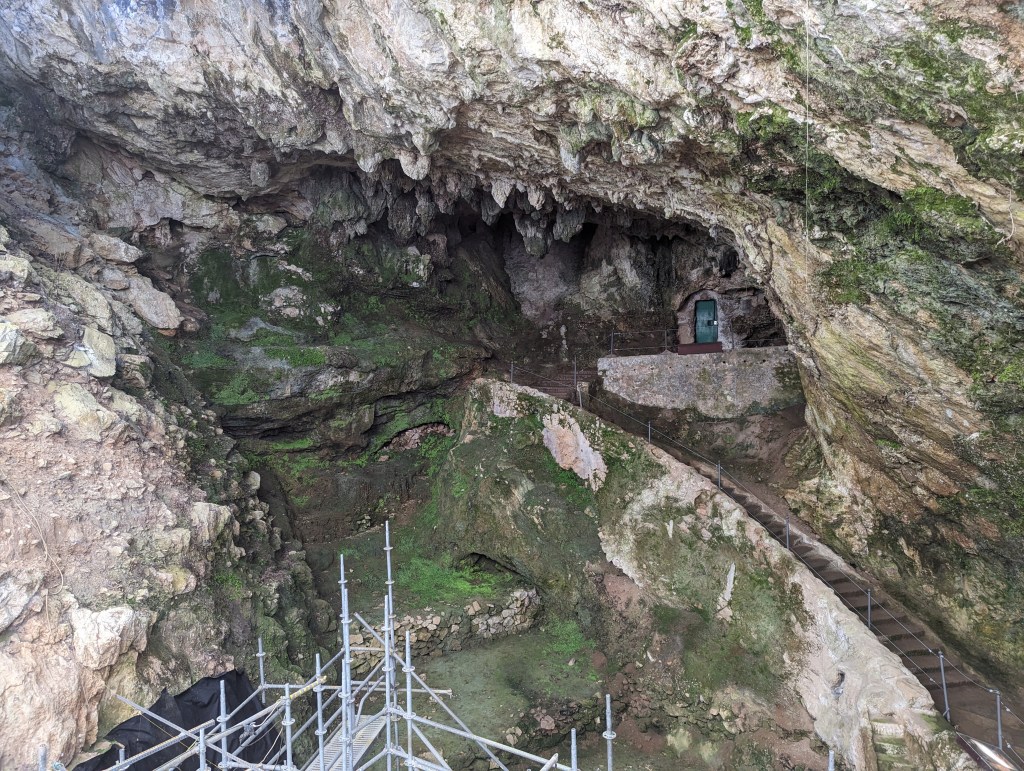
We were at Cueva Castillo, a cave similar to and nearby the world-famous Altamira cave. But whereas Altamira only has reproductions visible to the visiting public, Castillo has the real deal. Cave art from multiple timeframes within the paleolithic era can be found here, from the aforementioned 40,000 years ago to 12,000 years ago.
The guide was heroic. It is advertised as a Spanish language tour that we signed up for because it is the only way to get in, but so did the the rest of our little group (Kiwis and Germans). So rather than speak Spanish to no one, the guide did his best to do it in English, and his best was really very good. He had an intensity and sincerity that I often find in not-quite-fluent speakers. The words and sentences are short and direct and literal. I think I absorbed more of the facts because of the simple language, repetition, and absence of space-filling patter.
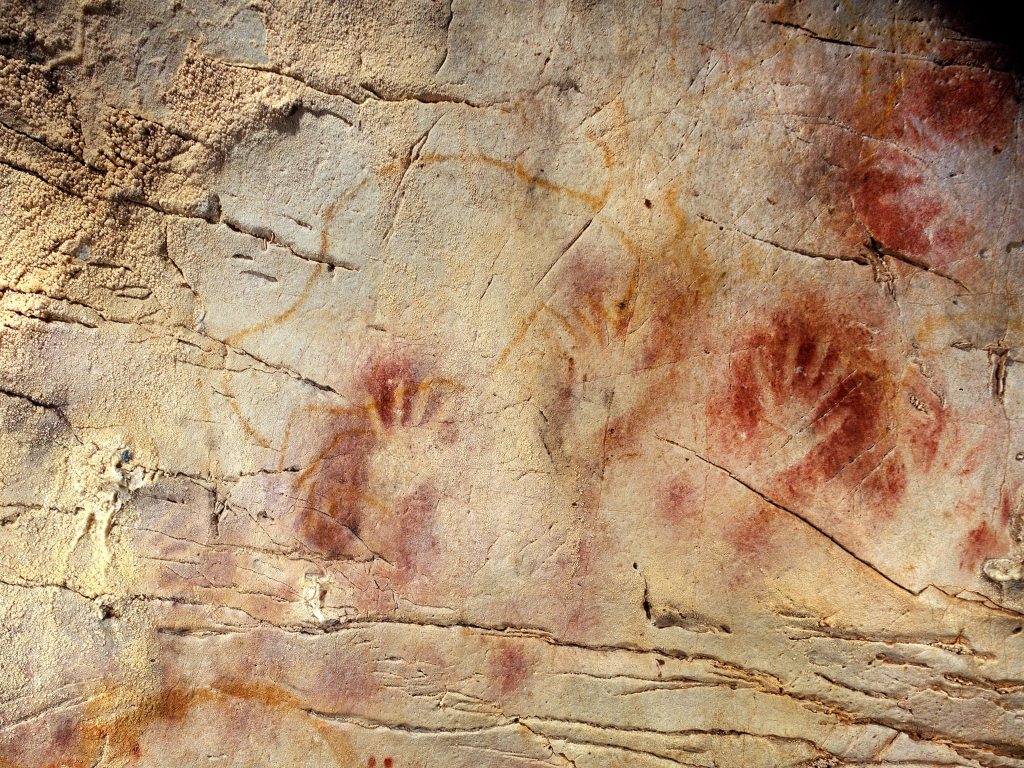
There are better sources of facts than this blog for the archeological details of this cave, so I’ll just share some of my impressions and questions.
It’s easy to say 40,000 to 12,000 years, but that is an unfathomably long time. That is more than double written human history. And yet for that whole time (perhaps with breaks for several generations now and then), people kept entering that cave to paint and carve. It was so important to them. The Catholic church has been holding mass for like 60 generations; Our ancestors in Spain held their version of mass in this cave (and probably other places that haven’t survived) for perhaps 1,000 generations.
I’m comparing it to Catholicism just because that’s really old, not because I am sure this artwork is religious. It might be. Or I t might just be art. A love of nature. An instinct to express oneself. An urge to leave a mark. Our guide told us the when and how of it. There are only guesses of why. Probably they are all true to some degree. The people living 40,000 years ago were the same as we are today. Biologically, there is no difference that I know of in anatomy or genes. They are us in a different context. The reasons we have for creating art today are the reasons we had back then. Sometimes spirituality or superstition. Sometimes aesthetics. Sometimes to tell a story. Sometimes to remember. Sometimes to leave a record of ourselves. We can know them to essentially the same extent as we can know ourselves.
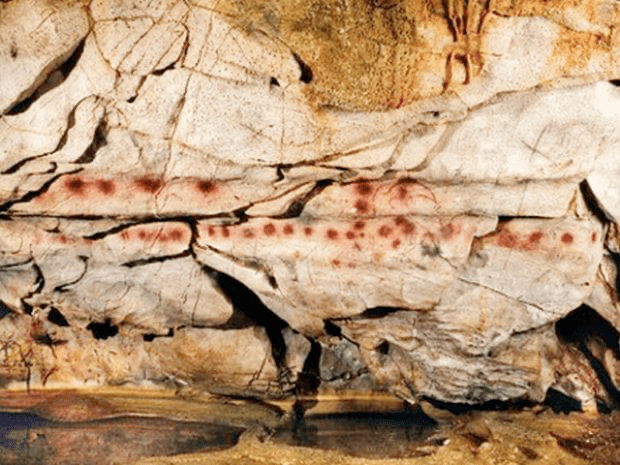
In a deep cavern that periodically floods, there is a long row of red dots. They are not perfectly in a line or evenly spaced or exactly the same size, but they are fairly orderly. What are they for? An accounting system? A record of water levels? A census? I will throw another possibility in the ring: they aren’t for anything. It became just an empty tradition with its own changing and arbitrary just-so story to justify itself. Let’s say they were all made in the same 5,000 year period (it could have been over a much longer or shorter span but we can’t date ochre itself so we only know that they are older than 25,000 years but not as old as 40,000). 5,000 years is such a long time that for most of that period, people’s traditions and stories about why they go and put their dot in the line would have been completely different than the original reason.
And that’s the other thing: what did the upper neolithic residents think of the art of the lower neolithic? When the Magdelenian culture was drawing bison, what did they make of all those hand outlines? Did they revere them? Appraise their craftsmanship? Because those bison are really sophisticated. I have heard other people say this, and I have seen pictures, and I secretly thought they were full of crap. But you have to see it in person. The lightbulb moment for me was seeing how they use the 3-d shape of the cave wall to suggest much of the form. In some examples, it almost seemed like they were finding the animals in the shape of the rock, and then adding just a few strokes so that we can see it too.
What’s kinda funny is that we didn’t even plan to visit the cave. I was just looking for something around the halfway point of our drive that day to break up the sitting. But it ended up being perfect. On a very warm day, the cave was a cool balm (it is a constant 12-13 degrees no matter the weather outside, which is why we have more cave art than, say, tree art). I couldn’t believe how far into the cave these paleolithic humans –even children, based on hand size and structure– had ventured to paint. They’ve found evidence as far back as a kilometer into the cave, presumably using only embers to light the way because a torch would have left smoke evidence on the walls for us to detect. They must have managed alright though, because we’ve yet to find any skeletons belonging to the less skilled navigators.
A traveller’s hotel in the heartland of Basque country. Large room, terrible wifi, strange shower. Groceries for the next day.
We came into Basque region feeling pretty confident. We were Picos fit. This Basque hike, while decently long and having a respectable elevation climb, would be just a nice leg stretcher through some bucolic pastureland and round hillocks. But we should have known; countless cultures have tried and failed to assimilate or capture the Basque… why did we think we’d be any different?
It started at the ugliest monastery we’d ever seen. It was like someone made a cement cast of styrofoam padding, then slapped on some depressed ghostly statues. Indeed, the unconventional design of the Sanctuary of Arantzazu did cause some controversy when it was being built.
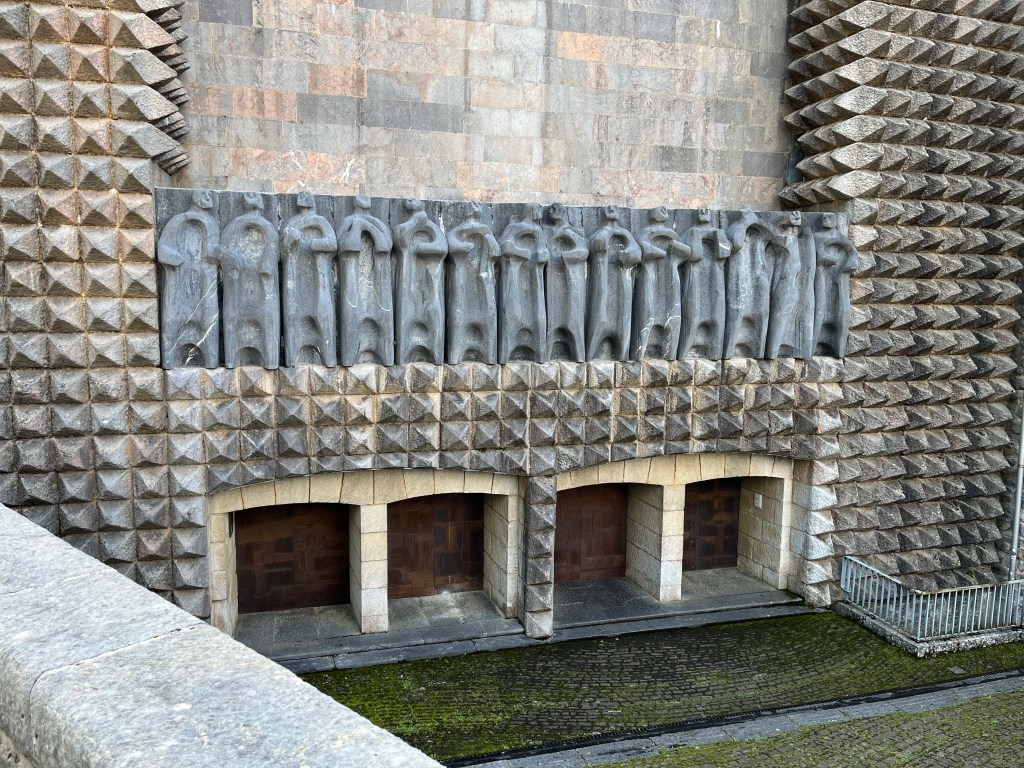
It isn’t beautiful, but I can respect something so brazenly bizarre. Even the clock chimes played a surprising and slightly unnerving melody. The whole region is just a bit strange. It’s a Scrabble player’s paradise. Lotta Xs and Zs.
Anyway, our hike started with another ascent through old oak and beech forest. These glades have almost no undergrowth at all which gives them a very pleasant, airy feel.
After about three kilometres, the views opened up. A lookout over the valley was swiftly followed by the kind of tree-lined path you’d see in a medieval film. Around us, calves and foals napped and nursed while their mothers grazed. Then the ascent began. A long, sloped climb up Aitxuri Mountain that just got rockier and rockier.
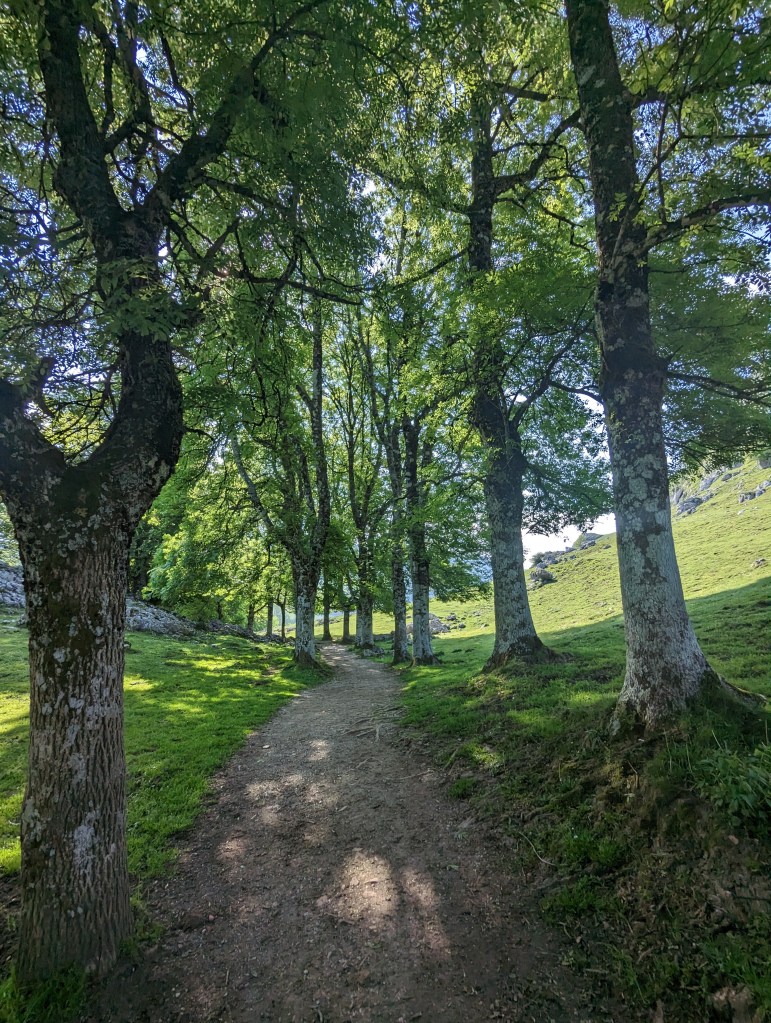
Despite our quick, confident pace, we were still being passed by even faster walkers and trail runners, who said what sounded like “hohpah” but might have been “ona” or “kaixo” as a greeting in Basque. We kind of grunted in return and hoped it sounded friendly.

There was a lot of careful foot placement. The path was clear, but after a certain elevation, rarely was it simple. Rocks seemed to poke up through the earth at odd angles, and each step demanded thought. At some point my mind must have wandered because suddenly my right foot was twisting and I was catching my fall with a pole handle to the jaw. Two days later it’s still tender in the spot where cork met mandible. But otherwise I seemed unscathed.
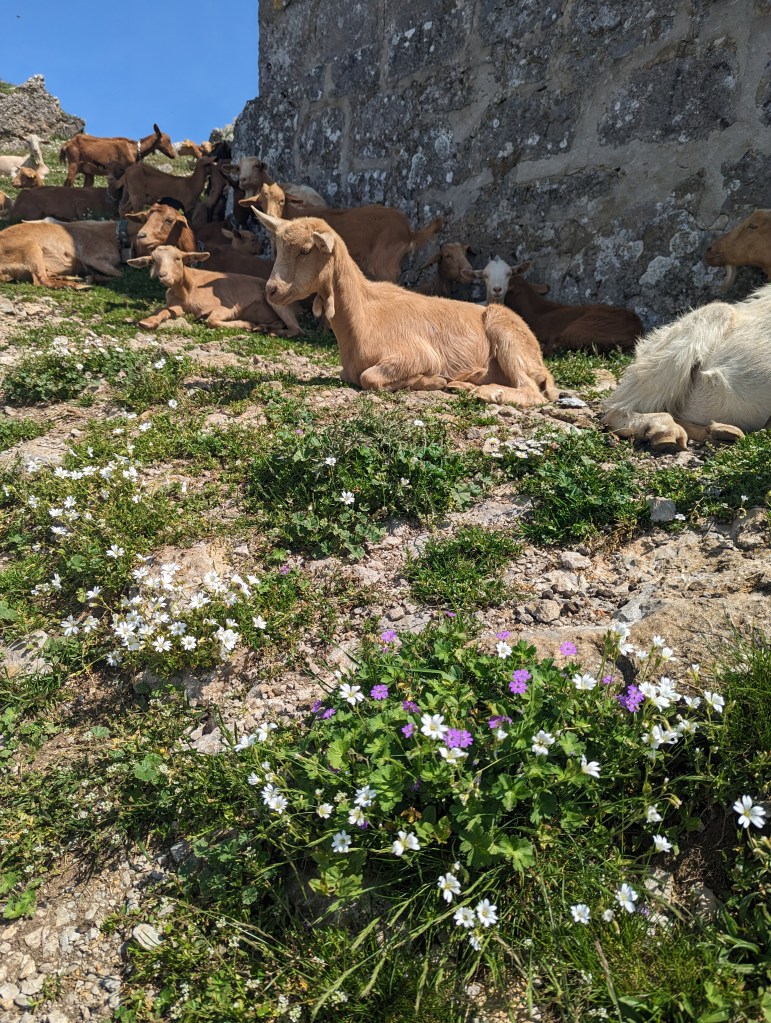
On shakier legs we carefully picked our way to a summit, where an old stone walker’s refuge and chapel had been taken over by goats. The place was buzzing. With people, sure, but even more so with flies. The goats seemed happy enough with their lot, but we soon moved on to somewhere with a bit more breeze and breathing room.
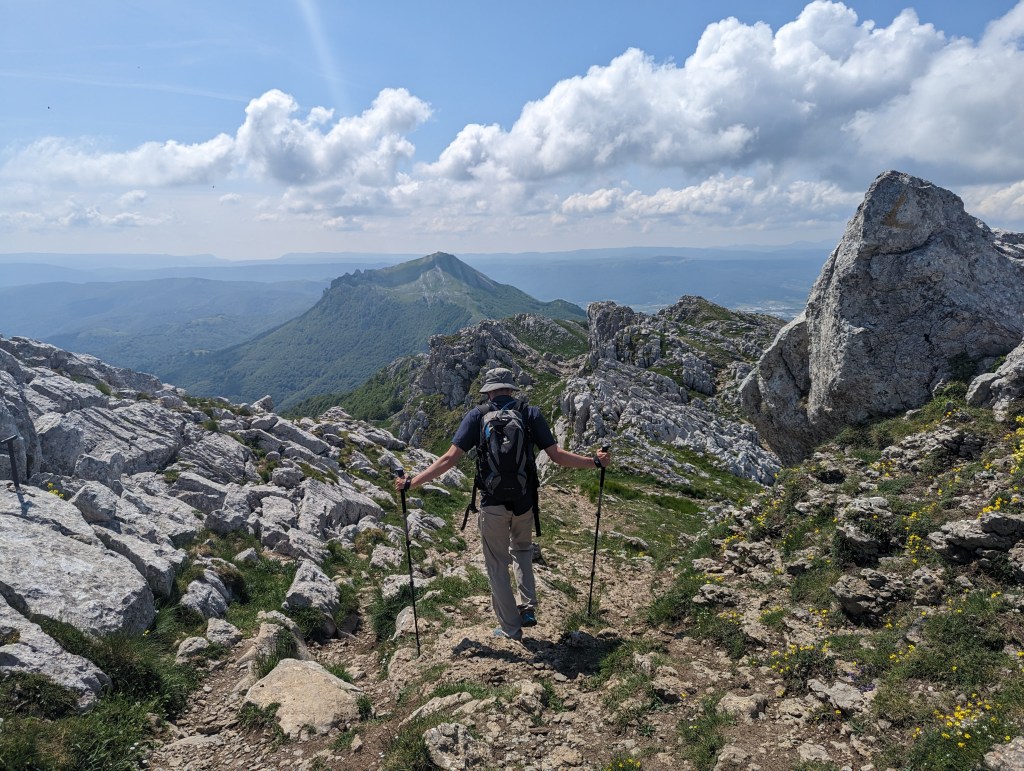
We continued along the ridge. The footing was still tricky, mostly made up of angular limestone cobble polished to a glassy shine by countless footsteps. The views made up for it. Though these are “only” big hills, the vistas they command are incredible because of their steepness. Farm and forest filled the valleys far below. We could see roads snaking their way between stone villages. Everything was vibrant and sharp under the early summer sun. Eventually, the ridge ended and we began a headlong plunge down through the forest. The shade came at the perfect time as the day had grown quite hot. We were feeling tired by the time it leveled out in a grassy clearing.
A wooden signpost marked a 4 way junction between several walking routes, including our old friend, the red and white stripe blaze. We continued down on a short side trip to see the Hermitage of San Adrian, a chapel built inside a large natural tunnel. The tunnel was neat. It is shaped like an almond, I guess 10 metres high in the centre and perhaps 30 meters wide. From the valley, wind rushed up through the tunnel to us. The chapel itself is essentially a shepherd’s hut with more grafitti and a generally unwholesome aura. Trash and signs of squatting and excavation made it feel more akin to being under a bridge in a rough part of a large city.
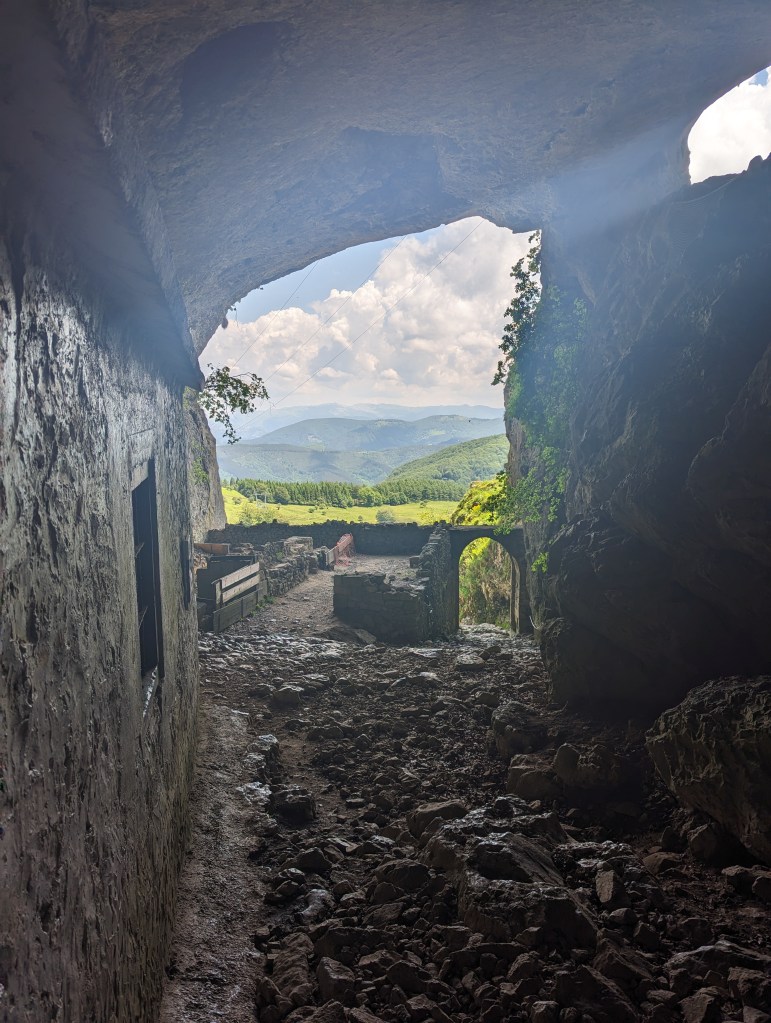
We returned to the crossroads and followed red and white markers to begin looping back towards the car. Deep leaf litter provided very soft walking, which we appreciated after all the pointy stones. Many other unmarked trails intersected and ran off through the woods, but between the markers and Sabrina’s watch, we never went wrong. We stopped to eat an apple on a log, feeling hot and weary.
Plan A had been to beat the six and a half hour estimated time and get to the town of Oñati in time for a fancy menu de dia before they closed for the siesta. In the Picos, we’d generally been a half hour quicker than the average time for other hikers, but today we were actually a fair bit behind. Basque Country is harder than it looks. Now we were just hoping to get some grub at Urbiako Fonda, a rustic taberna right on our route, high in the cattle-strewn hills.
We took one more swig of water and walked on. We hadn’t gone far when a great drumroll of thunder came from our left. Looking through the trees, we saw dark grey clouds had gathered over that valley since we had last looked. We walked a little faster. More thunder rolled across the sky, and the clouds continued to pile up around us until there was only a small patch of blue above our heads. We were striding with real purpose now, pushing to make it to the shelter of the restaurant before a storm hit. We emerged from the forest on a rough stone road passing farms and stone huts. Just a few kilometers left.
We had both been feeling the odd niggle here and there, mostly in our lower legs and feet. Is my achilles hurting or is it just a friction hotspot? Does my knee need a break or is it okay to keep pushing for awhile? They kept arising and then receding. But then with 3ish kilometres to go to the restaurant (and another 3-4ish to the car) I felt my entire right foot seize up. It felt like there was a corset around it, restricting and pulling in the “waist” of my mid-foot. I kept walking, waiting for it to loosen up and trying to alter up my pressure points but it stayed rigid. It was the same foot that had twisted earlier on the mountain; unclear whether there was any connection to my current predicament.
800 metres to go until the eatery, and we still weren’t even sure if it was open. The limited info I’d gotten from my pre-downloaded google maps seemed to think it would be, but we were in the dangerous “siesta” hours and we’d been heartbroken before. If it was closed, we’d be resigned to filling up on old oranges and tiny corn bars because at our current pace we wouldn’t reach the town until after all the restaurants shut down (and wouldn’t reopen until 8pm). I was kind of starting to limp a bit, but the surrounding thunder and encroaching dark clouds spurred us on. At last, it came into view. Groups of people were scattered around the many picnic tables on its lawn, and it was such a relief to see giant piles of bread and fries.
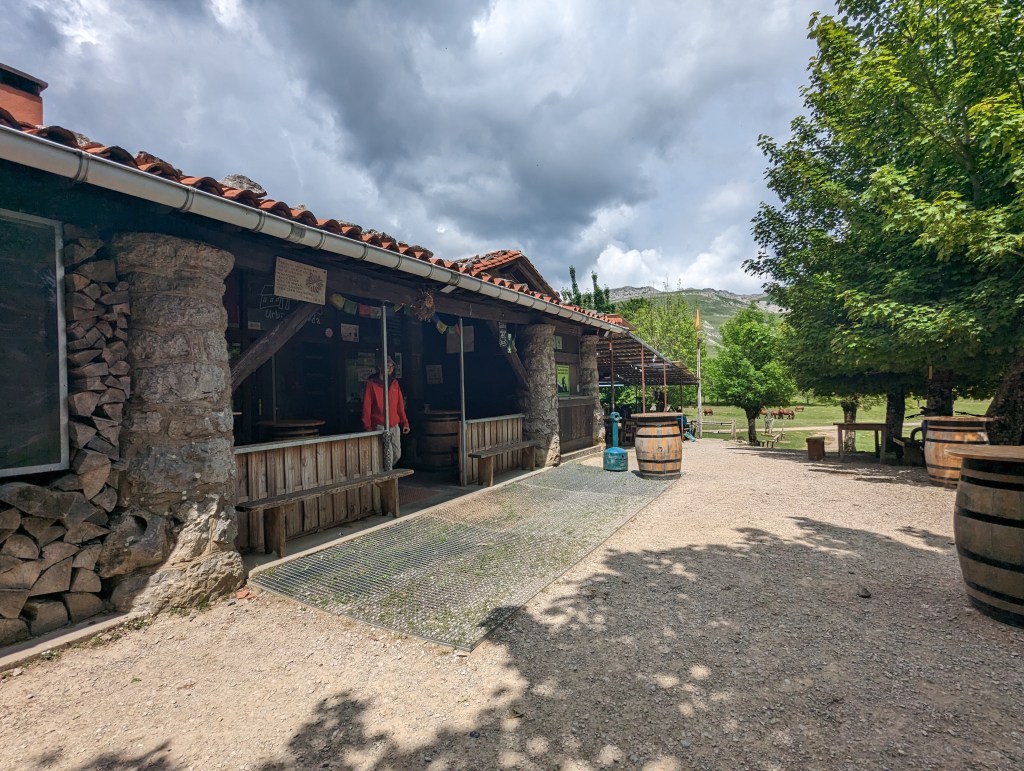
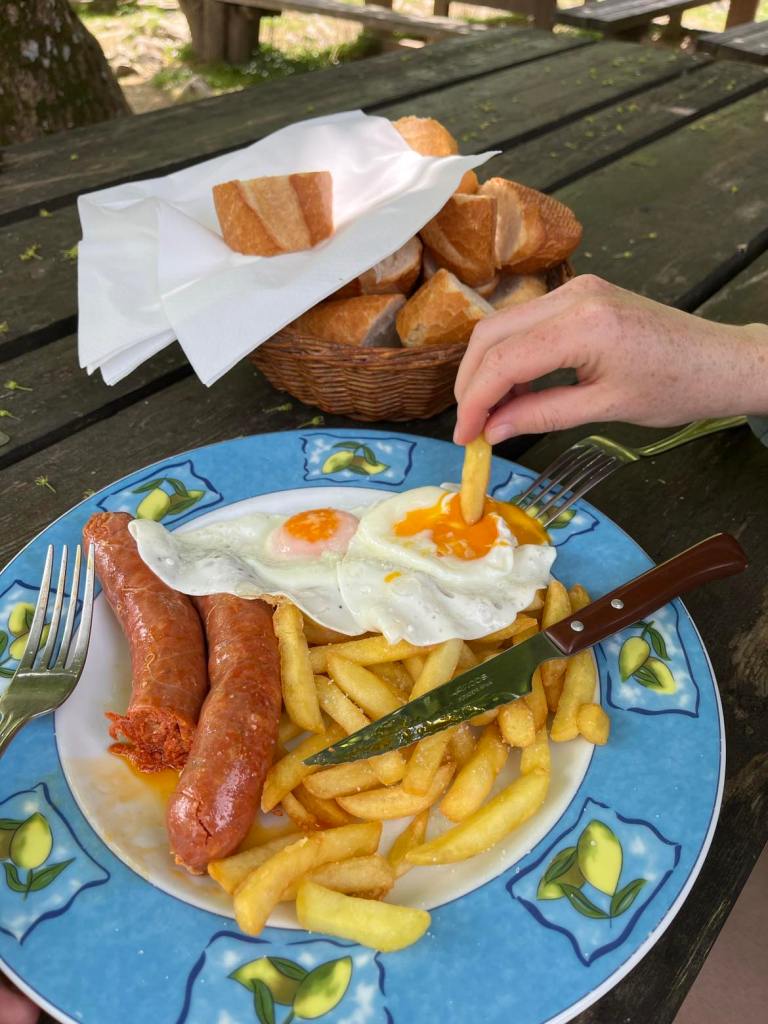
Inside, it was pretty dark and rustic. But the woman behind the bar spoke english and we ordered her recommended plato combinado, which included eggs, fries and chorizo. Ben’s stomach had been a little off that day so we only ordered the one, with my promise to share as much as he felt up to eating. It was a good call. The plate that came out was enormous, piled high and wide with salty, fatty grub and a bread bowl big enough to feed six. Happily, Ben gobbled down as much as I did. The rain had not yet arrived, so we ate outside while skinny cats prowled for dropped scraps.
My foot was still pretty seized up when we left, but at least we were fed. The rain did arrive about fifteen minutes later, when the skies opened its jaws on us and spewed forth a giant, single waterfall. But there wasn’t a slant to it so standing in place with our umbrellas, nary a drop got on our pants.
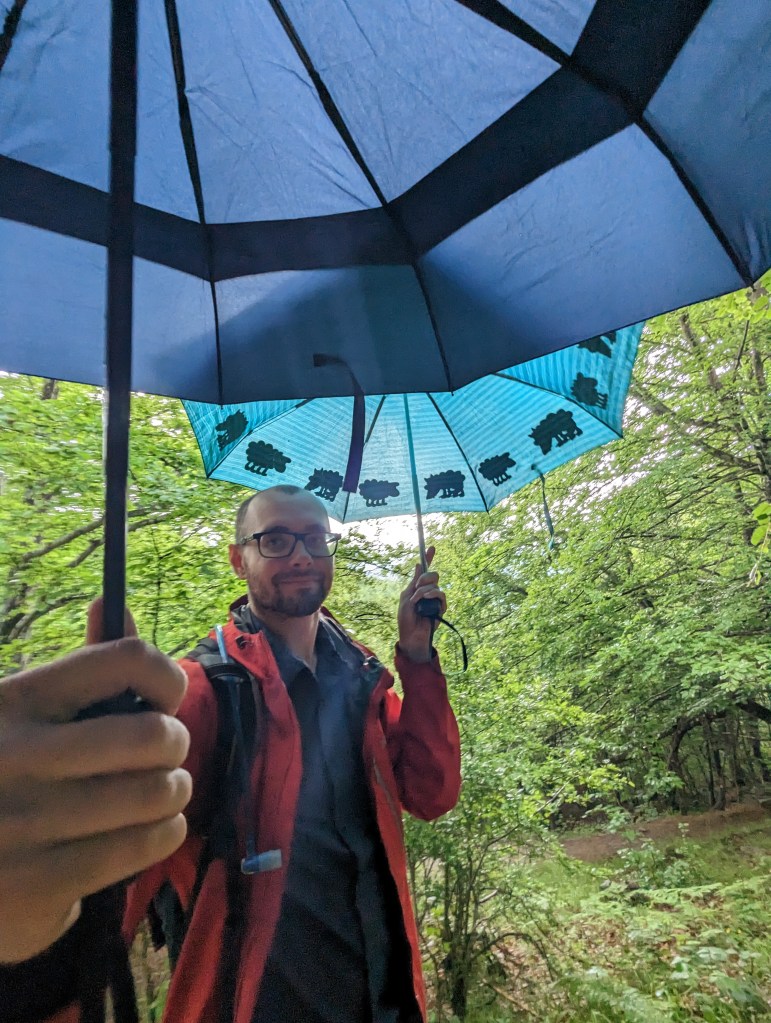
We made our way carefully down the path. Until the rain had stopped dripping off the trees, I held the umbrella for Sabrina so she could use both hiking poles, and tried to cheer her up. It’s not just the ordeal of finishing a hike in pain. It’s the worry that it was really injured and how that will throw off her plans and training. To keep her mind off her foot, we also each put in an earbud and listened to a podcast she had downloaded about an archeologist studying rock art, including at the very cave we visited. When that finished, we fell back on counting down the distance left. At last we came to a road, and then the ugly monastery, and then our parking lot, and then our car. Thankfully Sabrina could still drive OK, and after washing off in our weird shower chamber, we took an early night.
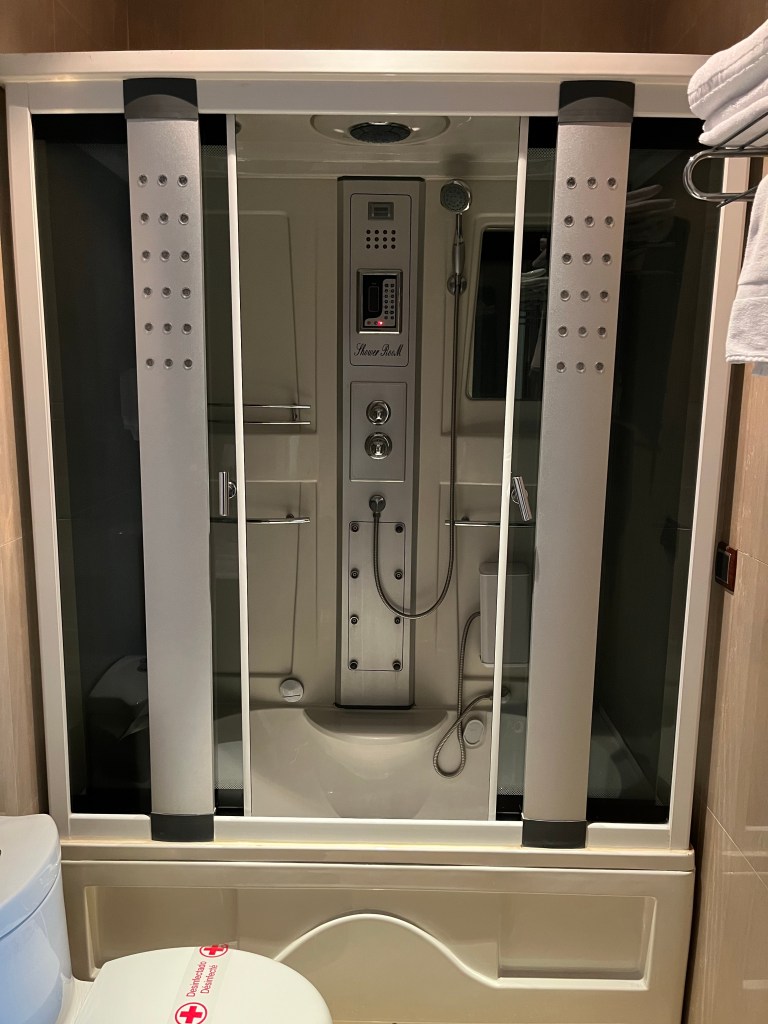
We’ve mentioned the weird shower twice now so I’ll just briefly describe it. In an otherwise calming and modern hotel room, the shower was a needlessly techy, standalone box. Among the many buttons and knobs, there were options for sideways jets, music, as well as a light setting more fitting to a disco. It was like a spaceship pod. You should have heard the yelp Ben let out when he turned into the bathroom that first time.
I thought I had finally met the robot sent from the future to kill me.
 Mostly BS
Leave a comment