Beño: normal, drab. Sabriñita: fun and fancy.
We are on the third floor of a posada in Quintana. The inn is a large manor house in the local style. We didn’t quite get the room we booked online, but it is still incredibly lovely. The couple who own the house speak no English. When we were shown the room, Sabrina tried to explain with Google Translate that it wasn’t the right one, the little old gentleman held up a finger, his whole face crinkling in a smile, and threw open the curtains of a large dormer window, revealing a stunning view of the Picos. His air of delighted pride seemed to say, “does this not satisfy thy every concern?”

I find that the dormer window, which folds our waking moments with birdsong and the sight of alpenglow traversing the mountains, has done for me just fine. However, they still threw in breakfast to make up for the lack of balcony, thus ensuring we always had our daily allotment of ham.
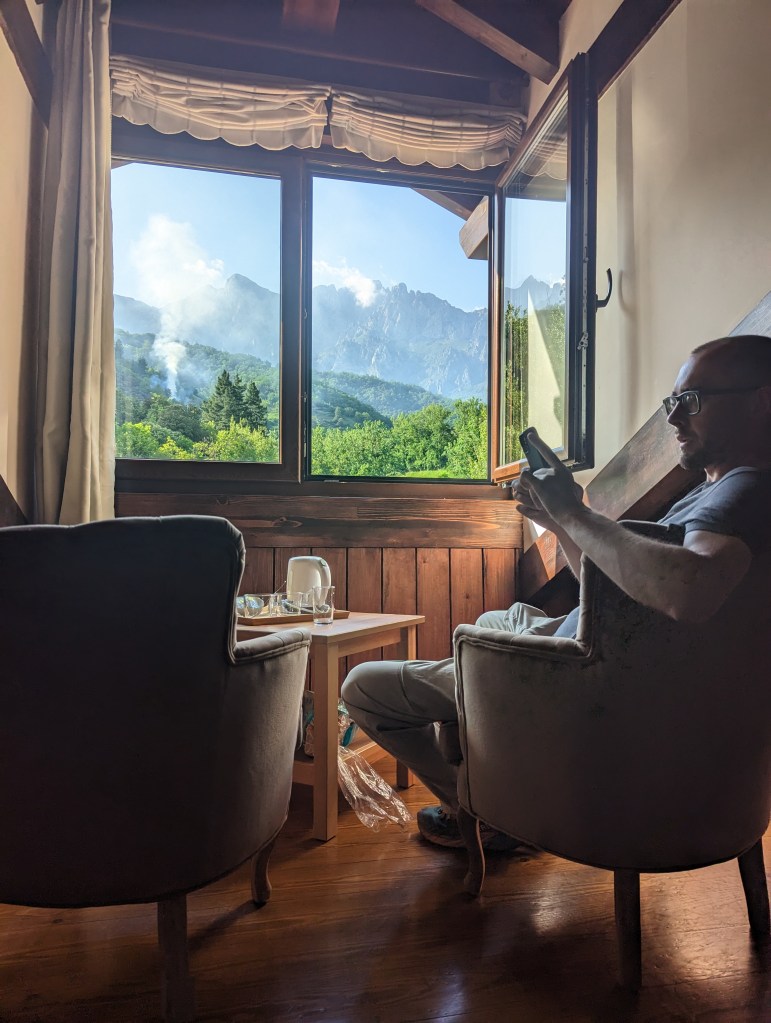
It’s truly a magical little inn, and we spent four blissful nights there. After the light afternoon showers, we’d pass sunny, warm evenings on their manicured lawn, writing and relaxing our muscles and watching the clouds play among the peaks. The breakfast was a sophisticated affair, with white linens and tidy, bespoke portions of food (also, great coffee with warmed milk — a nice touch we became quite attached to). As a general rule, this trip’s accommodation has been more posh than any of our past adventures. This is partly due to wanting a lil sum’n special for our first big international sojourn in three years, and partly due to some lingering discomfort with the coughs and sniffles of strangers (thus, we’ve avoided shared dorms).

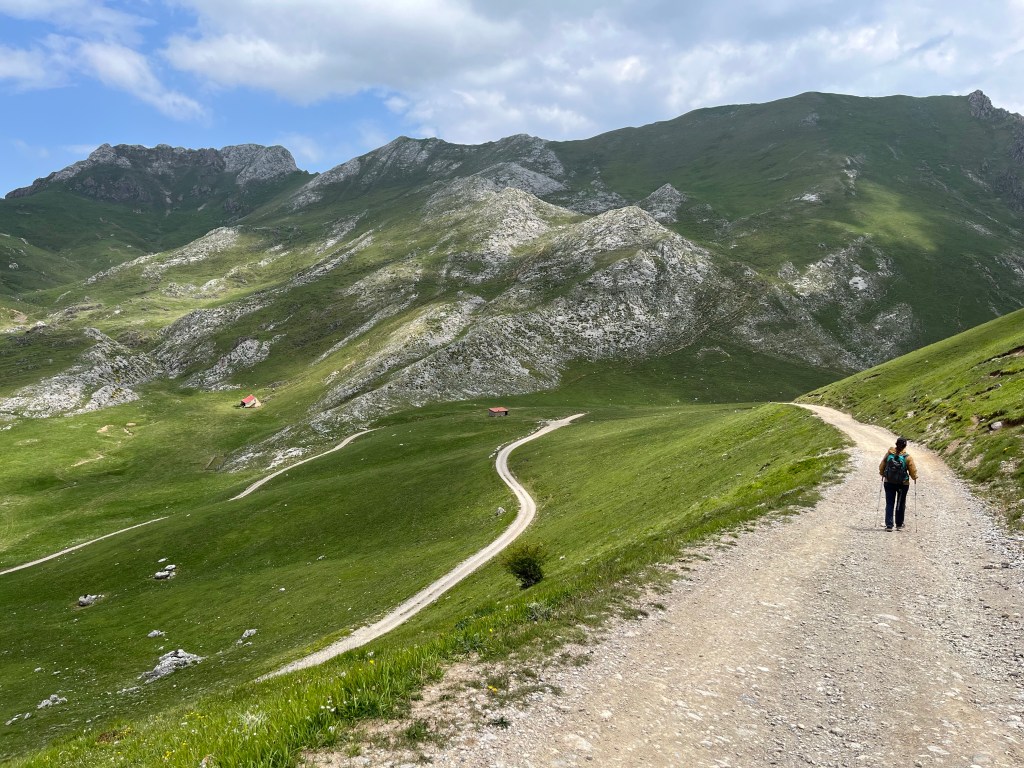
My trickiness of the night before led us to select the Puertos de Aliva for today’s walk. Once again, having maps downloaded on Sabrina’s watch and phone (do I get brownie points for this?) gave us the confidence to take an alternate path up, which varied the walk and was softer underfoot than the cobble stone road. When we reached a towering cliff band, we were forced to rejoin it at the literal gates of Aliva. From there, the scenery opened up into more grazing pastures on rolling hills, fenced in by the ubiquitous vertical mountain tops. We cut across country for the final kilometre to the hotel.

The Hotel Aliva *had* been my top choice to stay since stumbling across it during my early research days. But in the end the timing didn’t work out, so we resolved to break up our hike with a lunch at its restaurant instead. I wasn’t sure what to expect. How much *can* you expect from a restaurant located at 1,650m altitude, even if it *is connected to the main road by a rugged, four-wheel drive only stone path? When we got there, we discovered that lunch service hadn’t started yet (only a philistine would take their almuerzo at 12:30pm, obviously) so ordered the teeniest lil tapas serving of chicken soup which turned out to be just a thin broth. Briefly warmed, we scurried out to reach another viewpoint before returning. We were promptly ushered out of the drafty bar area of the building (a great relief, as it was lousy with rowdy pre-teens and hacking old men) and into an empty dining area with big windows over the region. We sat down, and ordered the full Menu del Dia. Before the lentil and chorizo soup had even reached out table, English crooning blasted out of the speakers immediately above us. We were treated to such classic combos as Careless Whispers + steak, and Candle in the Wind + fish in tomato sauce. We made eyes at each other over custard and cheese pie as When a Man Loves a Woman slammed into our ear drums.

Despite how waddle-y we were after such a meal, in 2 hours the rough road deposited us back down at our car.
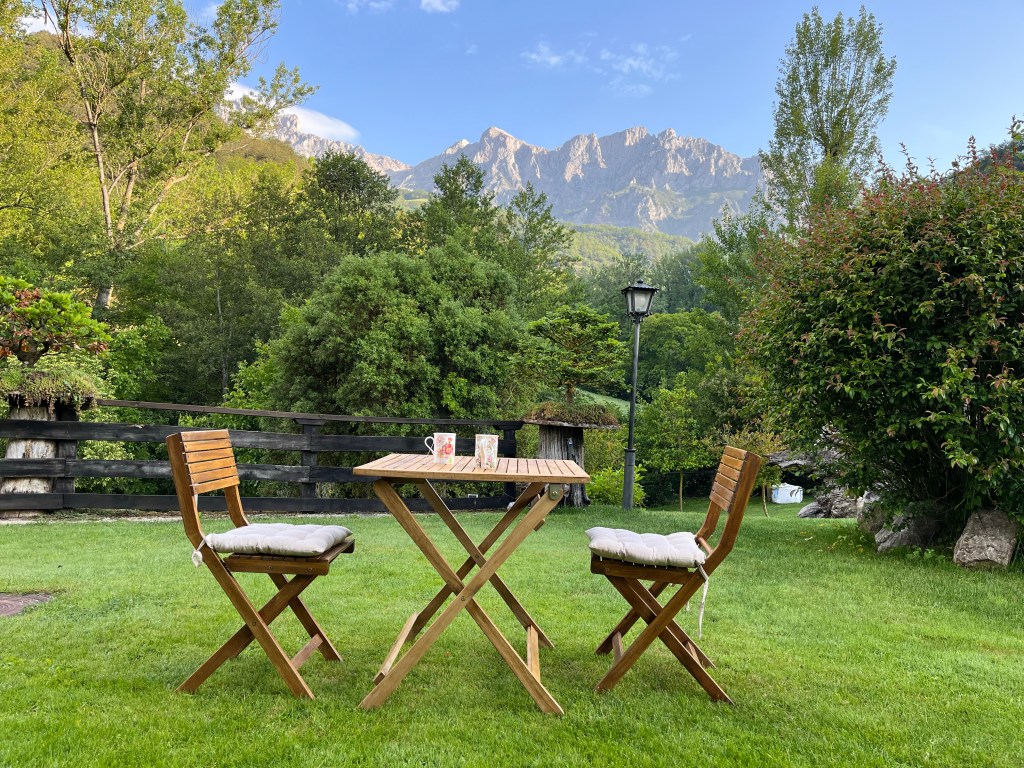
We sat in the shade out back of our posada and took turns writing while snacking on our own little tapas, made out of a wheel of the regional cheese and a fresh loaf of bread. I watched the clouds gather and disperse on the peaks above so gradually that I don’t notice the change unless I look away for a while. It is the perfect temperature for relaxing and there is only the occasional fly. It is a revelation that there does not need to be mosquitoes to harass us in summer evenings.
We realized that even after our late, 3-course lunch, we were going to need an even later supper. This time it was Sabrina who was craving a burger so we opted to walk down to a comidar at a nearby camp ground, basically a European KOA. Pongo, the hotel golden retriever, escorted us safely down then went off to sniff the news while we sat down to big, greasy, and very red hambuergesa completo. I’ve heard they do ground beef on the raw side in Europe, but it was still a big concerning. We gobbled it all nevertheless and it did no harm. Once more we were reduced to waddling.
It felt strange having such a relaxed start the next morning, knowing that we were heading to the high alpine. Usually we would be up at dawn, already packed from the night before. But such early starts aren’t necessary when you’re getting a 753m elevation boost with the help of a tram. We’d been on the fence about using this shortcut because the Fuente De teleferico didn’t start running until 10am and that felt like a lot of lost morning (when the weather’s best). But in the end, we realized that even with the delay, it would greatly improve our chances of actually reaching the summit of Horcados Rojo, our main goal of the day.
That said, I’d read in reviews that sometimes the tram started earlier than they advertised online. So shortly after 9 AM we pulled into prime parking spot with our 10 AM tickets in hand, ready to seize any opportunity that presented itself. No dice. Over the next hour a few scattered wandering couples grew to a small crowd, then a vibrating mob. The nervous looking woman behind the turnstile activated the QR code reader. In the shuffle, I spotted some people who were also staying at our hotel and hoped that I’d live to see them on the other side. They disappeared from view as I was subsumed buy a swarm of Dutch people.
We caught the second cable car of the day. They packed 20 of us in tight (we later learned that it had originally been designed for eight but they must have found that to be needlessly safe). We can see the the steel cables disappearing against a sea of rock as they stretch towards the upper station, not straight or even slightly sagging, but sweeping a great parabola.
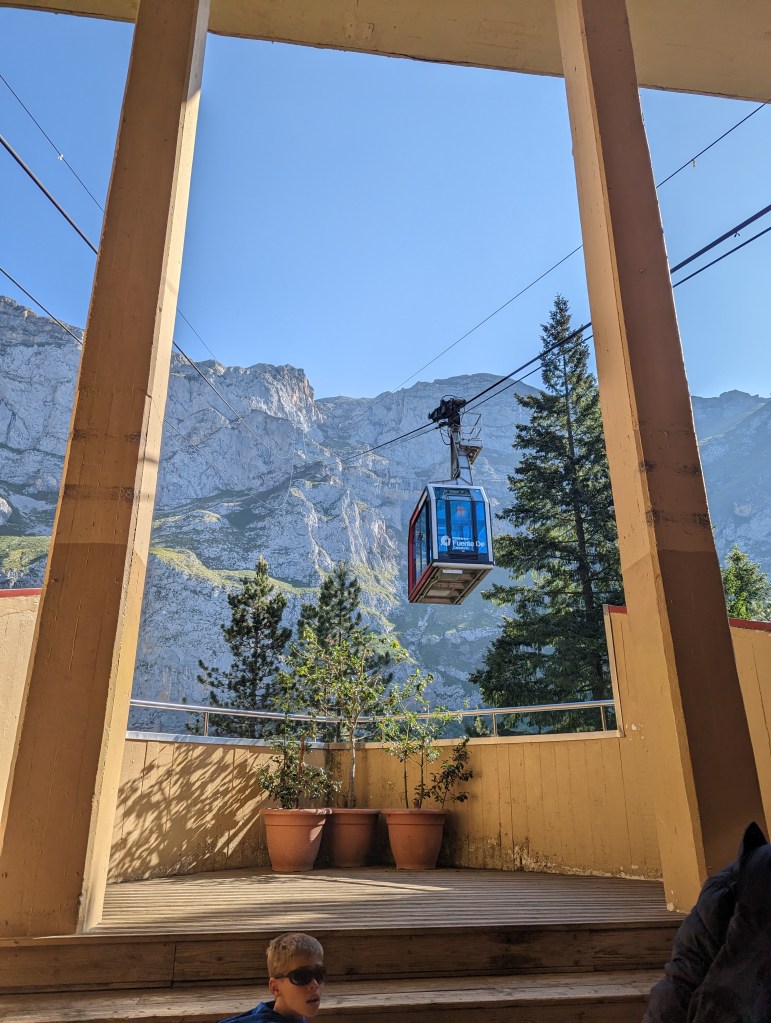
An alarm sounded, and and our car inched out of the building and over the road and then we were not inching, but accelerating smoothly. We never felt the speed because we were soon so far from every point of reference, dangling hundreds of meters above the valley, which is fairly flat until the vertical walls we were flying towards. As we neared the station, we looked straight down at a shepherd’s cottage balanced on a small green ledge halfway up. Another alarm sounds and we inch into the building. The entire ride lasted just 280 seconds.
Meanwhile, it took me only 20 seconds to spot the viewing grate on the information deck. I gleefully skipped over to stand suspended above the abyss while Ben went to the bathroom, shaking his head.
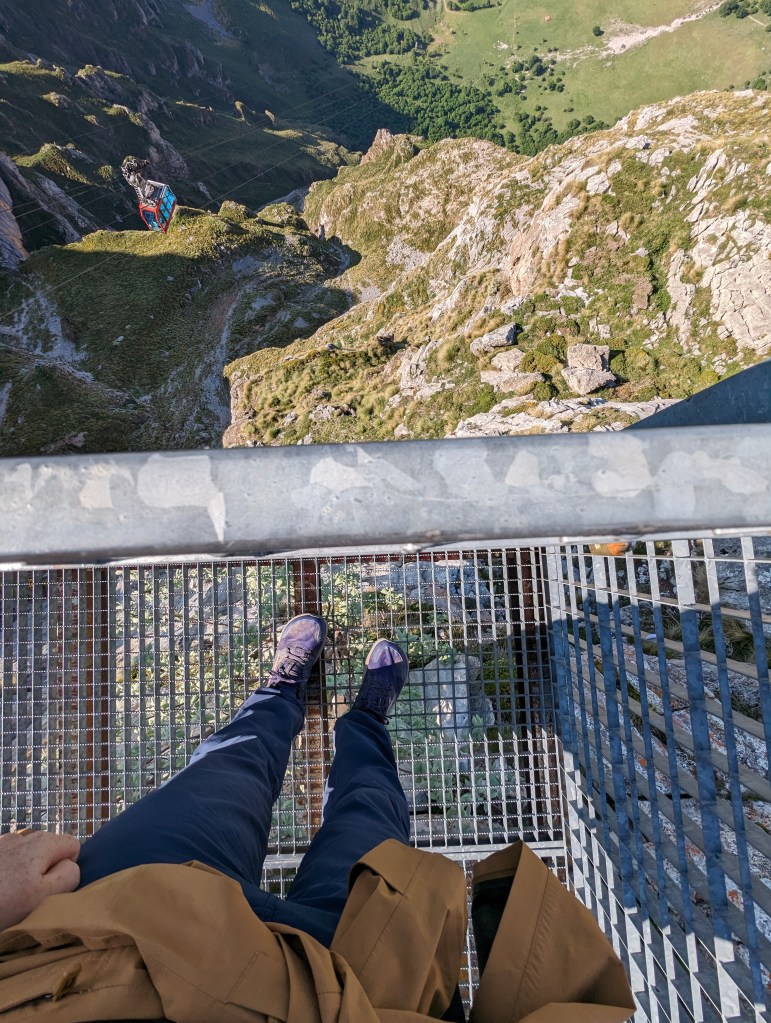
We BOTH saw the metal grate and we BOTH stepped on it to feel the thrill of looking nearly straight down 2,200 ft to the valley below. The difference is that I only stepped on quickly to prove to myself that I’m not a scaredy cat and then turned away so as not to have too much of a good thing. This moderation is a very wise policy that I recommend to wifeys with an overdeveloped taste for precipices.
Yeah jokes on me, because after he left, a woman snuck up from behind and took a running leap onto the grate, shaking the entire structure. Just desserts, I suppose.

We moved forward, through a rocky moonscape. Above us, the summits seemed within reach. Far below, the green foothills looked distant and hazy. We reached snow, stepping into the bootmarks left by others. Higher, more snow. This time, we veered left to stay on rocks because parts of the snow patch looked soft, and we didn’t know how far down we’d sink if it gave way. We reached the saddle, where most people turn around, satisfied with the panoramic view that lays before them. We sat with our sandwiches to assess the route to the summit. It looks simple enough at the start, then steepens and there’s a few cliff bands that look passable to me and iffy to Ben. A couple started up, and we watch to see what tack they take.
We couldn’t really see how steep the cliff bands were, but at one point, the people we watched tried and rejected a broken band in favour of an awkward hands-and-feet scramble up a snowy gully. I interpreted that as a bad sign, but Sabrina was very game to just go up and see for ourselves and I wanted to break out of the hesitant mindset I’ve had around high stuff this trip, so it was go for launch.
The clouds were starting to gather around the periphery of Urriellu; it was now or never. I promised we’d take it as slow as needed. We shouldered our backpacks, and started switchbacking up the side of the torre. We came to the tough bit we’d spied below. There was just enough hands and feet action to make it fun, but never so exposed to be dicey.

There were four scramblers ahead when we started, and at the cliff band we met one who decided it was too steep and was waiting for her husband. We didn’t even look at the snow gully. The cliff band was a super fun class 3 scramble with no consequences. After scampering up that, there was a bit more scree and a bit more scrambling, but nothing as loose as we have in the Rockies. I was so glad I had Sabrina to urge me to give it a try because it reminded me how joyful climbing and scrambling can be when it doesn’t feel too dangerous.
The views at the summit were spectacular. A Dutch fellow (the one who left his wife behind) told us that the views at the second summit (about a metre higher, and separated from the first by a very narrow, no-fall “walkway”) were also incredible. We peered over the edge at the thin bridge of rocks, and the who-knows-how-long drop on either side of it. I looked at Ben, eyebrows raised. “Please no. No. Have mercy.” We descended the way we came.
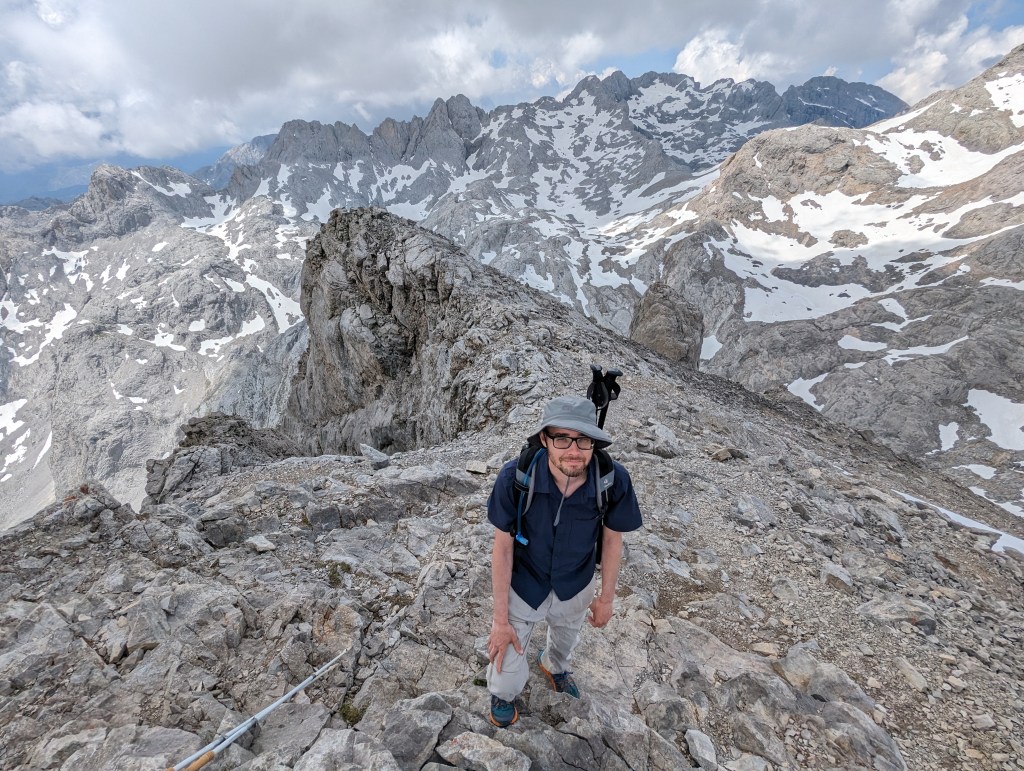
From the saddle at the base of the torre, we took a quick detour to check out the tiniest Refugio Véronica. Perched on a rise sat a gleaming aluminum dome, made from the gun turret of a WWII fighter, it seemed impossible that more than one person could curl up inside. When we reached it, we found a couple young British lads talking over a morning adventure while flaking out a couple climbing ropes for packing. One had traversed the saw-toothed ridge line to the west, which looked extremely harrowing from where we were standing. We poked our heads into the Refugio and sure enough, there was a tiny kitchen and two ingeniously built bunks. There couldn’t have been much more than a foot of air headroom, but it was shelter and certainly snug.


On the trail back down, it began to rain with a few tiny hails mixed in (again, a pittance compared to the whoppers that Hinton might receive on any random June day). It had stopped by the time we reached the upper tram station, and we briefly looked west at the area we’d considered trying to explore after Rojo, but in the end we decided we’d conclude the day pleasantly tired instead of destroyed.

We enjoyed another peaceful siesta at the posada, briefly interrupted by mooing and shouting. A few herdsmen were driving their cattle down from the hills, and the parade route went right past the front gate of our inn. Pongo, ever eager to help, had to be kept back. After this excitement, I went upstairs for more water and when I came back down, Sabrina had struck up a conversation with a Dutch couple.
Nico and Yolanda! They were the ones I’d seen that morning in the tram mob. She a physiotherapist, he a train inspector, they were visiting their adult son in Madrid and luckily for us spoke excellent English. How nice it was to have a fulsome conversation with someone! We sat out on the patio for a long time just chatting about our travel plans, the linguistic quirks of borderlands, and Spain’s mind-boggling lack of mosquitos. We separated for dinner; they’d made plans with another Dutch couple and we headed back down to the campground restaurant to write and eat some hopefully slightly more cooked meat.
We arrived just before 6. As we were studying the menu at the door, a German gentleman came out holding a couple glasses of wine and told us that he had been told that kitchen won’t open until 6:30. We contented ourselves with waiting on the patio. A little after 6:30 we went in to the desolate restaurant. The woman lounging behind the counter seemed surprised that anyone would want to eat at this hour. The bar was open (never closed, in fact) but supper doesn’t start until 7:30. We returned close to 8:00 to be safe. The service was leisurely, but we enjoyed three large courses. While we were eating, the British climbers we had met at Véronica sat down at the next table. There are several other villages between our posada and the cable car, and other directions to go besides, so it struck me as quite a coincidence. They made merry over burgers and huge mugs of beer while telling stories and speculating about the potential use of a grappling hook to swing between pitches.
We moved slow the next morning, loathe to leave our adorable abode. The week of adventures in the Picos de Europa had surpassed expectations and despite the lengthy hikes involved, had somehow been restful too. But Basque Country (and its many culinary delights) awaited, so we laid out our just-washed hiking pants across the dash of the rental car to dry, waved goodbye to Pongo and swerved our way out of the mountains.
 Mostly BS
Leave a comment