I’ve booked a hike for midsummer that I’ve been dreaming about for years. Almost 200 kilometres long with many high mountain passes along primitive trail. It is the longest and most remote backpacking trip I’ll have attempted. I’m confident Sabrina and I can do the whole route from Saskatchewan Crossing to the town of Jasper. But there is one question in my mind: can we ford the Maligne River?
During the winter I carefully plan each day. I’m excited for the views and the challenge and the adventure, but when I picture the end of the Maligne Valey, I see the river, fast and dark and deep, blocking my way forward. Throughout the spring whenever I look forward to this trip, this obstacle looms in my imagination.
In most years the river will be low enough by then. The snow that swells mountain rivers every spring should have long since melted. But in 2019, an unusually wet year, a hiker was swept downstream and required a rescue. This year, the snowpack in the Rockies is high and spring is late.
It takes just over two hours for our friend to drive us down the parkway from Jasper to the Owen Creek Trailhead. The scenery slides past the windows effortlessly. For the next eight days we will haul ourselves back north, roughly parallel to the highway. When we lift our packs and take our first steps I’m surprised to feel calm. For months I’ve been planning and stressing, but now I’m walking in the present.
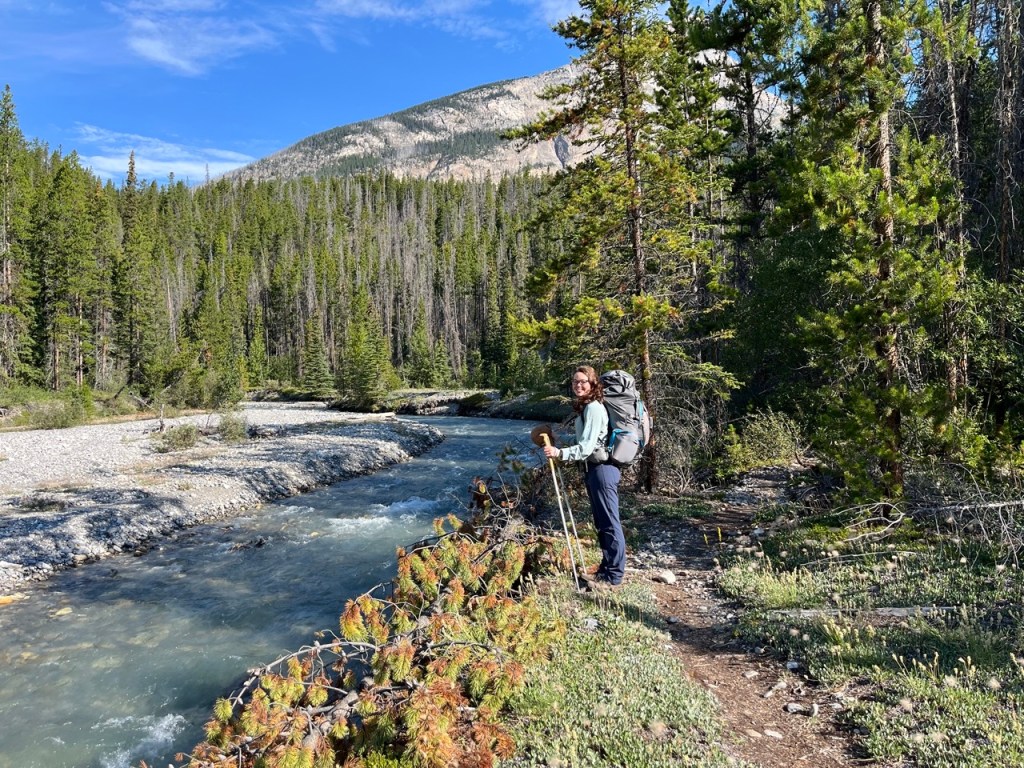
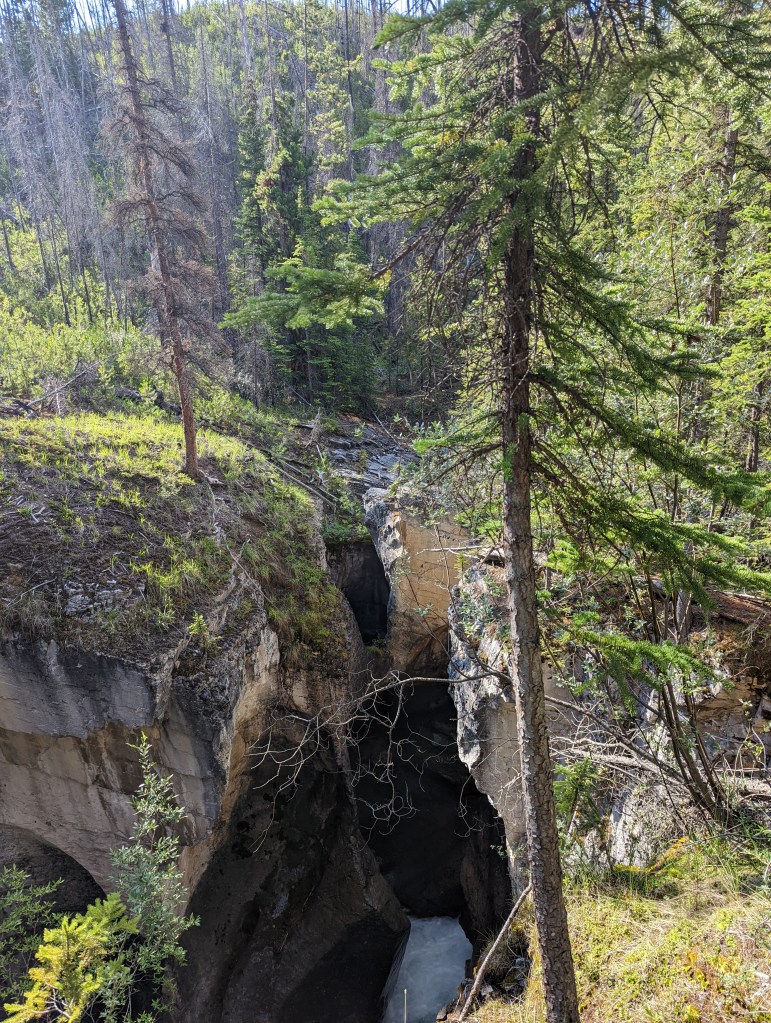
The difficulties that we will meet are not here, by the creek. There are wildflowers, the sun catches the water tumbling past me, and I can talk cheerfully with Sabrina. Soon we push up to a ridge and lose sight of the river in the trees. Gradually we hear a muffled roar growing louder until it comes almost from below our feet. A fissure seems to have opened up in the forest floor, and we peer down in awe and horror at the thundering creek tearing at its limestone walls, scouring the slot canyon deeper and deeper.
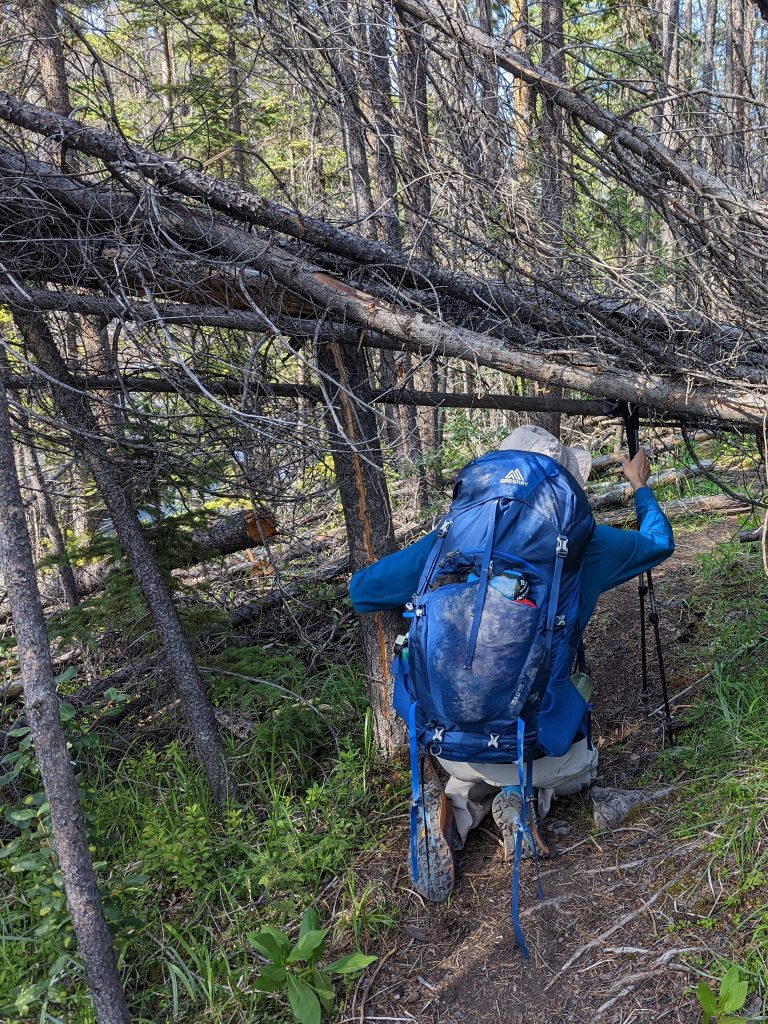
The trail gets steeper, often switchbacking up into the forest where we climb over deadfall more often. We feel the heaviness of our packs and the heat of the day. We come to an exposed patch where the sandy hillside runs down to the water too steeply for trees to grow. We cross it, ground crumbling under foot, river rushing below. At the far side someone has tied some cord to a tree root, and we gratefully use it to ascend to the forest.
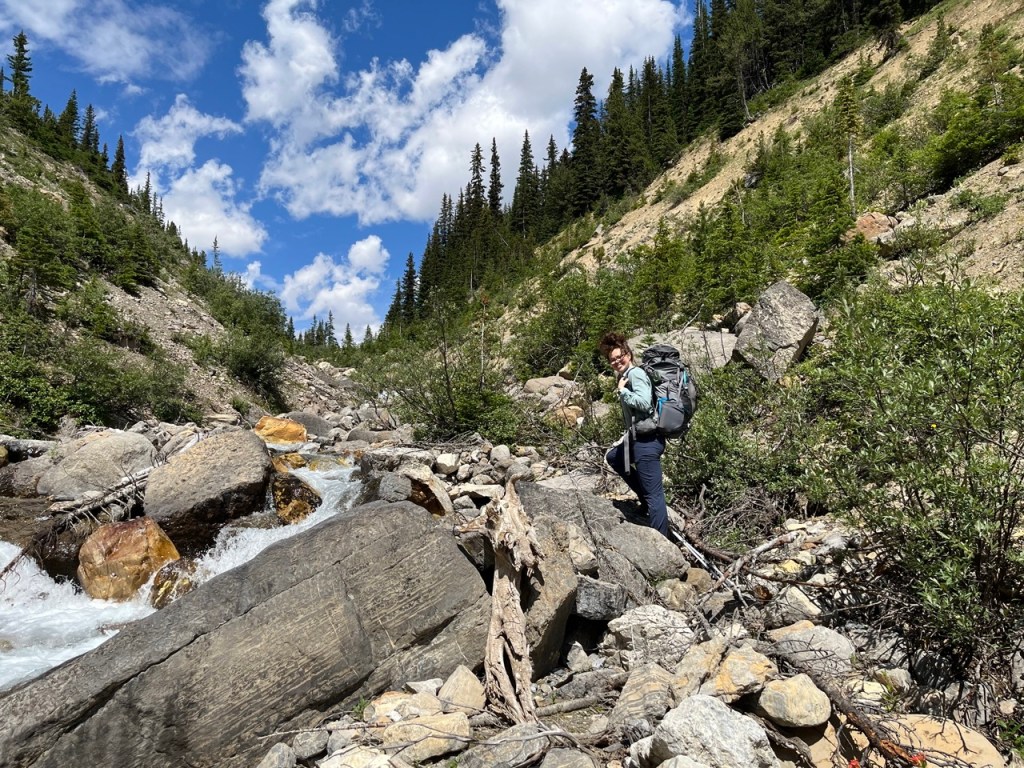
Gradually, Owen Creek is dwindling. Now and then it’s possible to rock hop along. Our boot track is replaced by small cairns that we hunt for. We find so many that we get confused. Hot and frustrated, we rest on a small island and decide on our course. We haven’t been making good time. The trail has been physically challenging and we have used more time route finding than we expected.
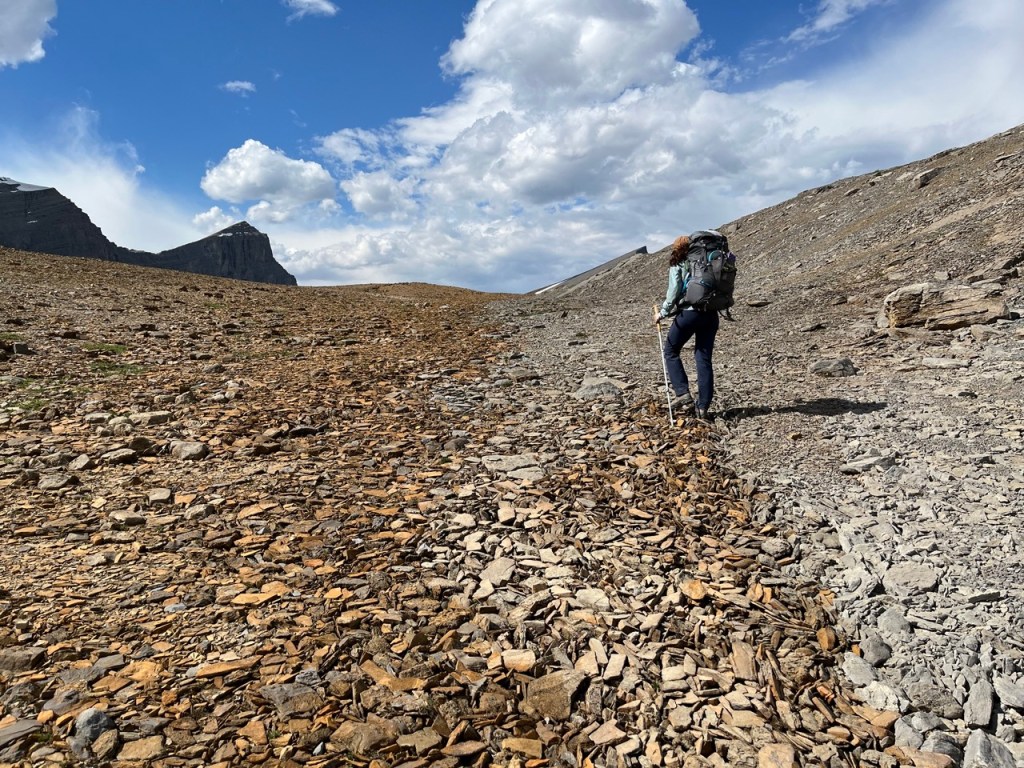
After our rest, we choose the right-hand bank and soon feel better. The track grows more obvious and less steep. The creek is shallow and quiet, lending a friendly atmosphere to the warm afternoon air. The trees shrink and thin out as we reel in Owen Pass step by step. We cross patches of snow and trudge up loose scree as dark clouds gather over us. Rain wasn’t in the forecast, but we know enough not to count on that. As we near the pass, the valley narrows and it is steep on both sides. On the right, a slope of yellow rock is crumbling down. On the left, a towering rock wall is dropping reddish blocks. We walk up the center of the valley, the stones under our left foot tens of millions of years older than those under our right.
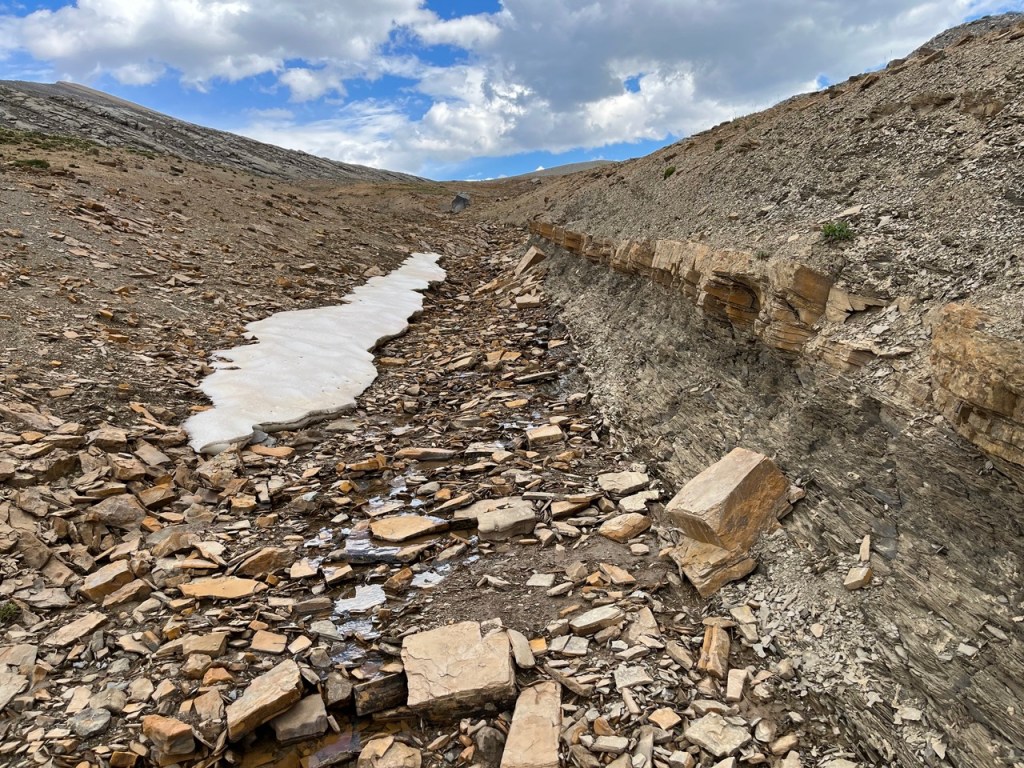
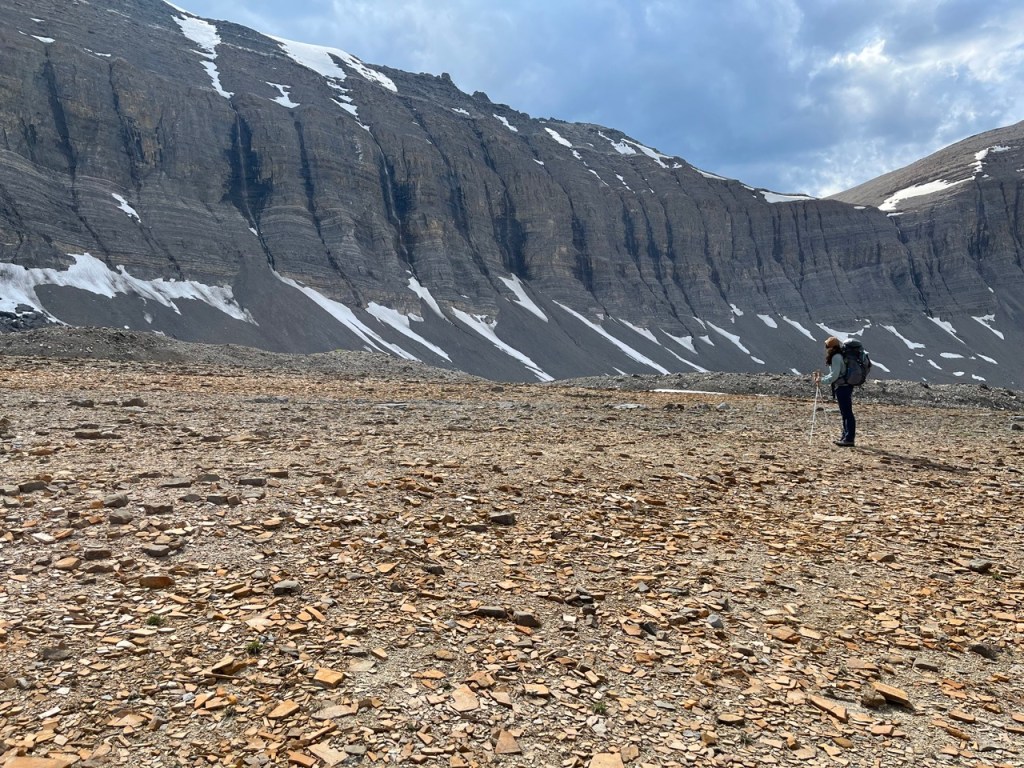
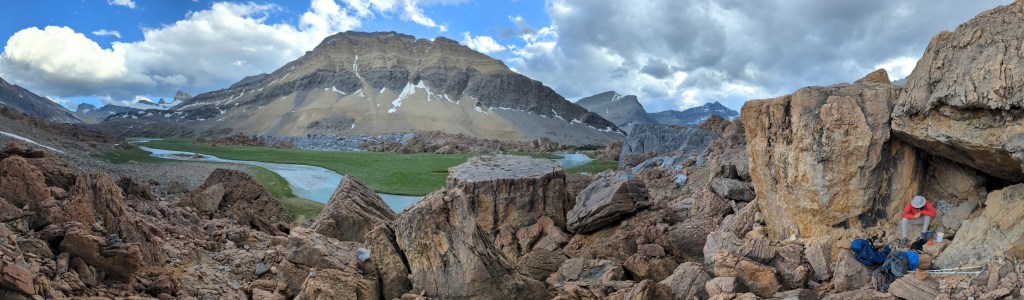
When we reach the pass, we don’t stop long. The wind is howling, the sun is behind ominous clouds. Astonishingly square red rocks dominate the north side of the pass. It looks like an ancient ruined city; the innumerable bricks are all that is left of a lost civilization. The west is blocked by a sheer wall hundreds of meters high. It feels like we are walking into the courtyard of an awful fortress, shallow tarns for moats. These drain down to the east, and as we pick our way along them, the upper Michelle Lake bursts into view just as the sun emerges. It’s that unearthly blue of water near its glacial source. Opaque, glowing with its own neon light. Sparse alpine shrubs frame the lake in dusty green. I feel vulnerable and I’m exhilarated by this wild, ancient beauty.
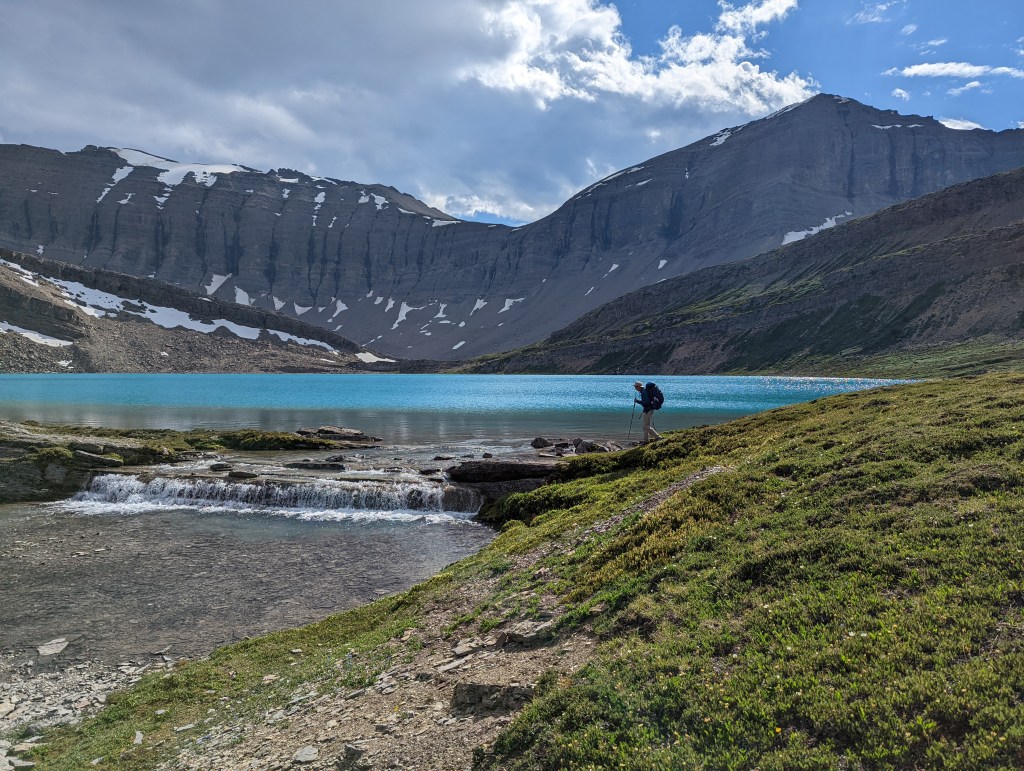
We contour around the north shore and see a strange sight. On a rise at the far end of the lake I see a silhouette: four thin legs and a large square body. The only thing I can think of is a bison. Sabrina squints at it. Bear lockers! There is nothing else around. We have been following only faint footprints for hours. The campsite is unofficial. High above the treeline, there are no tables, no tent pads, no privies. But here in this wild emptiness, a metal box bolted to a concrete pad has dropped from the sky.
Behind the lockers, in a stony depression we see the bright fabric of a tent. A friendly French Canadian smiles and waves. We don’t feel so isolated. The austere terrain is exciting, not intimidating.
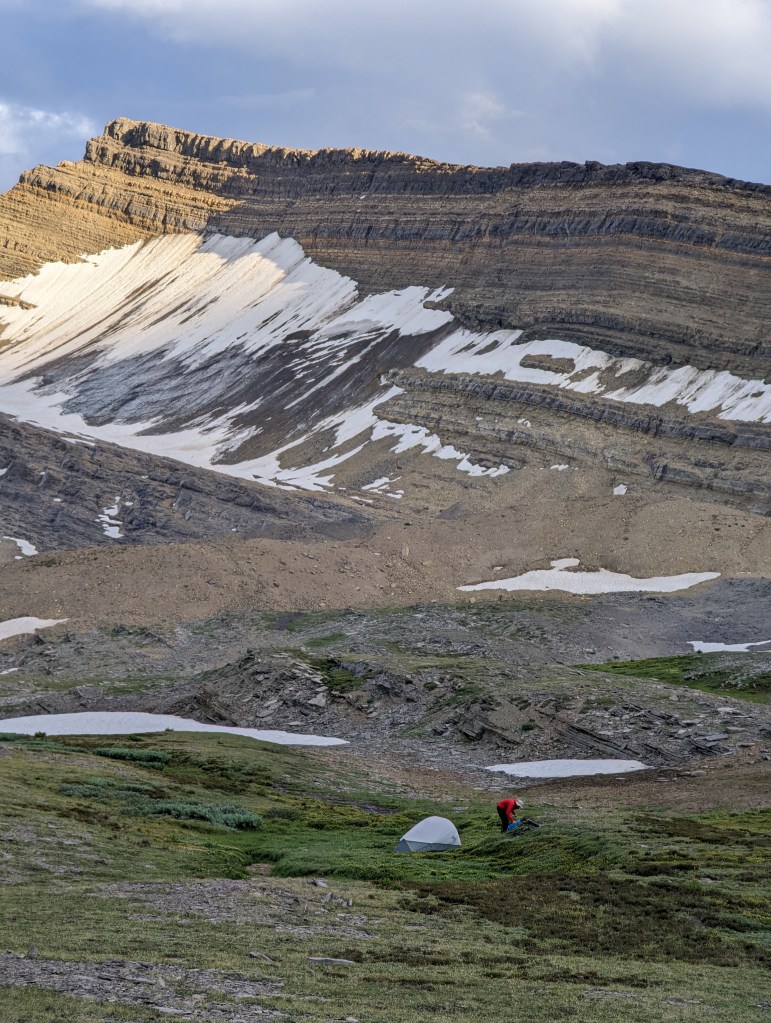
We look around, unsure where to pitch our tent. The nearest tree might be a kilometer away. The furrows of loose rock are our only shelter. We pick a spot in the lee of one a little way from the food storage. It is warm and sunny and we lie down, recharging mentally and physically. We have only come about 14 kilometers but this was enough.
At about six, the clouds and wind return. We put on all our rain gear and rush to make supper in case it storms all night. I rearrange the flat stones to shelter our stove from the wind now howling over the lake. It starts to spit rain before the water boils. The tempo of the rain accelerates, hard, rapid drops. There is no where to go. We simply stand in the rain and wait, water streaming off our hoods. We eat huddled against the bear lockers. The steaming food feels good.
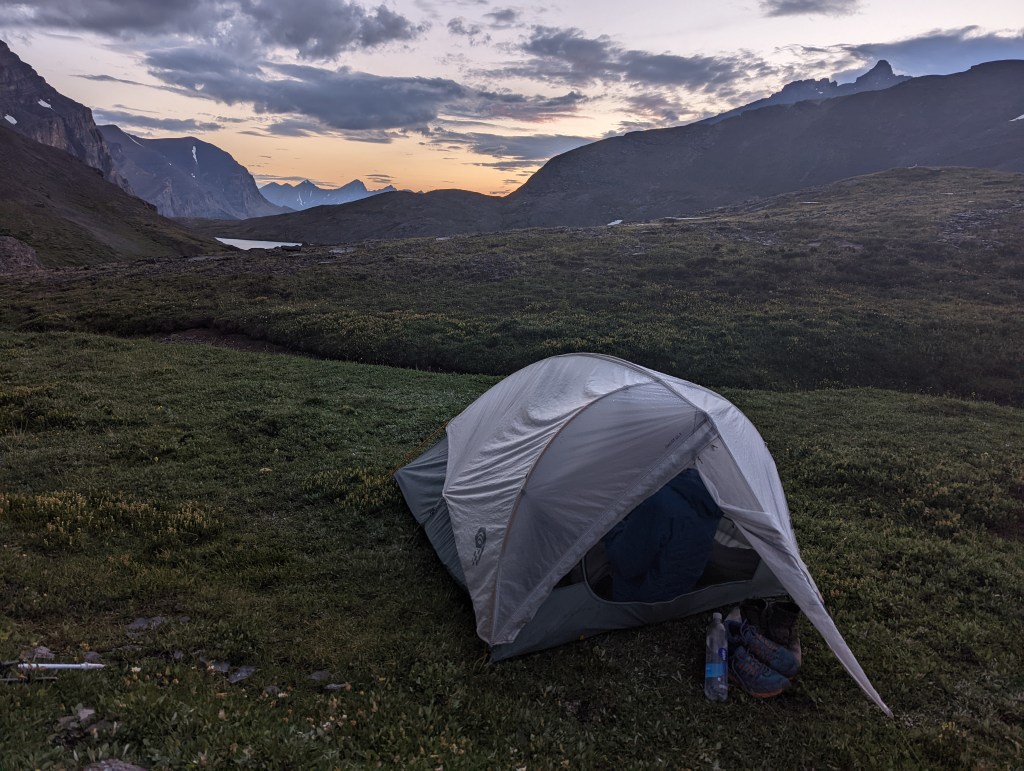
We walk back to the tent. The wind has pinned the fly against the inner tent wall. We unpeg the tent and rotate it so it isn’t caught broadside. As we retension the fly, the rain dies down and the clouds blow away and all is calm again. We let the sun evaporate the water off our rain gear.
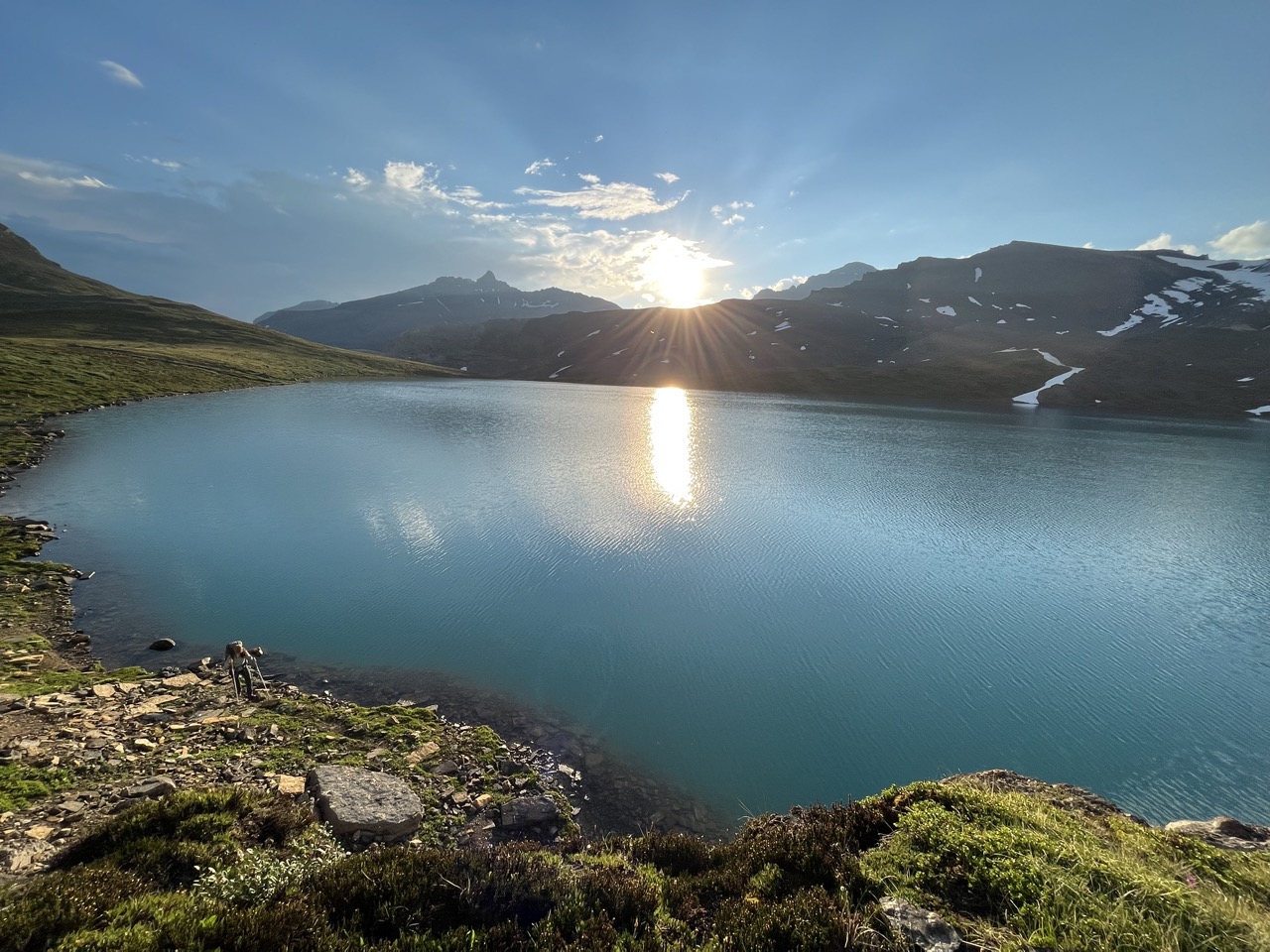
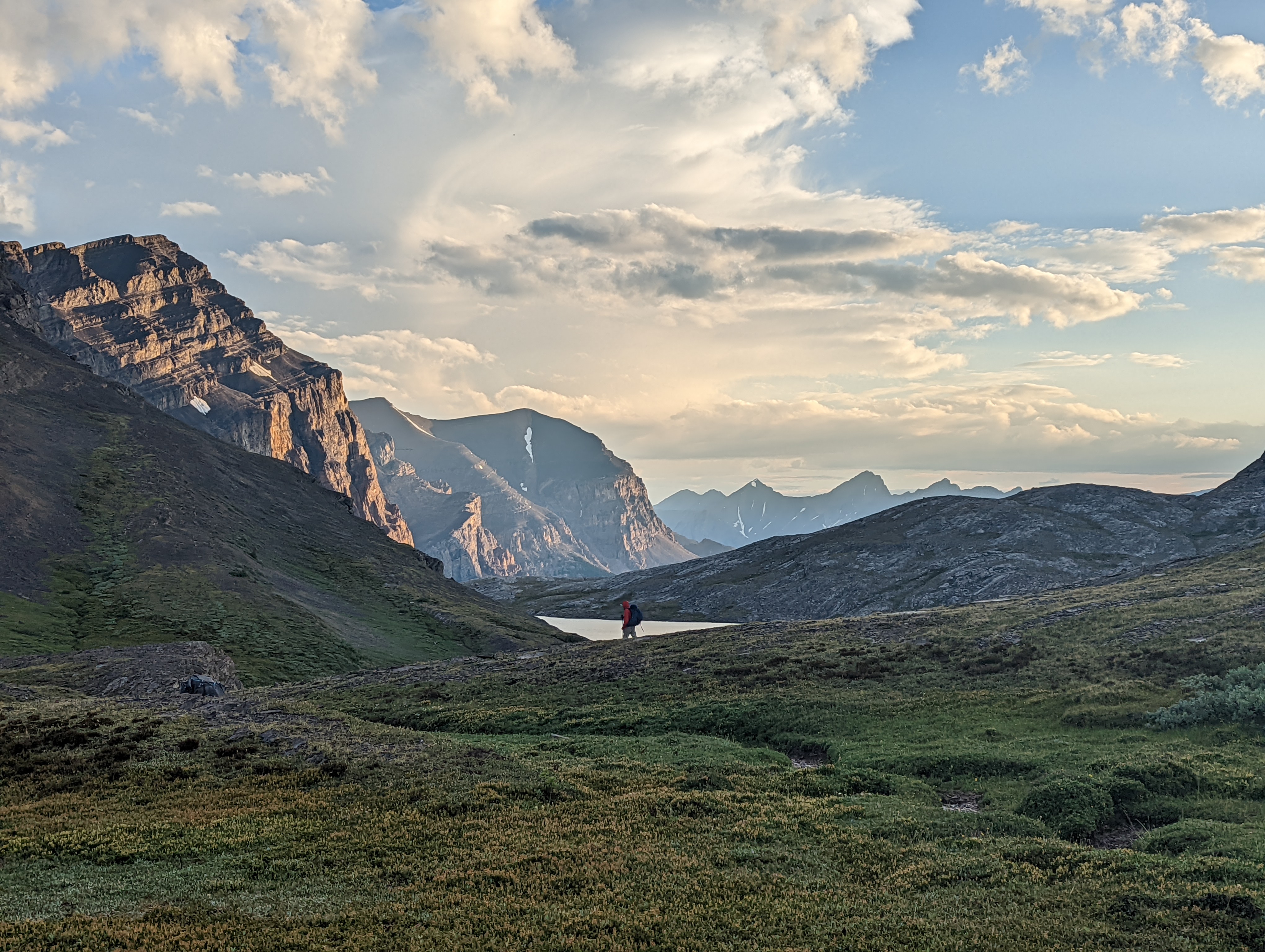
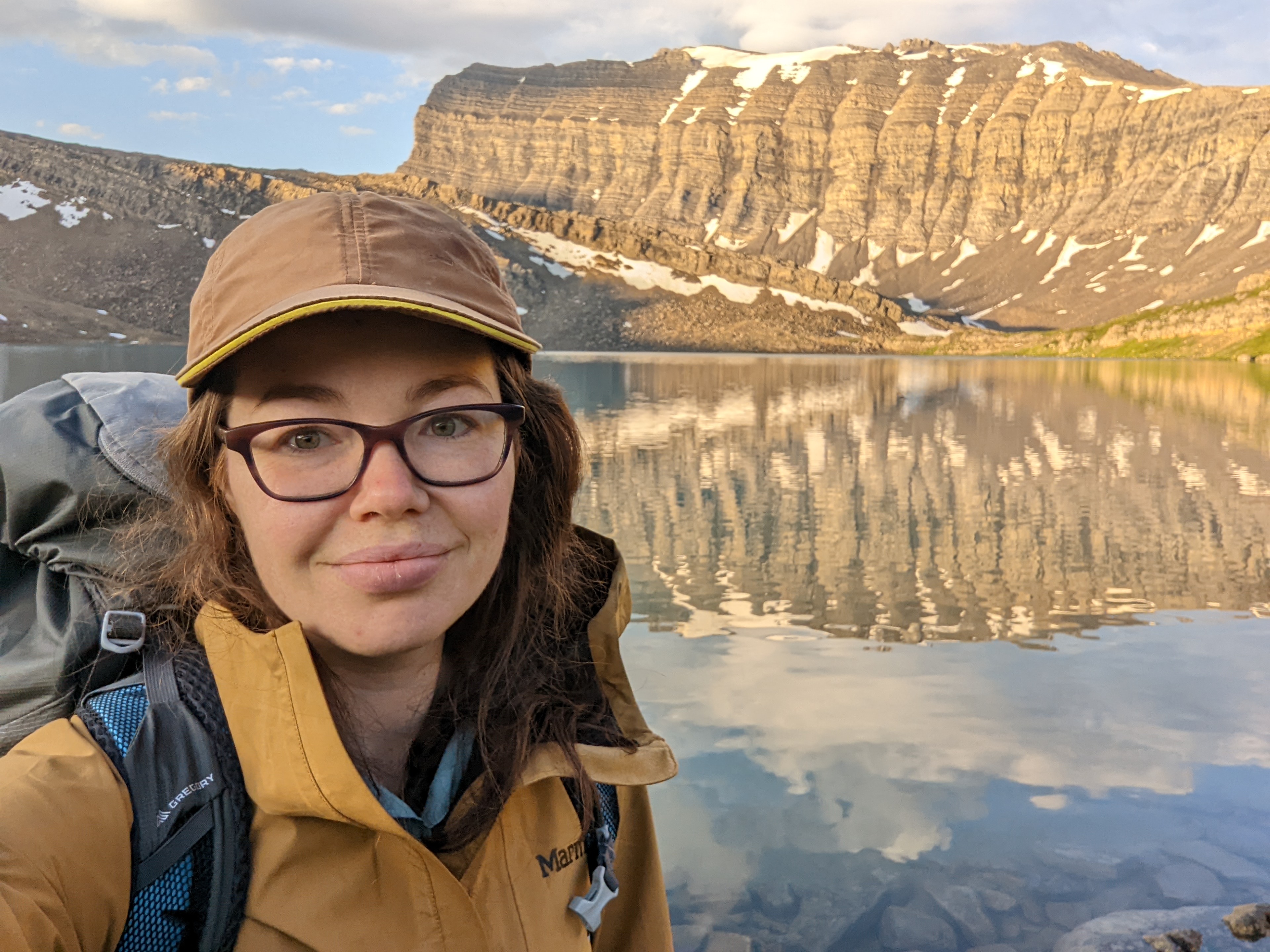
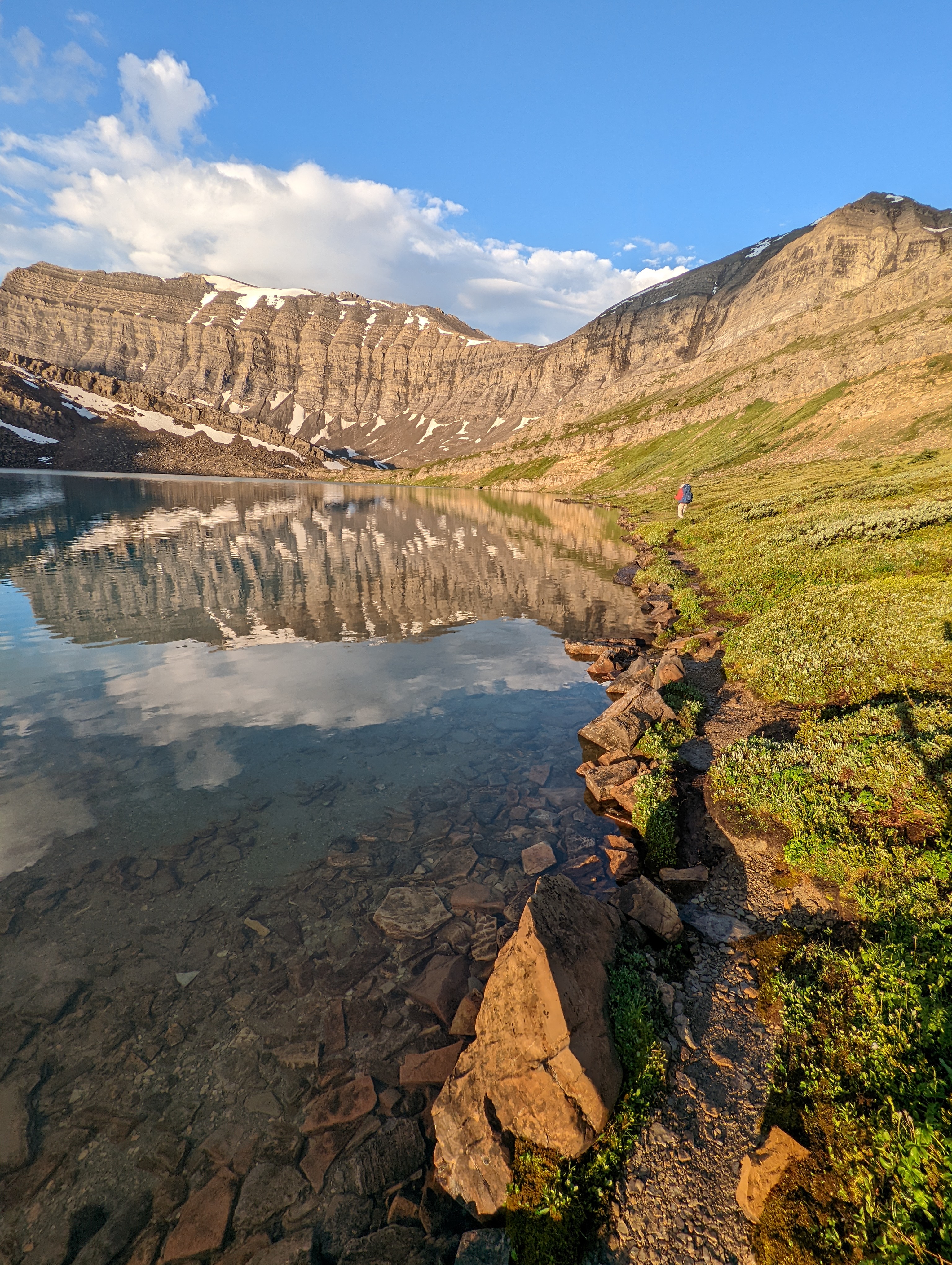
We wake to sun and stillness. No birdsong, no breath of wind. Humbled by the previous day we murmur about an early start and break camp by seven. We are surprised to feel greatly recovered. We walk back west along the lakeshore to resume the trail, enjoying a morning fresh and hopeful.
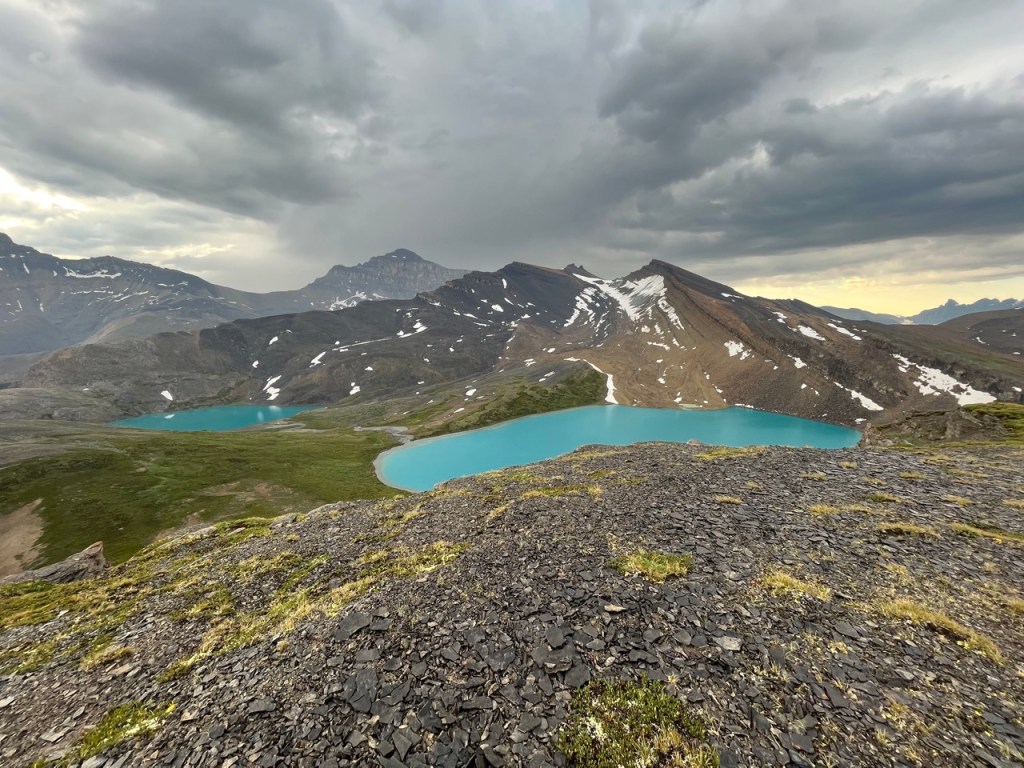
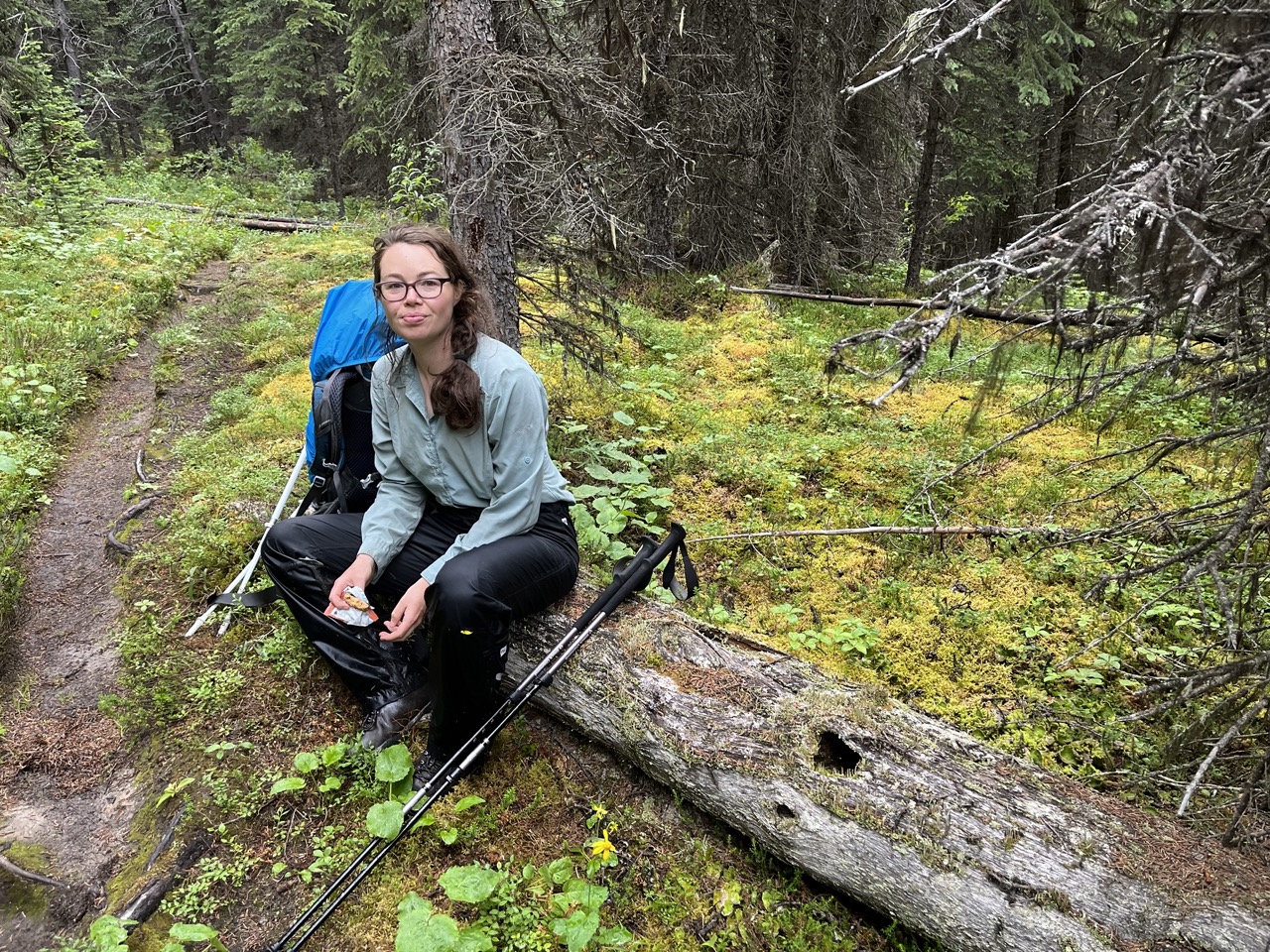
We return to the fortress walls. Our way north is over the unnamed pass that is the high point of the entire Great Divide Trail. We turn right and face a 225 metre high halfpipe of loose shale capped by a large cornice. The wind builds. The clouds gather. The rain returns. I start to feel a familiar pain in my knee and for a moment I doubt everything. I’ve trained and yet now I might be injured already. We’ve hardly started. These first two days were supposed to ease us in, but we have struggled. I’m struggling right now. Sabrina calls a rest. We eat a bar and take a drink and she leads us at a careful, deliberate pace. My knee doesn’t get worse.
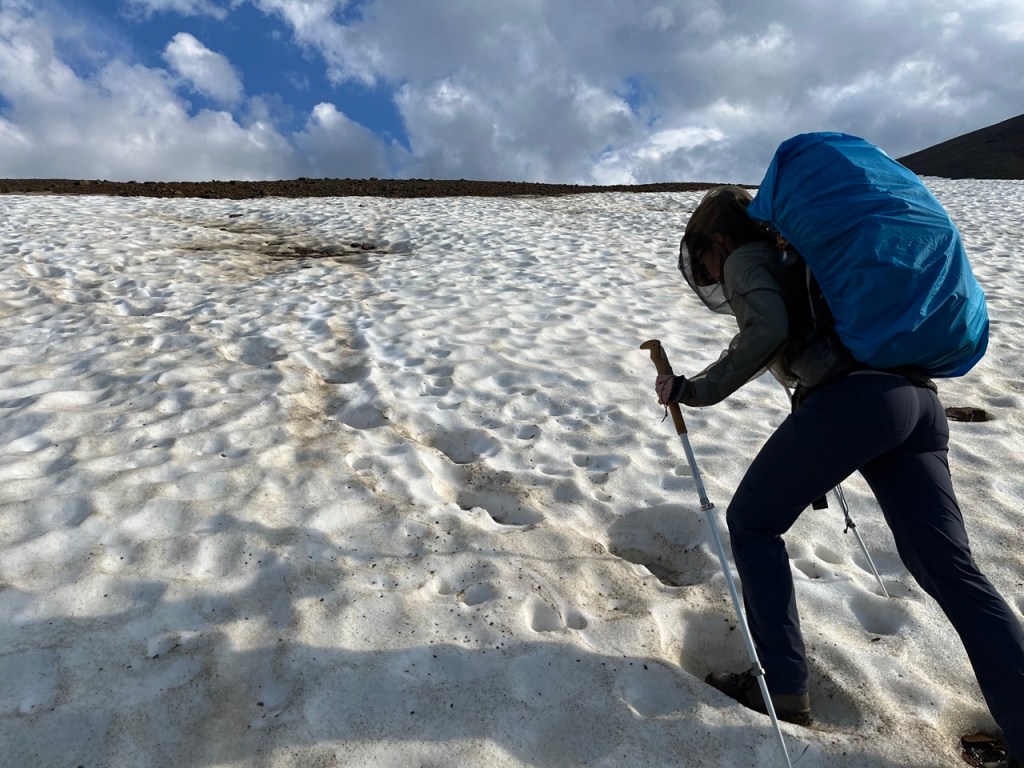
As we inch closer to the pass, we see a way through the cornice and it feels more doable with every step. We are slow, trying to choose the path of least resistance up. It is midmorning when we kickstep our way through the snow field and crest the pass. We set down our packs and celebrate. The sporadic rain has blown away. I’m relieve. I’m delighted.
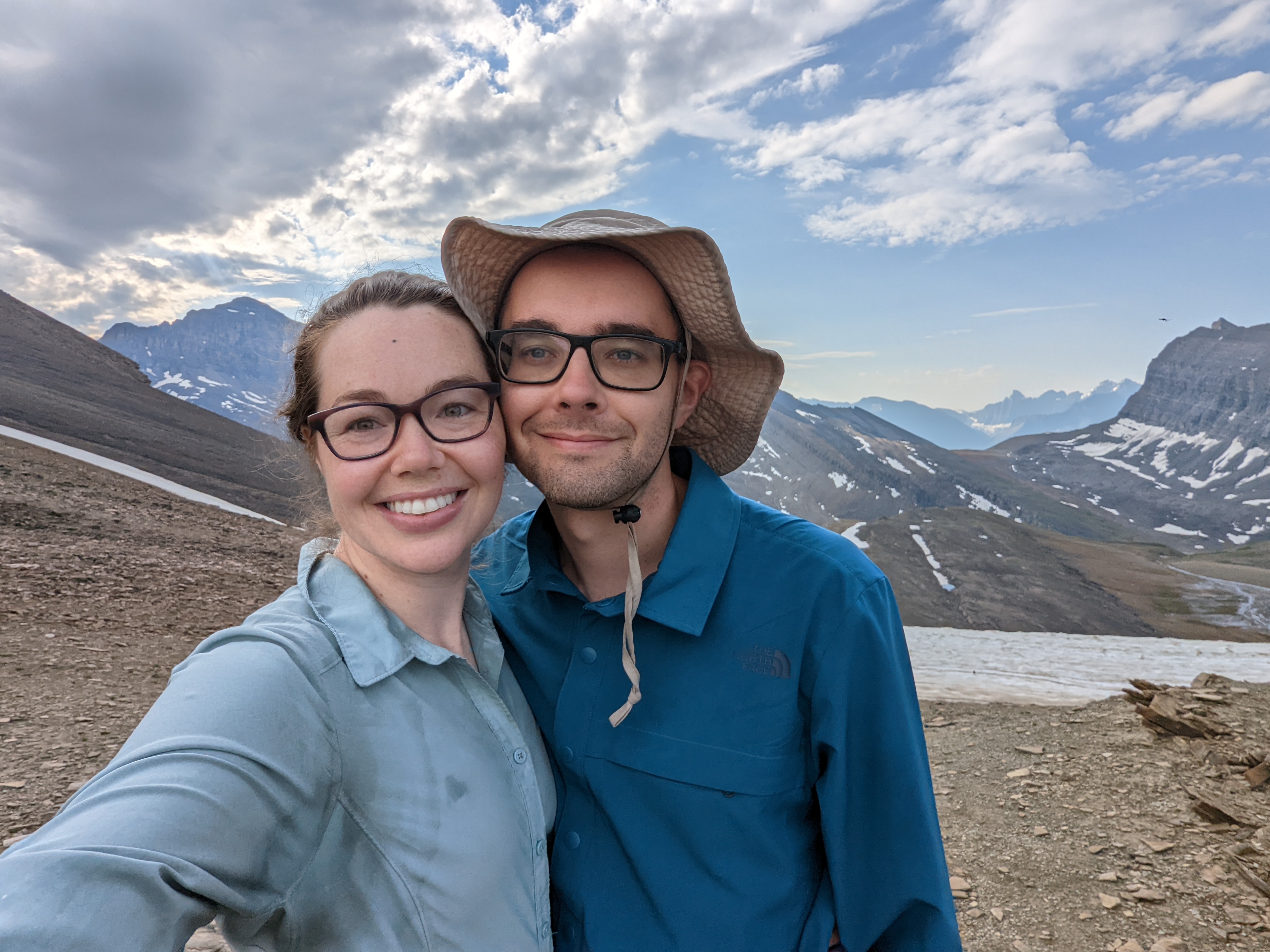
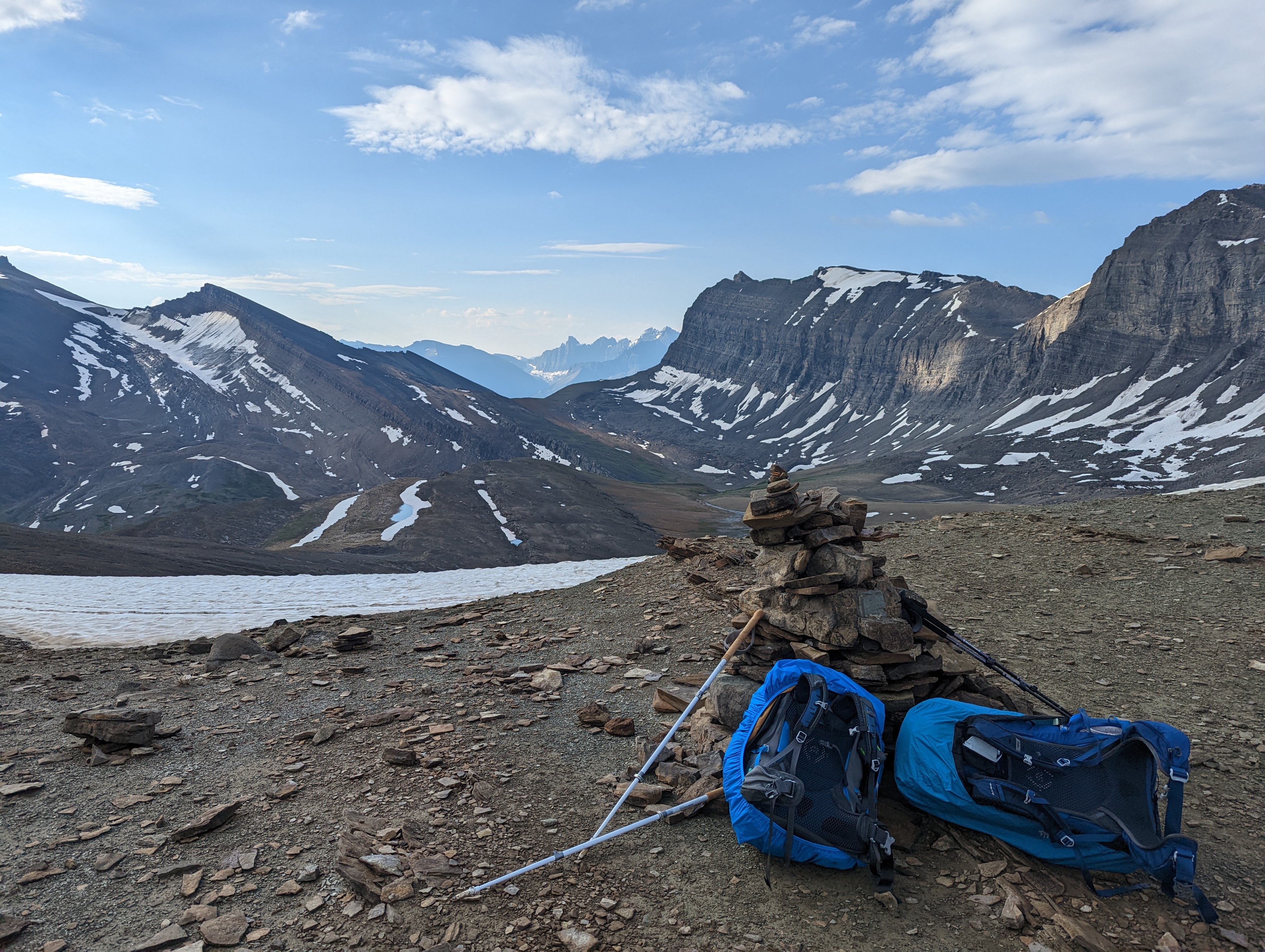
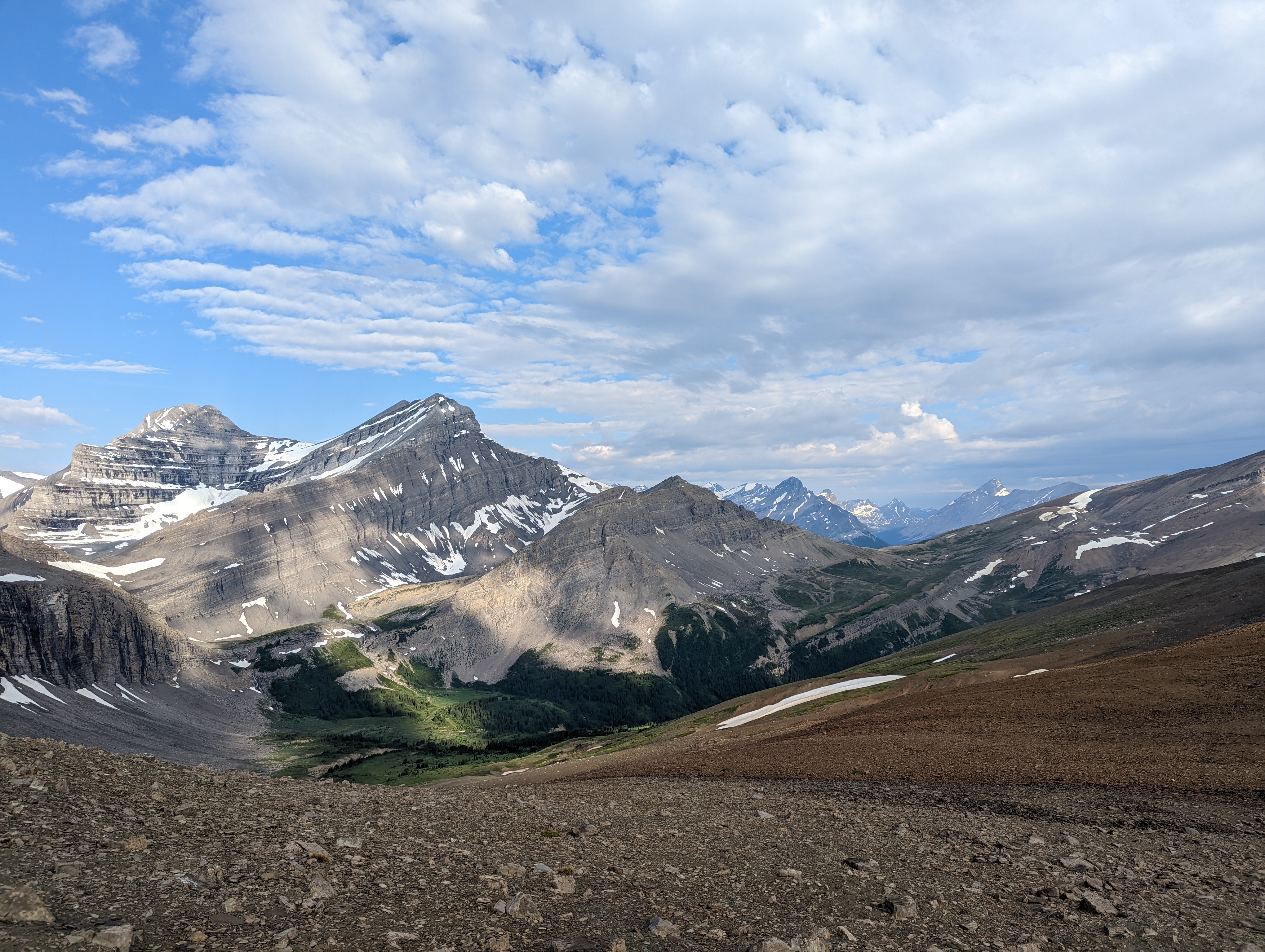
Behind us is the brutalist architecture of long, regular, vertical stone. Ahead is a deep green valley. The sight of trees in morning sun comforts us. We can see Pinto Pass on the other side and even though we will have to go a long way down and a long way back up, it looks close. We begin the descent, over twice as far on this side, and we are thankful we are doing the trail in the direction we are.
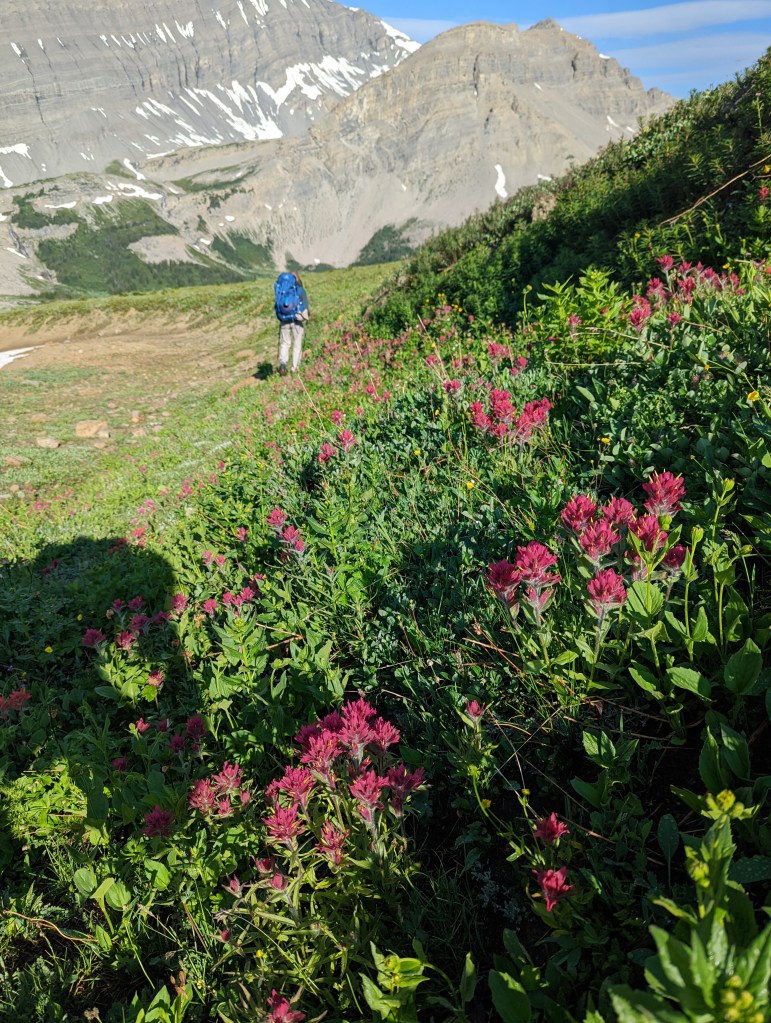
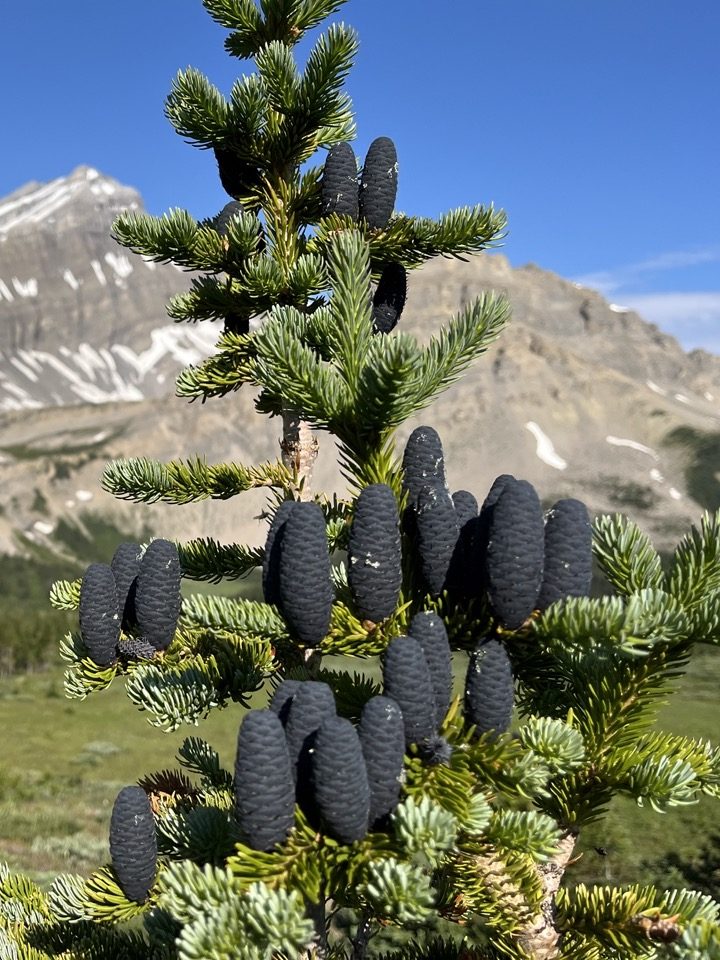
As we get lower, we reach alpine shrubs and then meadows brilliant with flowers and bordered by scraggly, ancient fir trees. We lose the trail in a rain drenched meadow. My feet squelch in my shoes. I’ve chosen trail runners on the theory that wet feet are inevitable but at least they will dry. Sabrina has stuck with her waterproof hiking boots and her feet stay dry, thankfully. We reach Waterfalls Creek and rest on a sunny gravel bank. We feel good. I am not conscious of just how closely tied our mood is to the weather.
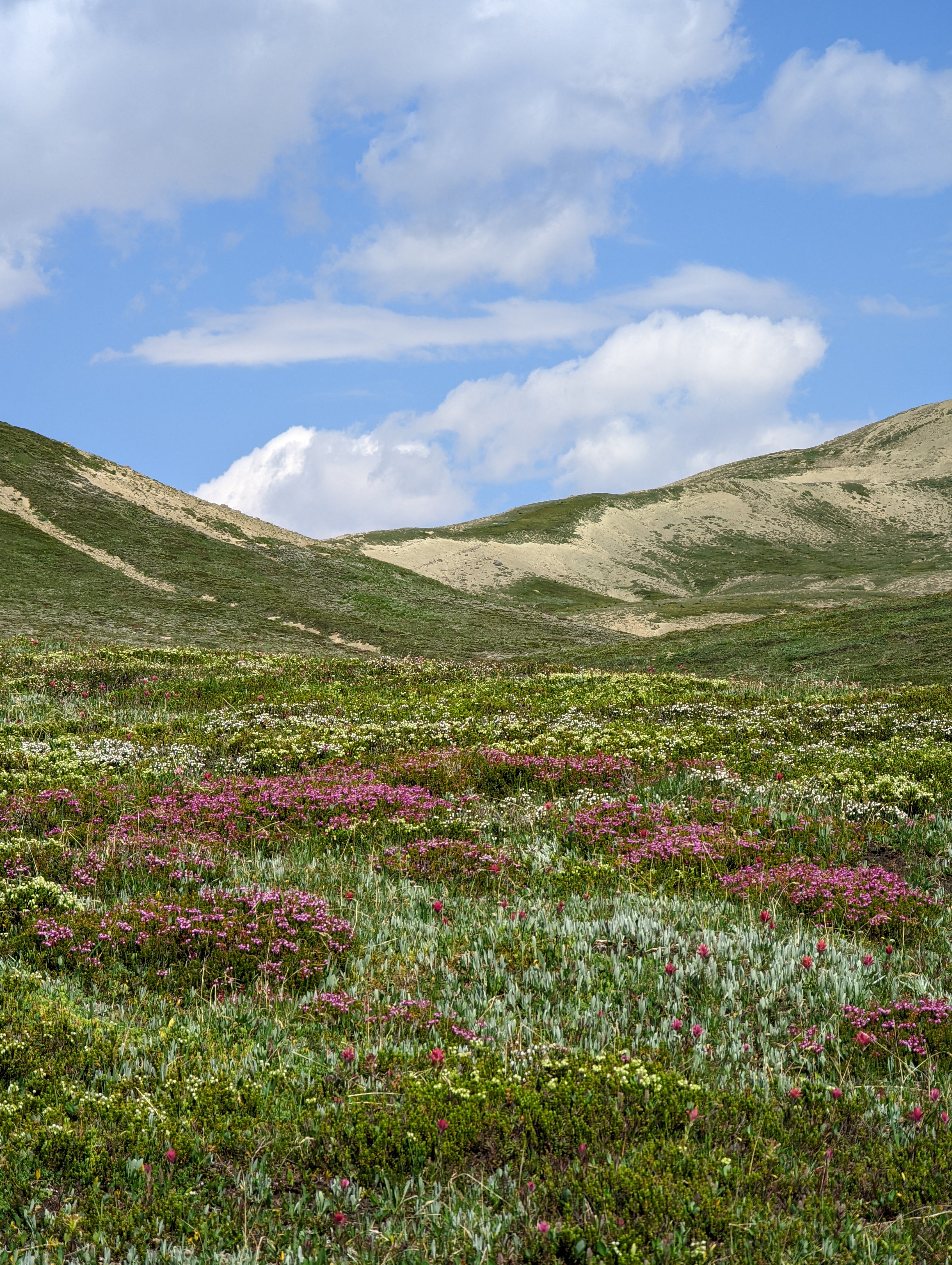
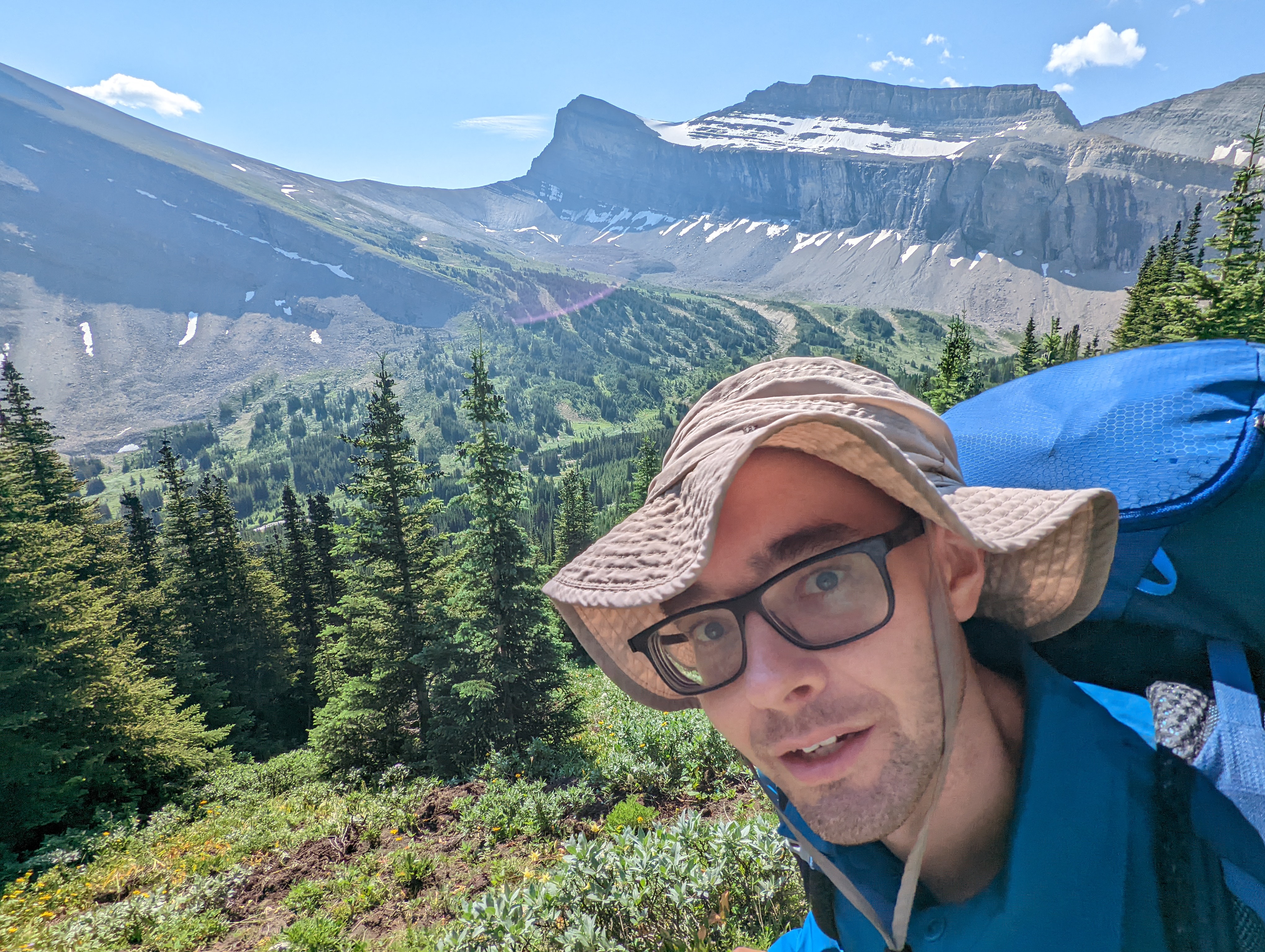
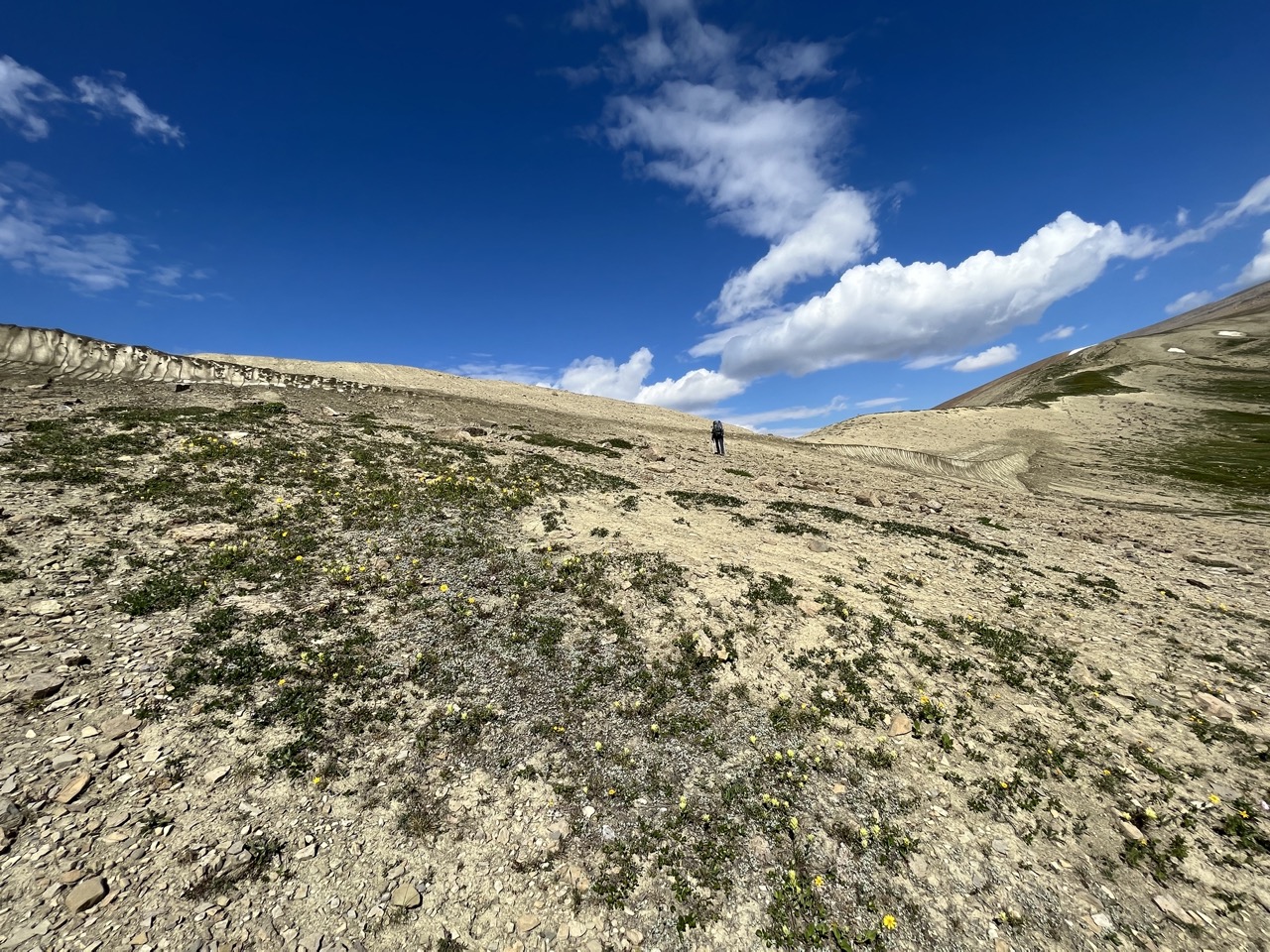
We’re also charmed by the valley. After our stay in the alpine, the sighs of big trees are soothing. We come to our first real river ford. We search for a place for Sabrina to cross without taking off her boots. We don’t find it. I am supposed to just walk across in my shoes, but I hesitate. My body instinctively pulls back. I have to force my legs to step into the icy water. There is a thrill like that of jumping from the high dive and it feels nice on my feet. Sabrina changes back from her sandals to her hiking boots and we begin our climb up to Pinto Pass. It’s steep but shaded by dense trees and there is no trouble following the path. When we pop out of the forest we are in a broad alpine meadow that rises gently to the pass. It is easy, pleasant walking through pretty flowers. There is another cornice but it too has a thin way through marked by boot prints.
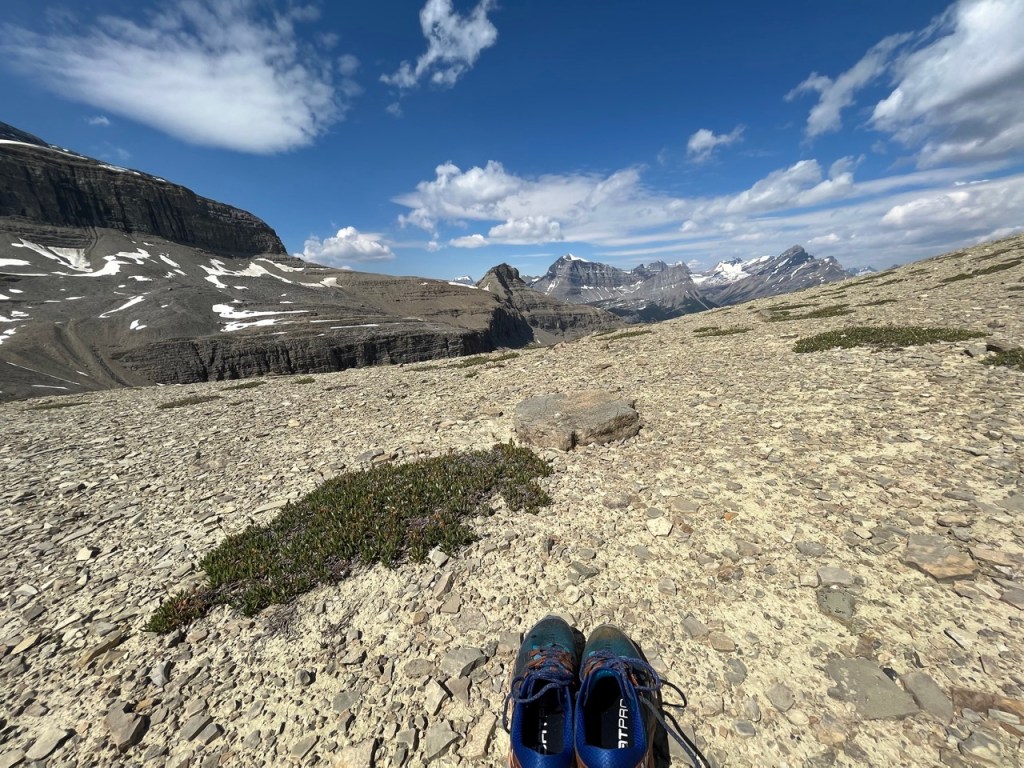
We take our lunch at the pass, truly enjoying ourselves, feeling sure we can do this trail. The way down is very steep and again we are glad to be northbound. When we have descended to the first trees in this valley, we meet a couple hikers coming the other way on a day trip from Pinto Lake.
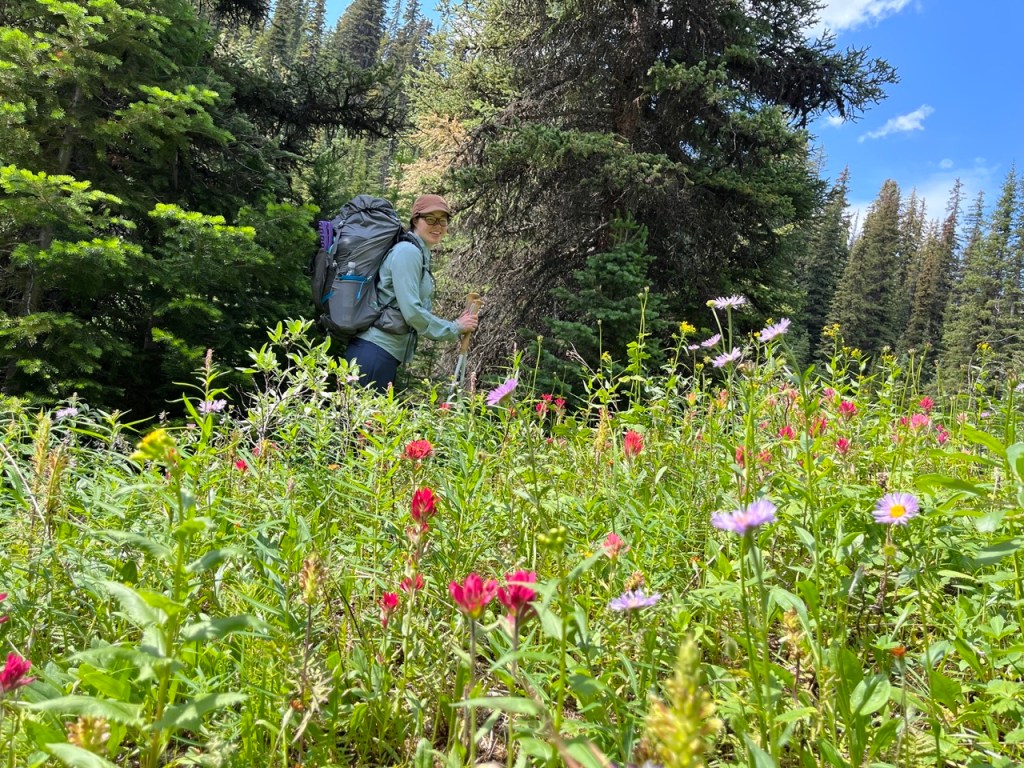
The trail is good now. Well graded, easy to follow and only a little overgrown. We make great time on the long gradual descent to Pinto Lake. The day is getting hotter and my shoes have indeed dried. We pass campgrounds with log tables built by horse packers and I feel like we are re-entering civilization.
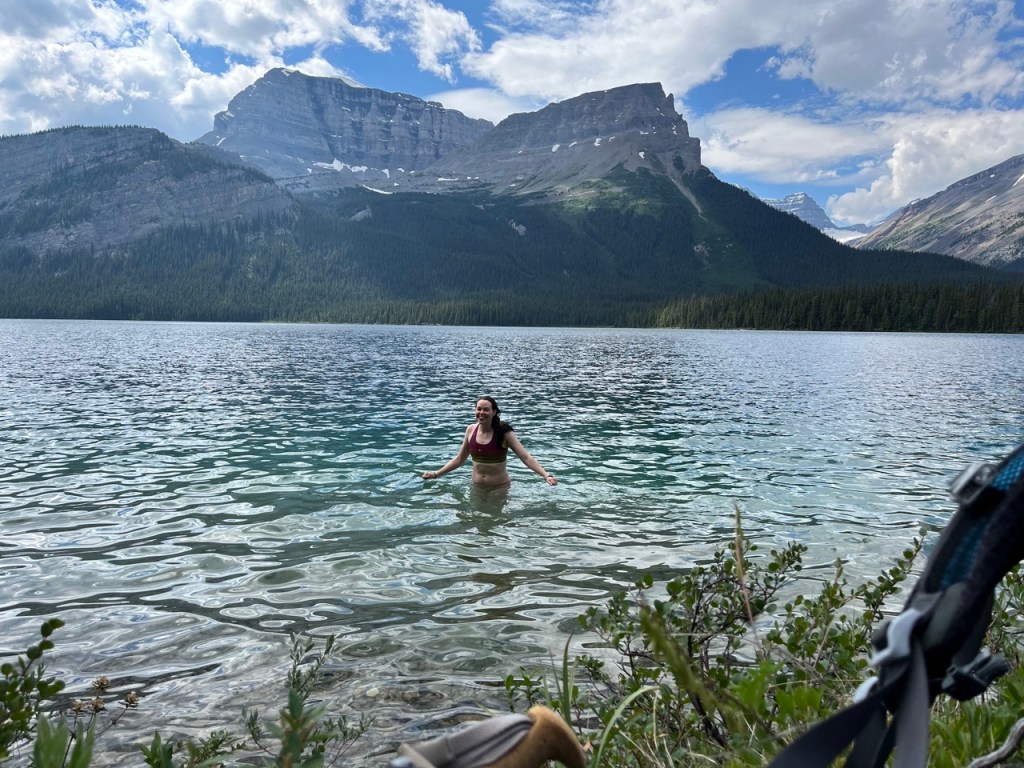
The forest becomes monotonous and the kilometers start to drag. Sabrina, not heat tolerant, wilts. We finally reach the south shore of Pinto and I suggest a dip. Sabrina resists. She wants to get to camp. I know that we are tired and hot. We find a nice spot. I go in to the bottom of my boxers. Sabrina does a full dunk and comes up beaming and refreshed. We carefully dry our feet off with a small camp towel and finish the last hour in good spirits.
Our planned campsite is on the far end of the lake. It’s a popular spot. When we arrive see a large group just packing up. They have coolers and big tents and stoves and inflatable toys. I wonder if they have a float plane coming to pick them up. We set up our tent as they pile their gear on shore. I keep waiting to hear the buzz of an engine but there is none. When I look again, they are gone. Neither Sabrina nor I saw where or when they vanished.
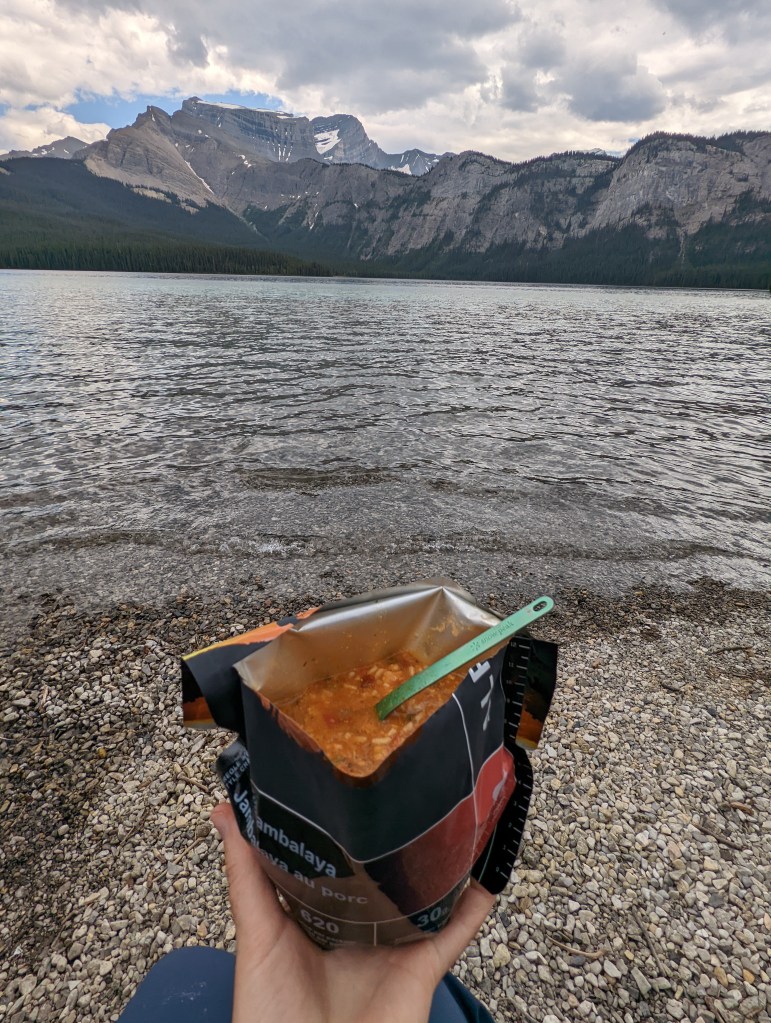
There are again bear lockers even though we aren’t in any official park. There are also log benches and a metal fire pit. It feels luxurious. We stretch and try to relax and recover as much as possible. Aside from some soreness from our food-heavy packs, we feel alright, but we know that tomorrow is likely our hardest day.
It will be 30 kilometers, mostly in an area called Whitegoat Wilderness, a zone where any development such as campgrounds or trail maintenance is illegal. Besides potentially confusing navigation and bushwhacking, we will have to ford Cataract Creek. It is partly for that reason that we are camping here: we want to reach the creek as early as possible, before the heat of the day melts extra snow and raises the water level.
After tomorrow, we will be back in a familiar place, the Brazeau in Jasper National Park where there will be more people, good trails, and a feeling of home. That feeling will end halfway through day five when we reach the Maligne Valley, a name rumoured to be well-earned by its overgrown state. And at the bottom of that valley is the river. It is starting to feel imminent. I push it out of my thoughts and fall asleep to the creak and groan of the pines.
We follow the Sunset Pass trail out of camp, but we soon have to leave it to trace a faint track along the Cline River. Sabrina changes into sandals at the first tributary. We aren’t sure how many small streams and wetlands we have to cross, and she opts to hike in her sandals to save time. I worry that the willows and fallen logs we’re contending with will gouge her exposed feet but she manages to avoid injury.
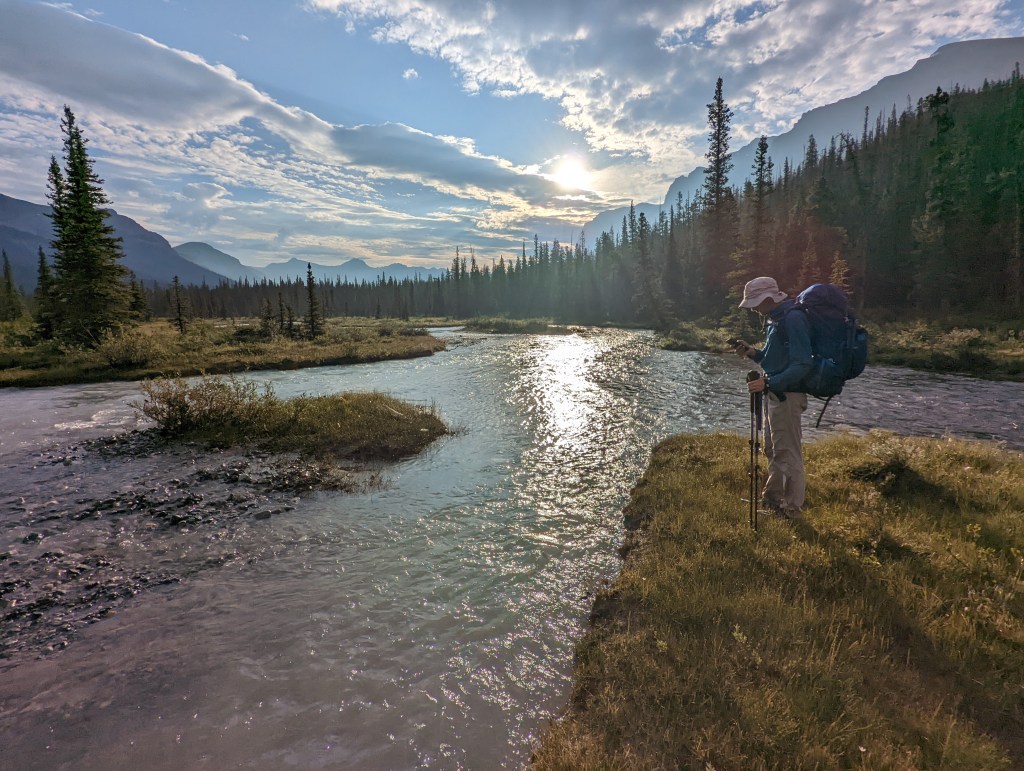
We reach an unmarked tributary and pause. It is extremely deep and strong everywhere we try. I bushwhack upstream and find a log that takes me over the deepest part. It’s slippery and unstable but I’m lucky and manage to jump down into the shallows. Sabrina has not been so fortunate. Her line took her over a hidden hole in the streambed that sunk her to her waist. We reach the White Goat Wilderness Trail register. From now until Cataract Pass, there will be no blazes or flagging and no cleared deadfall. We thread our way slowly through forest and willow, following what we judge is the most significant game trail.
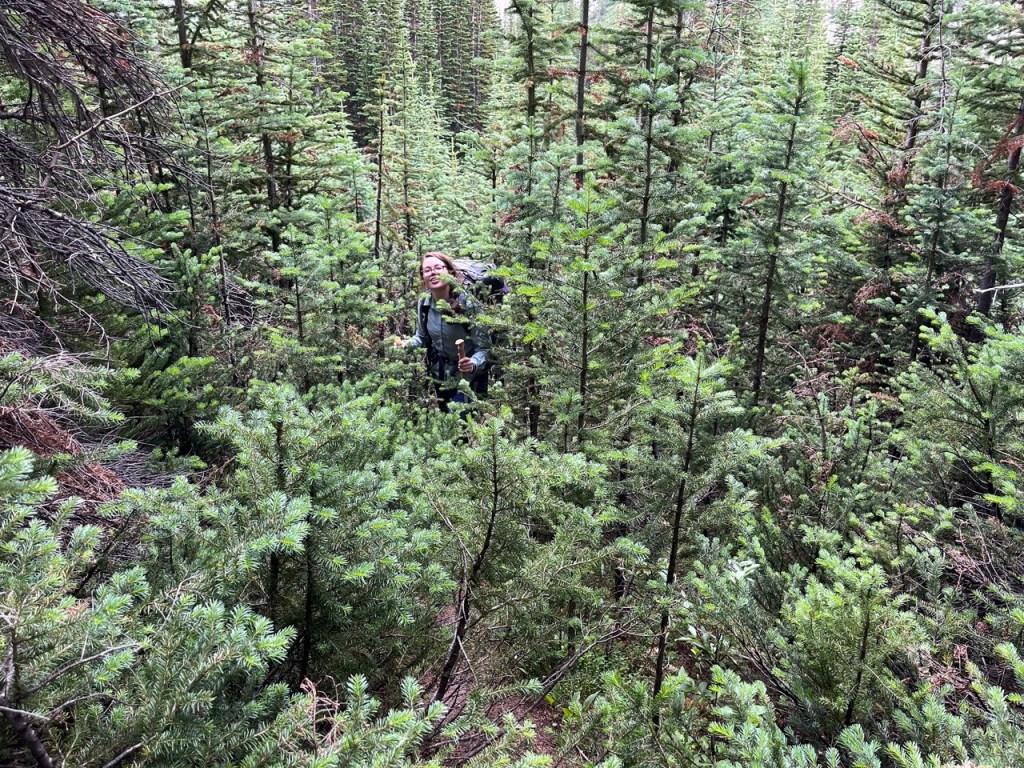
Finally we reach Cataract Creek. We spend a couple minutes picking our line and then just go for it. Halfway across the glacier water begins to bite my feet. The pain is excruciating. I try to focus on my footing. It’s knee deep and very strong. I know I shouldn’t rush. I know I’m rushing. Involuntarily, I stumble to the far bank as fast as I can. When I get there I scream and scream. The cold takes a full minute to pass away. My throat is sore from yelling. Sabrina, in sandals, bore the pain gracefully.
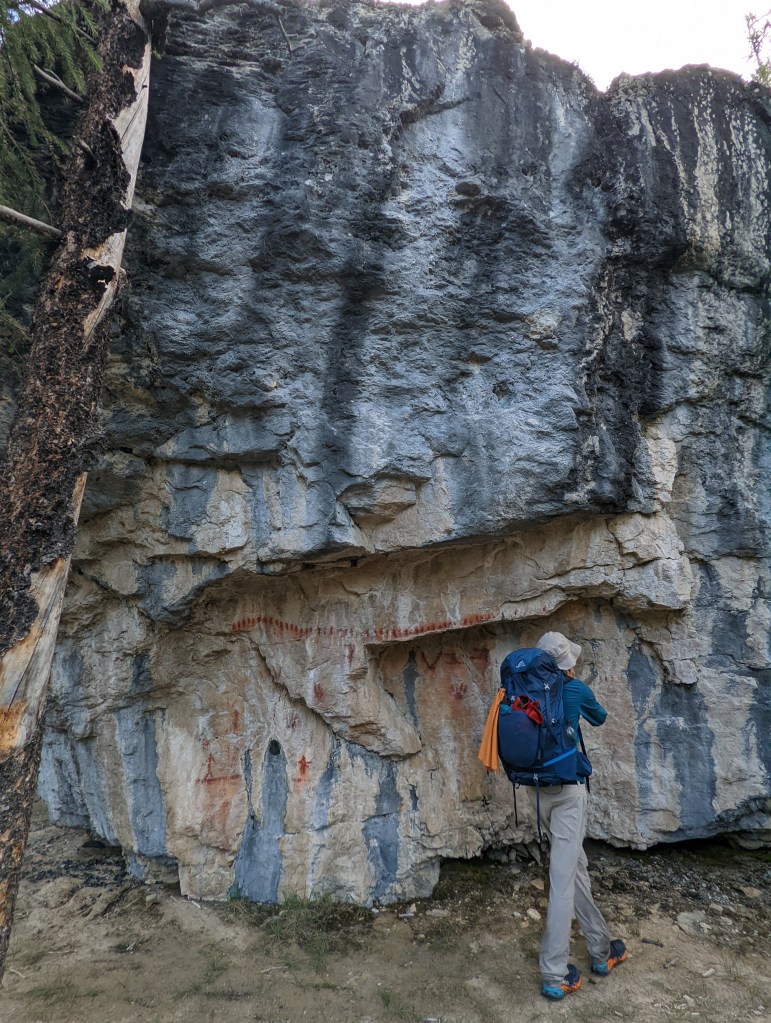
We start walking upstream on a very old trail through the forest. It seems like there is a log to climb over every 30 seconds. We detour around the big ones but that is tedious too. At lunch we stop at the pictograph boulder. On the far side, overlooking the creek, are dozens of figures painted in a red pigment. I’ve tried to find out who made them but that knowledge seems to have been deliberately hidden, perhaps to prevent vandalism.
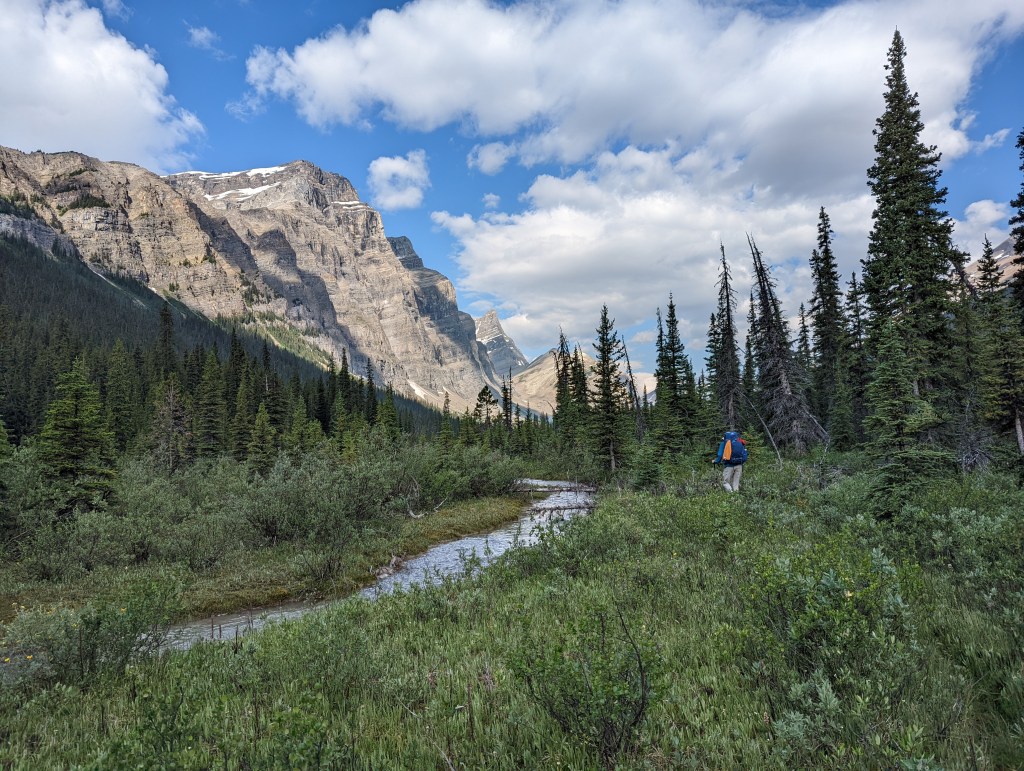
We have been progressing steadily but not quickly. As we follow the creek upstream we pass through wet meadows and Sabrina again tries to guess whether it is worth changing between boots and sandals. The day is getting warm and it is mid afternoon by the time we reach a particularly large tributary.
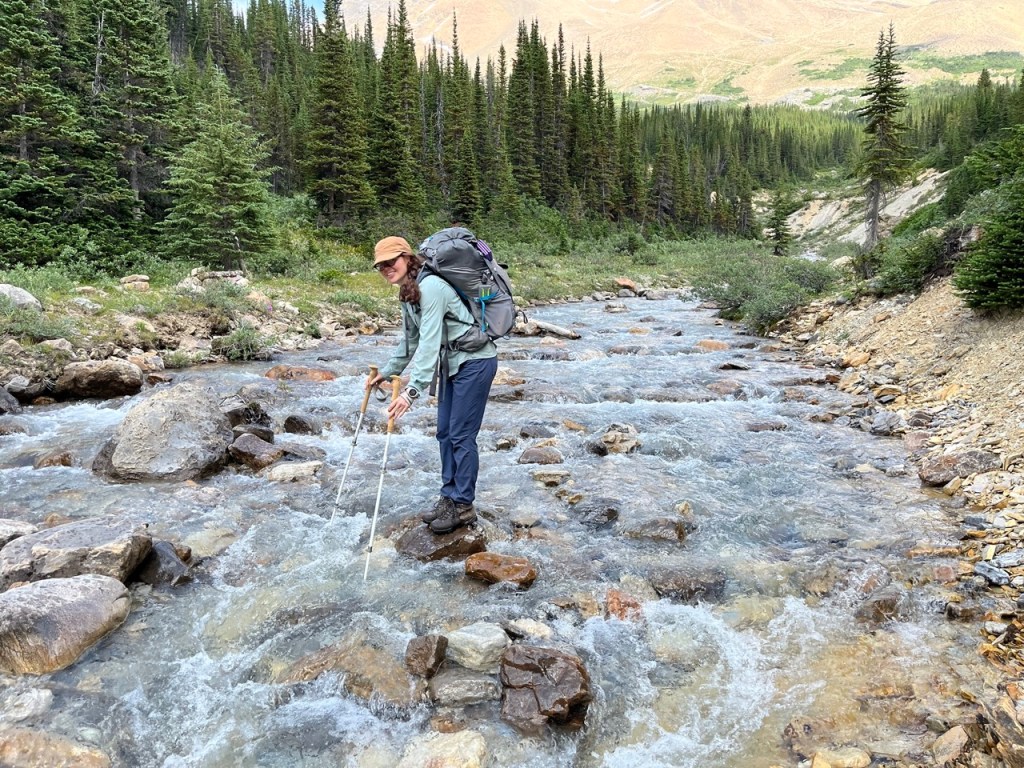
The banks are high, steep, and eroded. We are forced to stay down at the creek and pick our way back and forth across it. It is no longer knee deep but still broad and fast and cold. We sometimes find cairns and hints of trail, but we often lose it and spend too much time trying to guess which bank we should be on. We reach a waterfall and have to find a way up from the creek. We follow a game trail up a very steep slope but it dead ends in impenetrable bush.
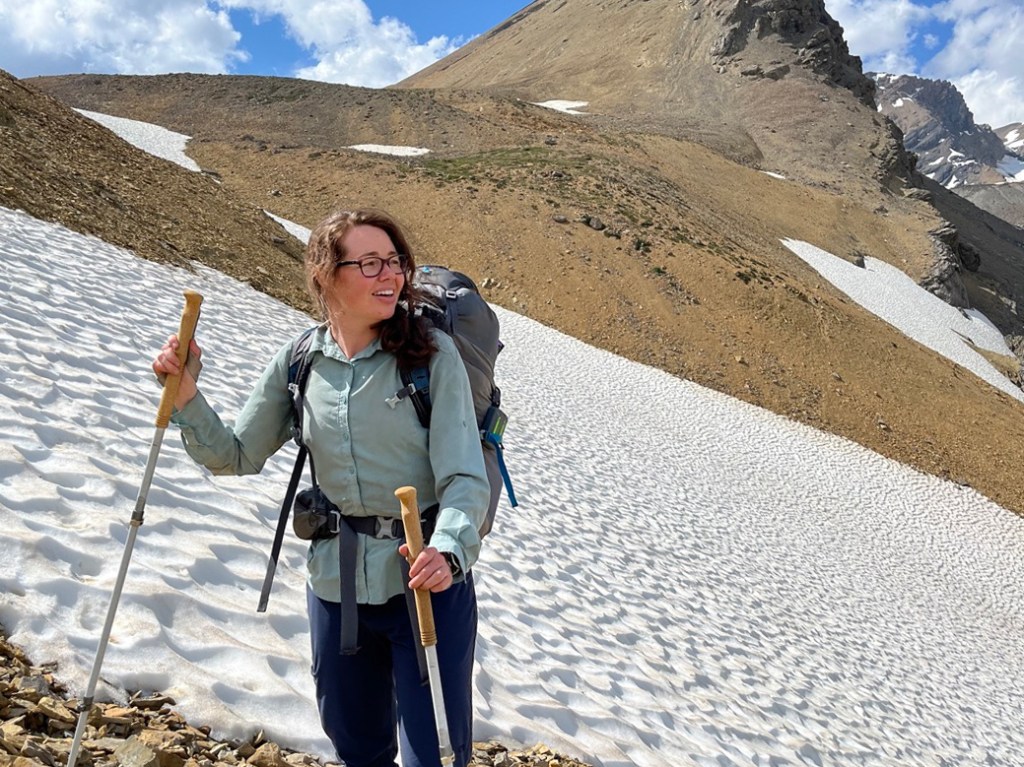
We rest on a moraine and look up at Cataract Pass. It’s huge. The steep scree slope still has a lot of snow. The sun is behind the pass and we shiver in the shade and start the slog up. As we get higher I have to stop myself from looking back down at the valley. In places it is very steep, almost too steep to get traction on the loose pebbles. The snow is soft but I’m still nervous kickstepping in it and try not to think of sliding off the cliff to my right. For an hour we fight our way up until the grade finally eases. We’re exhausted mentally and physically.
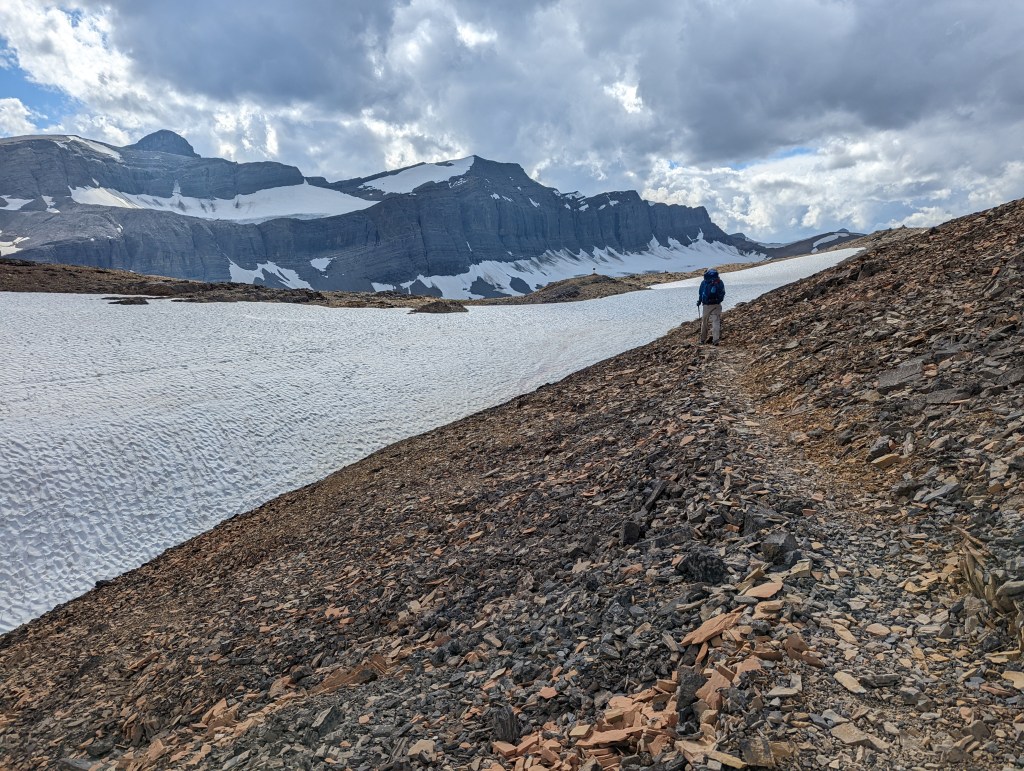
The pass is still higher and several kilometers further on. But now it is easy walking along the side of the peak. We pass to the right of an astounding cornice perhaps 50 meters tall. Finally we reach the true pass at a trail register: we made it through the Whitegoat. The afternoon has passed into evening, and the golden light fills the upper Brazeau Valley below us. Dark lakes head the valley, sending out a dazzling ribbon of water to meander through shale and shrubs.
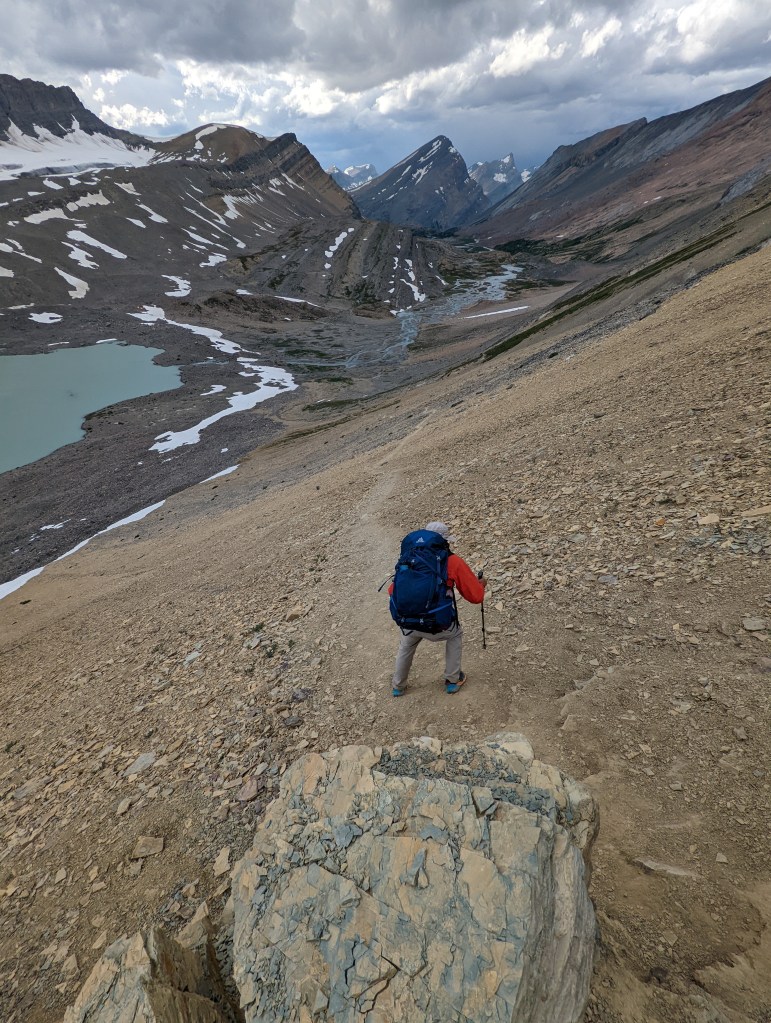
The descent is very steep and loose again, but there is a definite trail that switchbacks down the slope. We take shelter behind a boulder halfway down and rest. Our knees are complaining now, leg muscles spent. Sabrina is flagging, but this valley is energizing me. Maybe it’s the beauty of the milky blue river cutting through green plants and red rocks, or maybe it’s the feeling of safety from being back in Jasper.
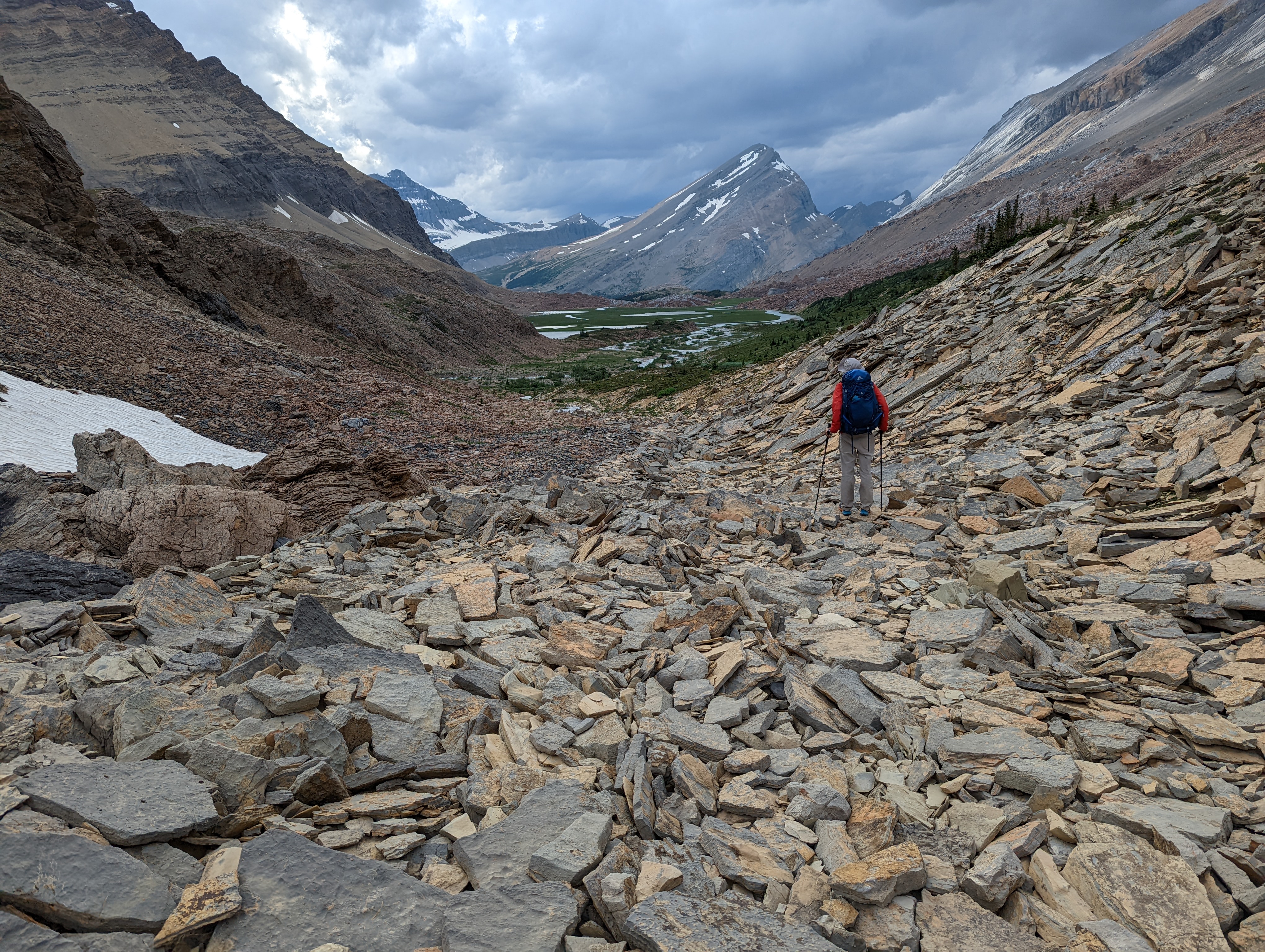
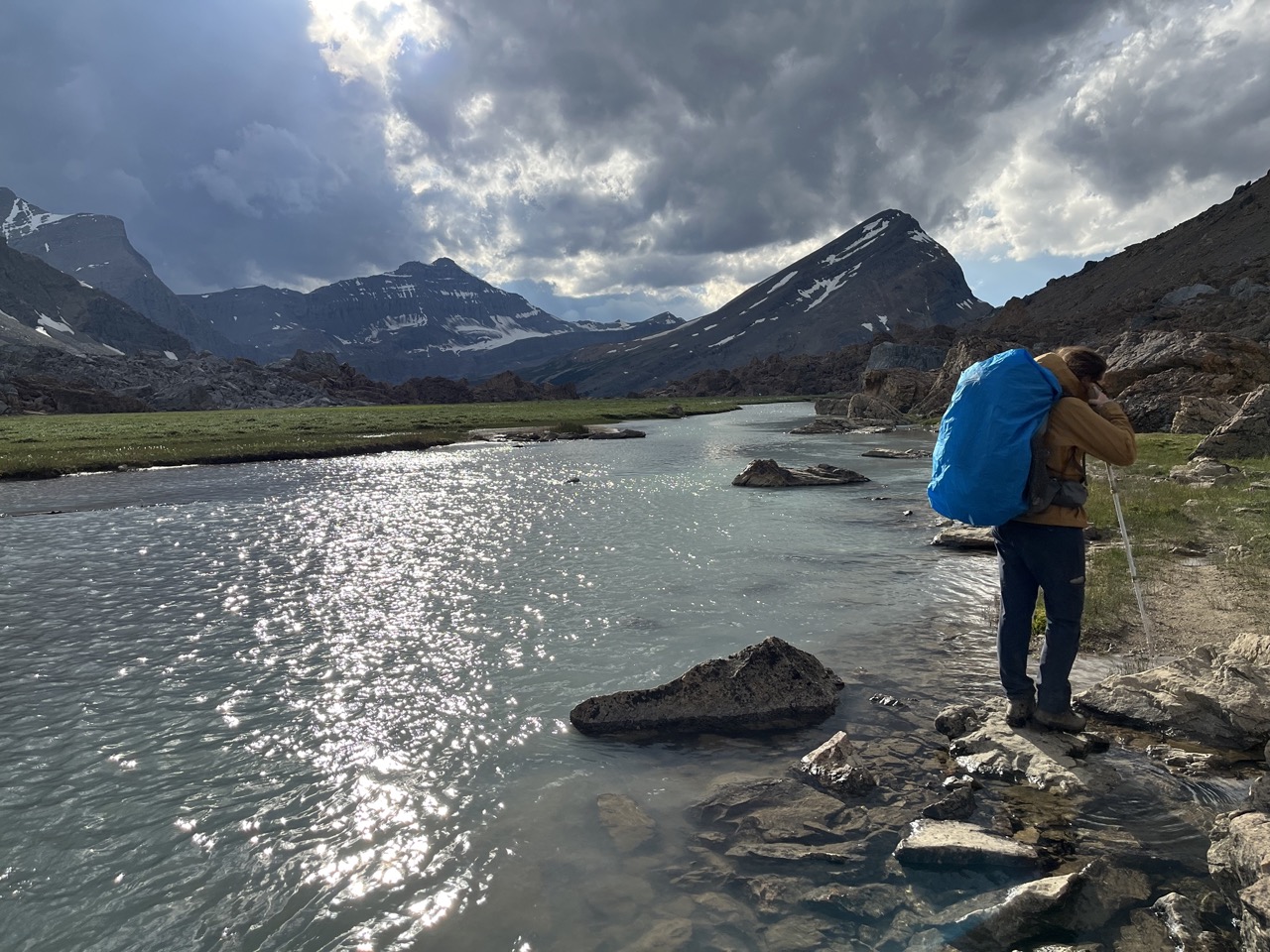
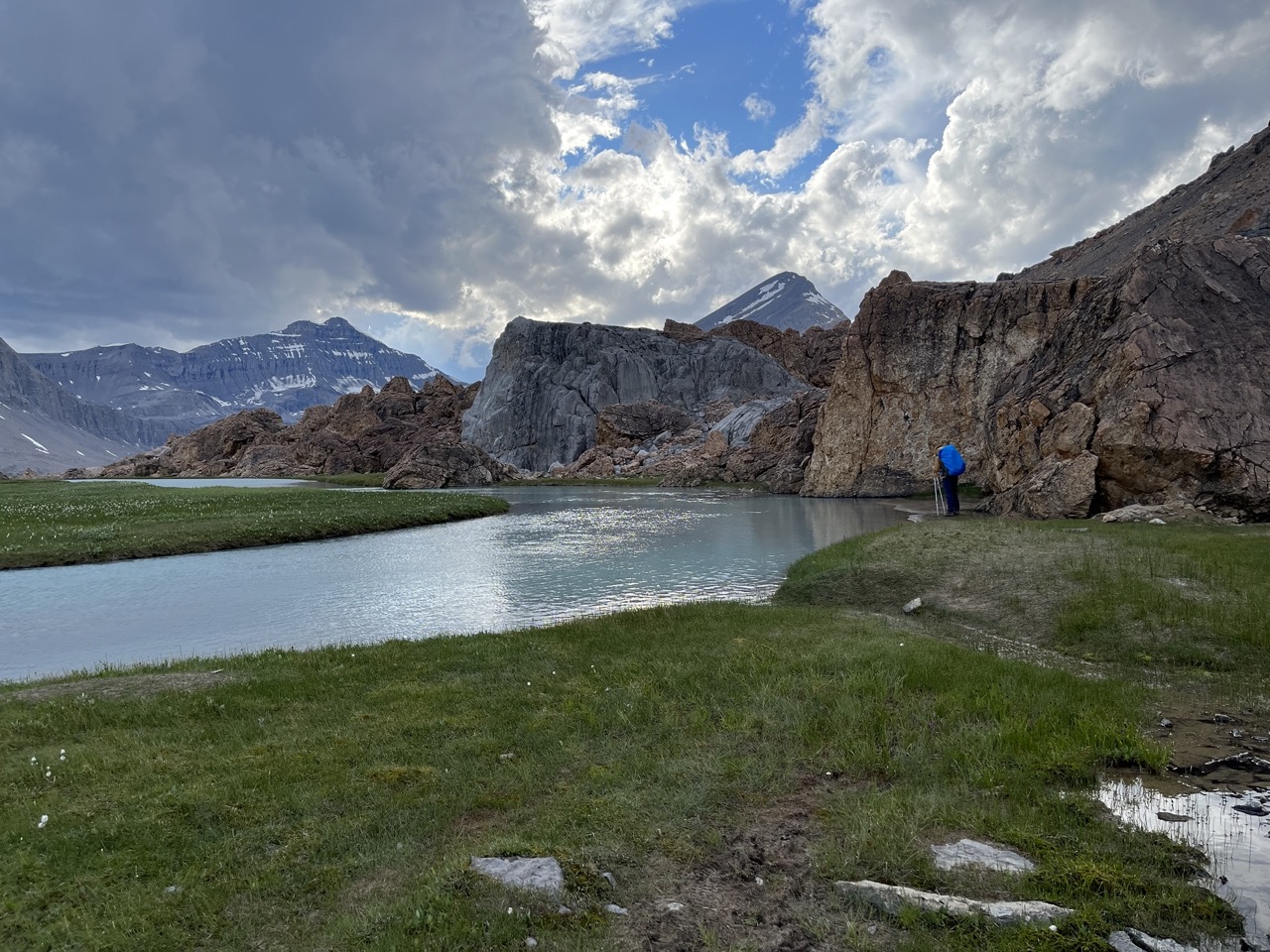
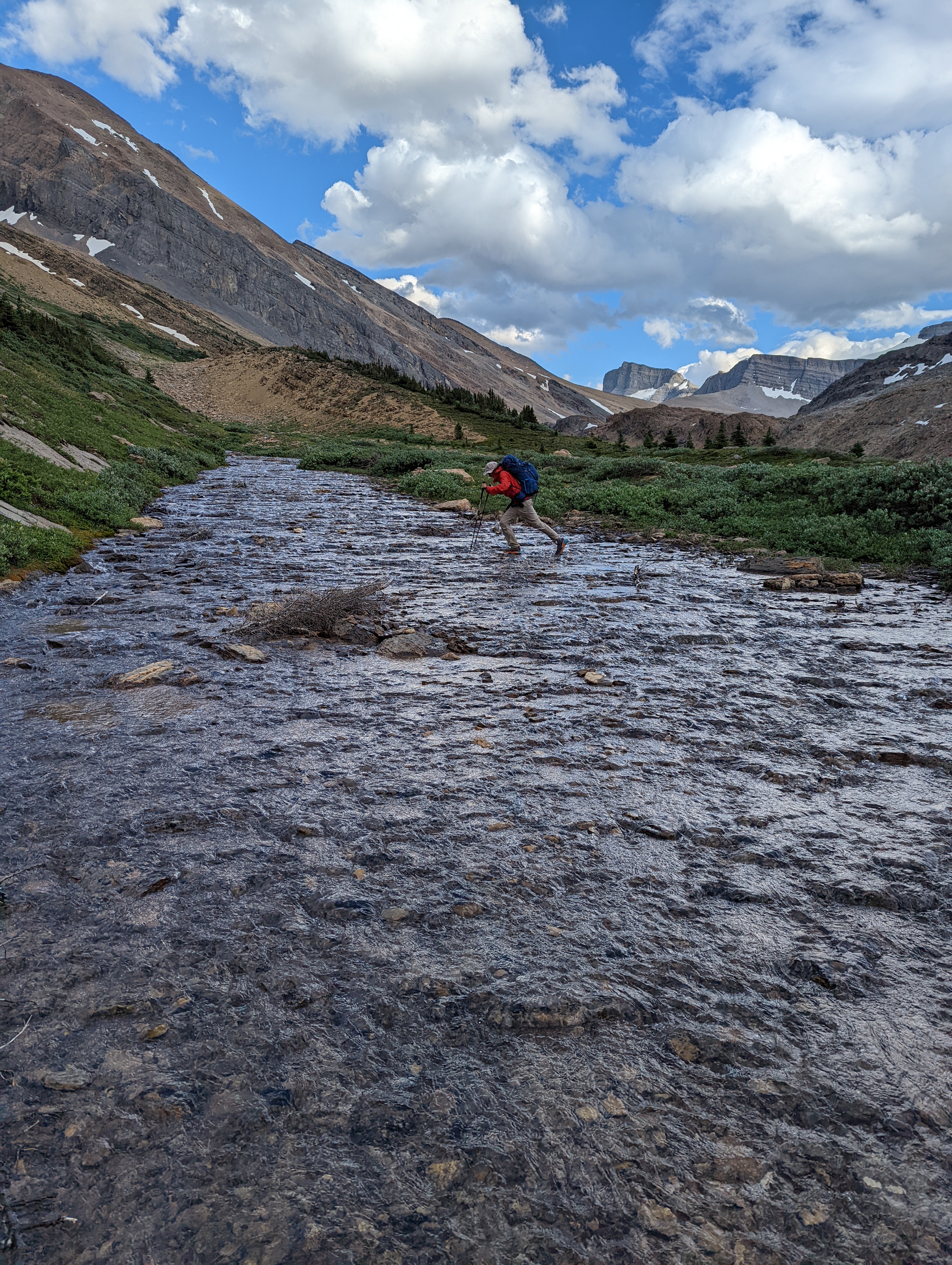
We reach the valley floor and pick our way through flooded patches of ground, around boulders the size of houses, and up and down small moraines. I keep telling Sabrina that we just have this short valley and then we’ll be back on the Brazeau trail. We can make it. She is dragging even on flat ground. The long summer evening is waning. I find a nice flat rock and call a rest. We try to eat yet another Cliff Bar for energy. We wearily stand up and walk on. We pass two people who are standing, admiring the fantastic colours of the valley. They have pitched their tent up there. I consider it. But tomorrow is already a very long day, and we have a campsite booked not too much further.
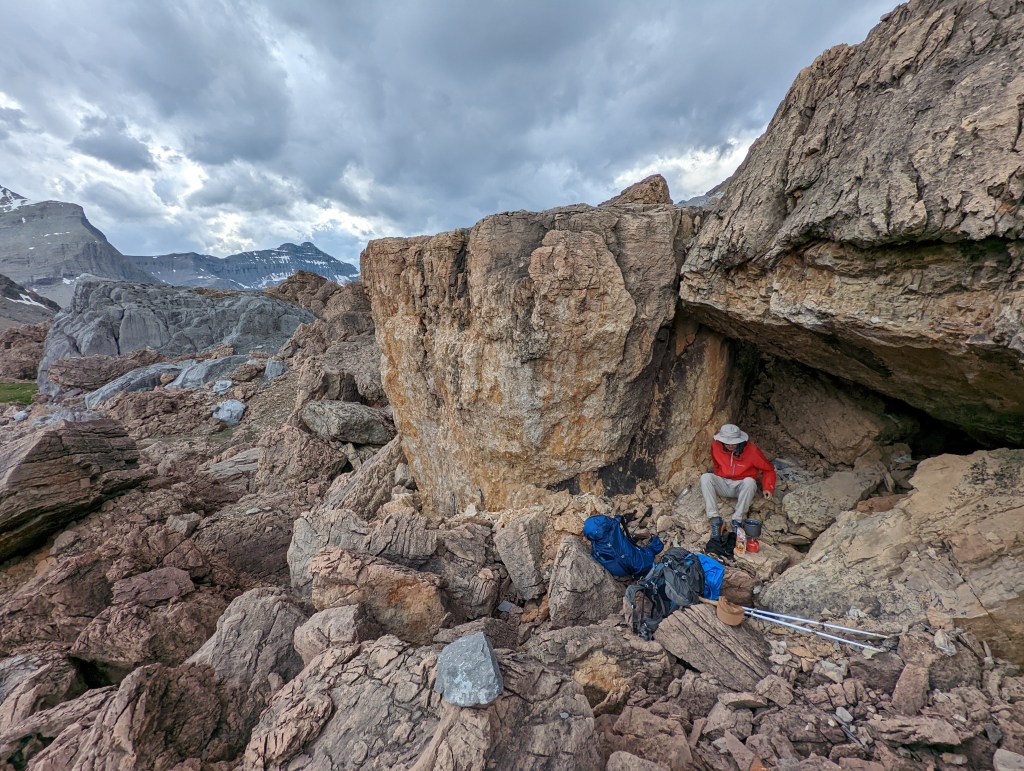
We can see the edge of the valley now. There is just one more obstacle. A boulder field. We have to scramble over massive blocks, red as the setting sun. I scout ahead, trying to find the easiest way through for Sabrina. We see a cave at the back of the boulder field, and we have the idea of cooking our supper here. It’s pleasant at the moment. Warm and no bugs. We badly need to rest. We have enough water. I agree. I take off my shoes to try to let my feet dry out. The bottoms are translucent-white and tender from stomping on the wrinkles all day. We are stopped for only 15 minutes, but it is enough. We pour the boiling water into the freeze dried meal bags, carefully seal them, put them in a grocery bag, and let them cook as we walk on.
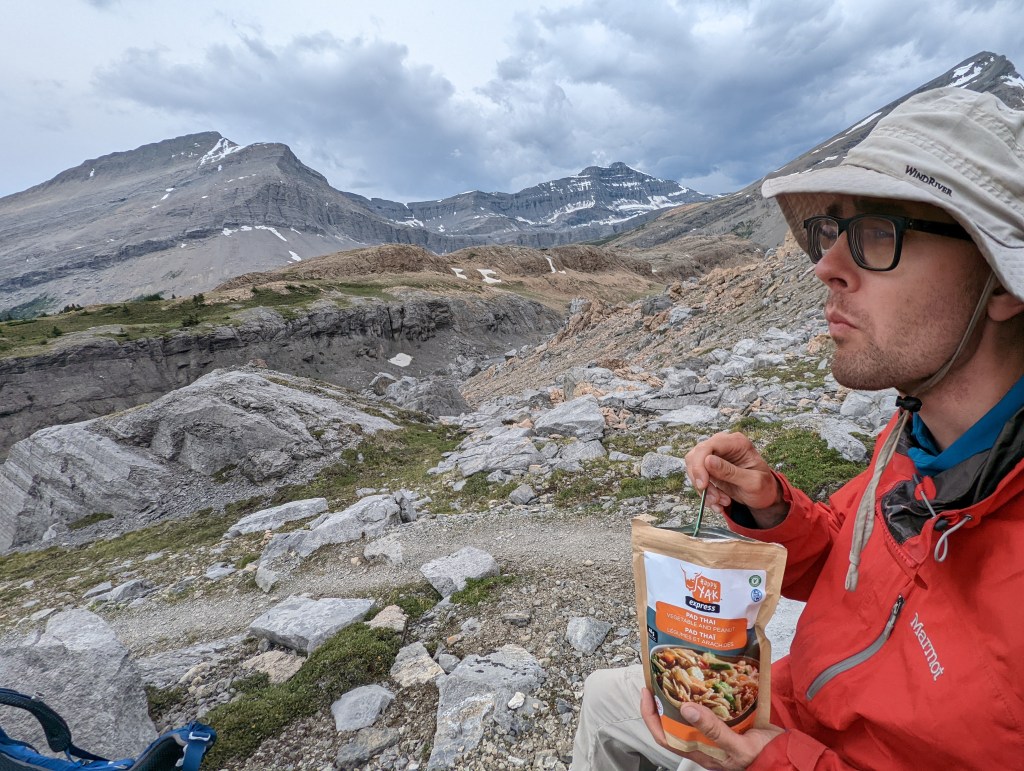
Now we are descending on easy trail, following the Brazeau River down. The first meal is ready, a delicious pad thai that warms and refules us. It’s 8pm, and an iron gray sky roofs the dimming valley. We walk on, and soon our second meal is ready. When we finish that we’re somewhat restored. Our feet, knees and shoulders still hurt, but we know we can make it to camp and won’t have any camp chores to do before bed.
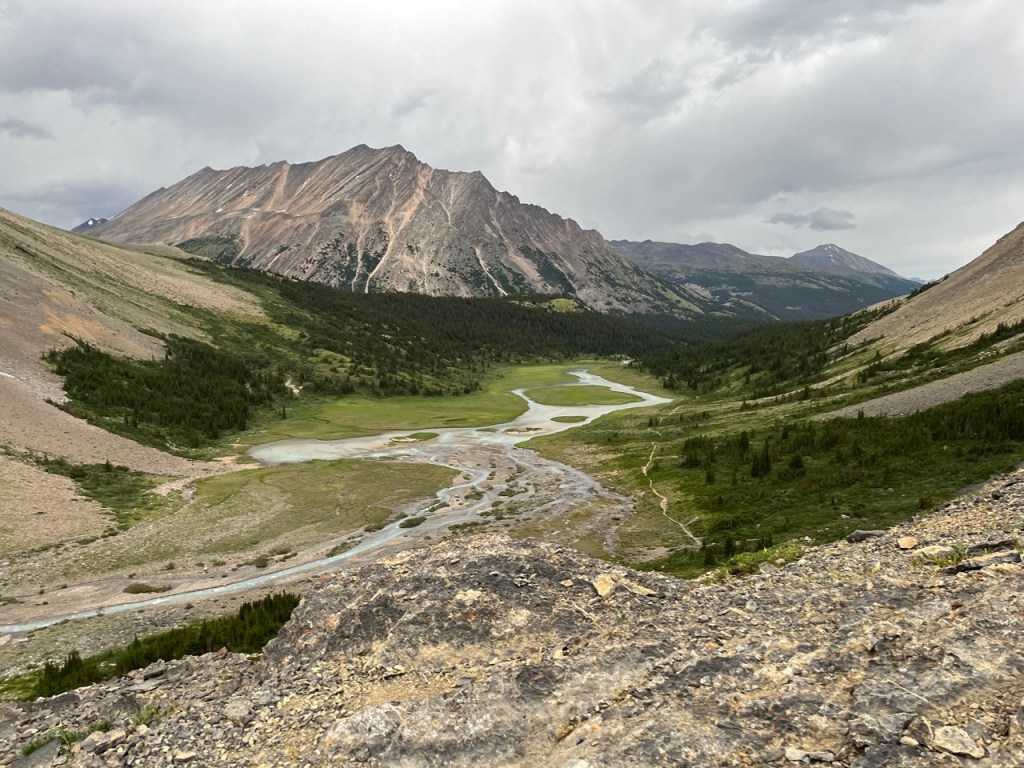
We re-enter forest and meadow and call our Hey-o’s with our last energy. We reach Boulder Creek camp with the last light, and discover that not only are all the tent pads occupied, but several more tents are pitched on other flat pieces of ground. We’re irate. We’ve been hiking for 14 hours, completely exhausted, emotionally spent, and someone has poached our reserved tent pad. Right on cue, the rain starts. I unceremoniously shove someone else’s food to the side of one bear locker and stuff our Ursacks in. I go for water while Sabrina tries to find a reasonable place to pitch our tent. The only option is almost right on the trail. We can’t be picky. We crawl inside and exhale.
We had expected today to be hard, and it was. It pushed us far outside our comfort zone. I am so proud. Our soreness made it harder to fall asleep, but we did eventually. We needed it. Again, to our surprise, our bodies are not destroyed in the morning. The only sign of injury is a blister on Sabrina’s heel. Our attitudes towards our fellow campers have mellowed to mild indignation and we are able to exchange a civil word with an older woman, the only other person awake when we leave.
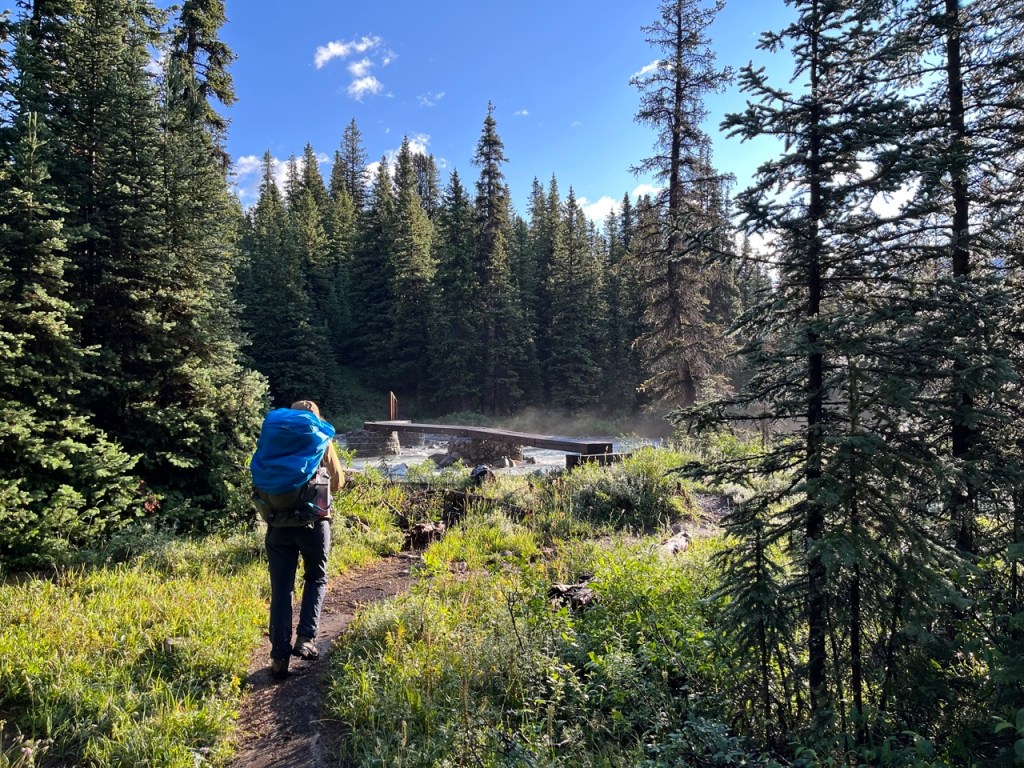
The morning glints off every blade of grass, and each leaf is a vessel of water delicately balanced and ready to spill. A willow field drenches Sabrina’s pants so much that water starts to run into her boots. We stop to put on rain pants but the damage is done. As we climb through rustling aspen stands, the wet tape shifts on her heel blisters. We stop again to retape them. They rub anyway.
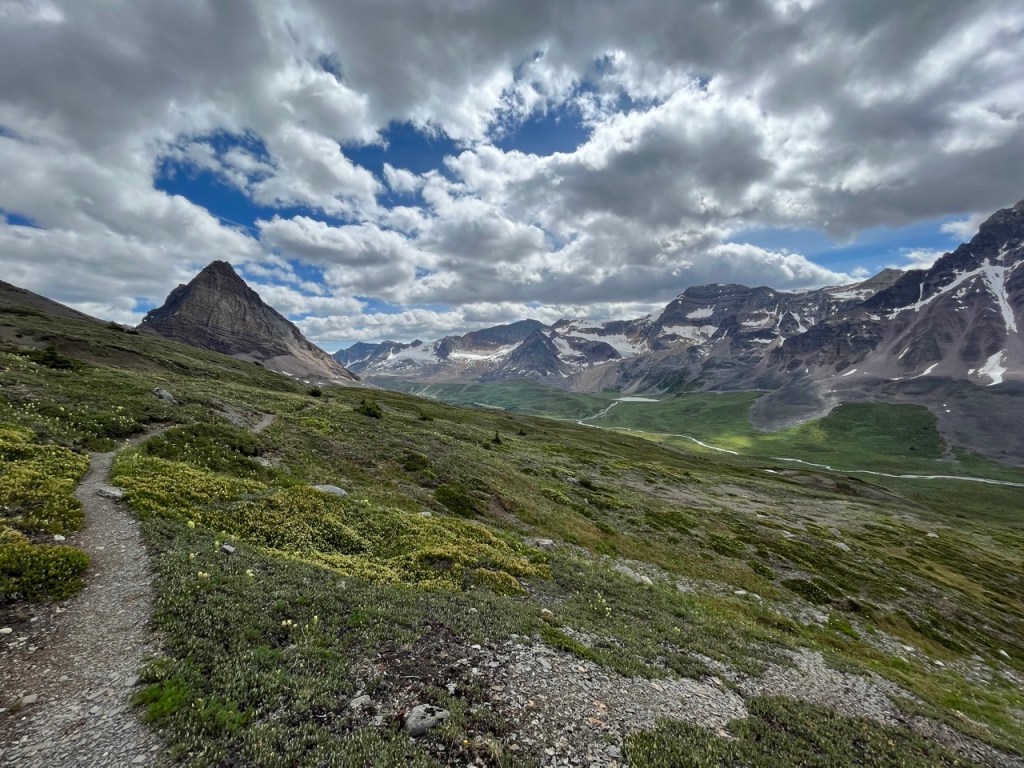
Now we are in the alpine on a steady march to a mellow pass. We spread out our wet tent and socks on rocks and rest. My feet have pruned up and become tender again but the cooler temperatures are not drying my shoes as quickly as on the first days. We reach the pass, a subtle fulcrum that splits the valley.
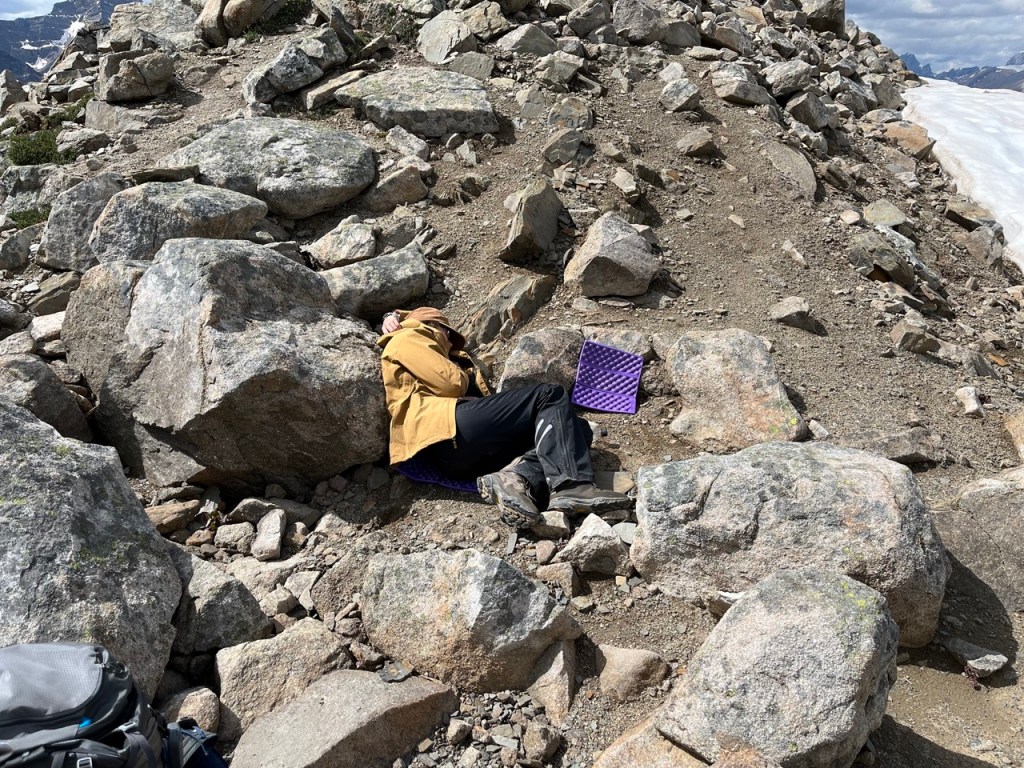
We trend to the right and start to angle up to a low point in the valley wall called Jonas Shoulder. It is steeper and Sabrina is wearying mentally from her blister pain. We count our steps. We will do 50 more. Then 50 more. Just 60 left now. Just 30. Sabrina unclips her pack and flops down. I ask if she has water. Yes. I find a seat and take my own rest. After a while she sits up and admits she didn’t have water. She had just answered unthinkingly.
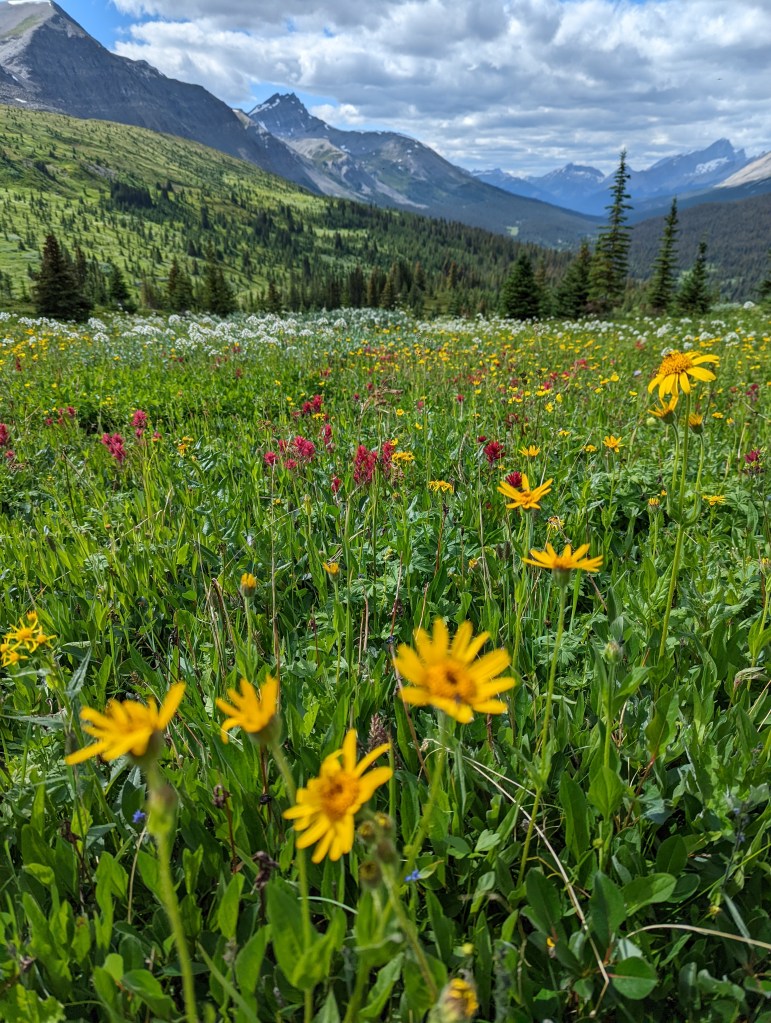
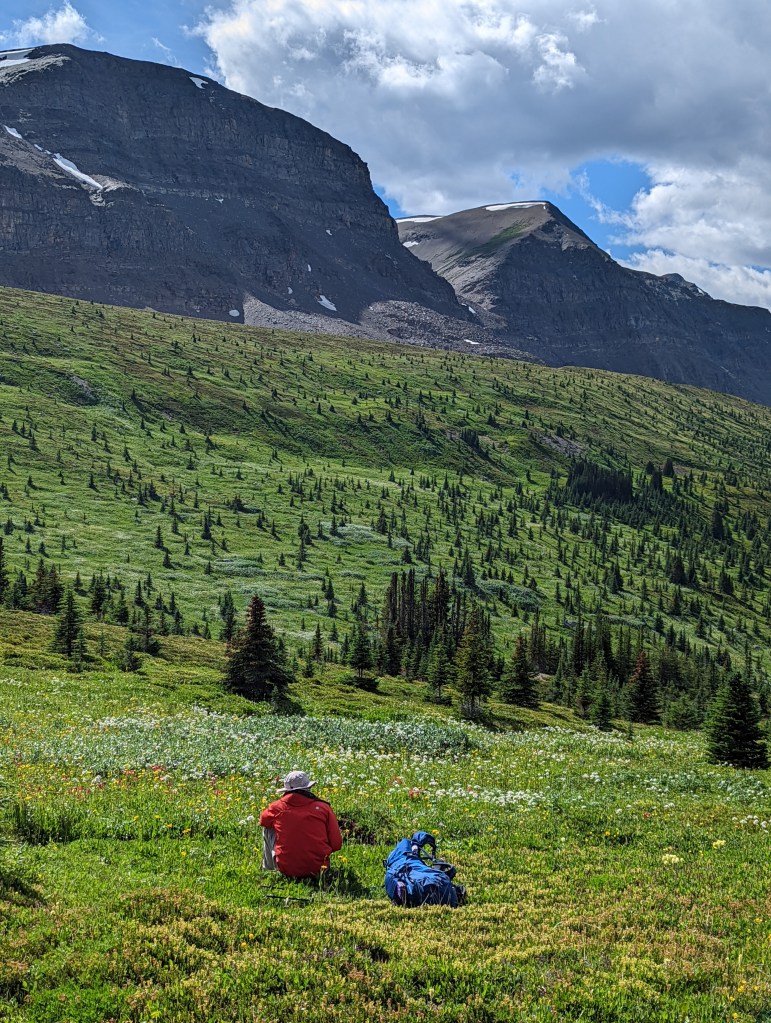
The way down the other side is much better. Sabrina’s heels don’t rub. The meadow below is an acre of extravagant, riotous wildflowers. Stalks loaded with tiny white, lavender, pale yellow, and blood red petals sway like a vast liquid rainbow. It is late afternoon and there is still well over ten kilometers to our camp, but it is a gentle downhill on wide trail and we are feeling optimistic.
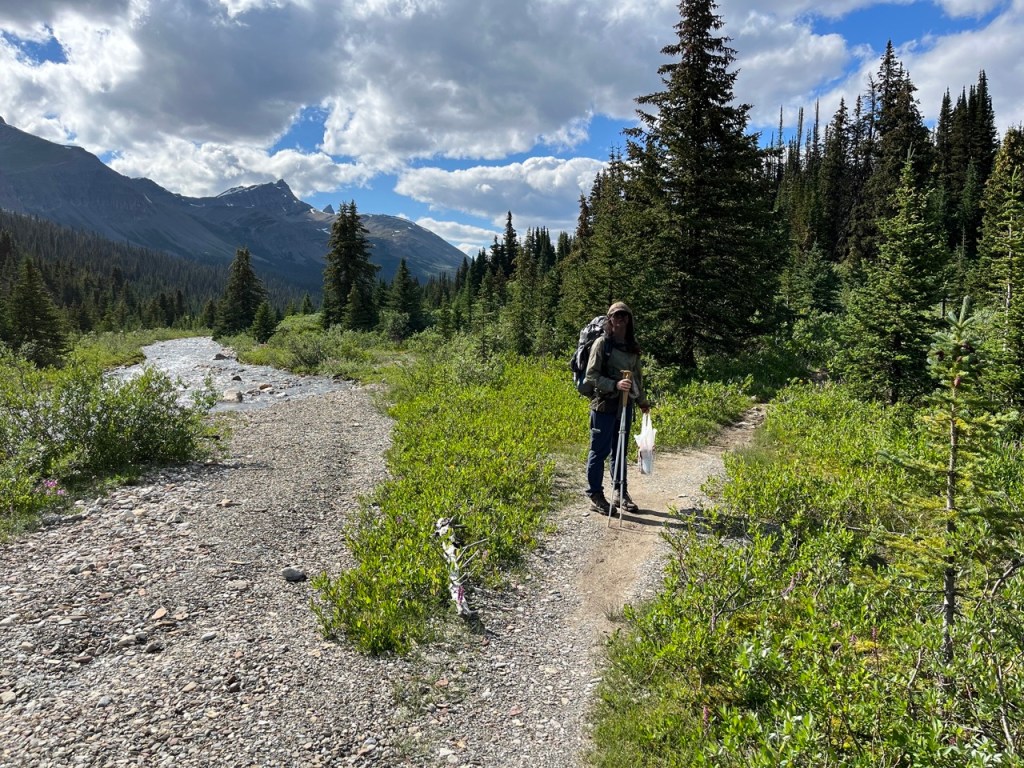
We reach a campground we have stayed at before and stop to cook our supper. It is warm and pleasant beside a thundering creek but we once again put our meals in a shopping bag and walk on while they cook, stopping twice to wolf them down as they are ready.
Although the overall trend is downward, there are many gullies for us to climb in and out of, which slows us down and saps our last energy. We realize my pre-trip addition somehow missed five kilometers for this day, and our final distance will be almost 35 kilometers,the farthest we’ve ever hiked in a day.
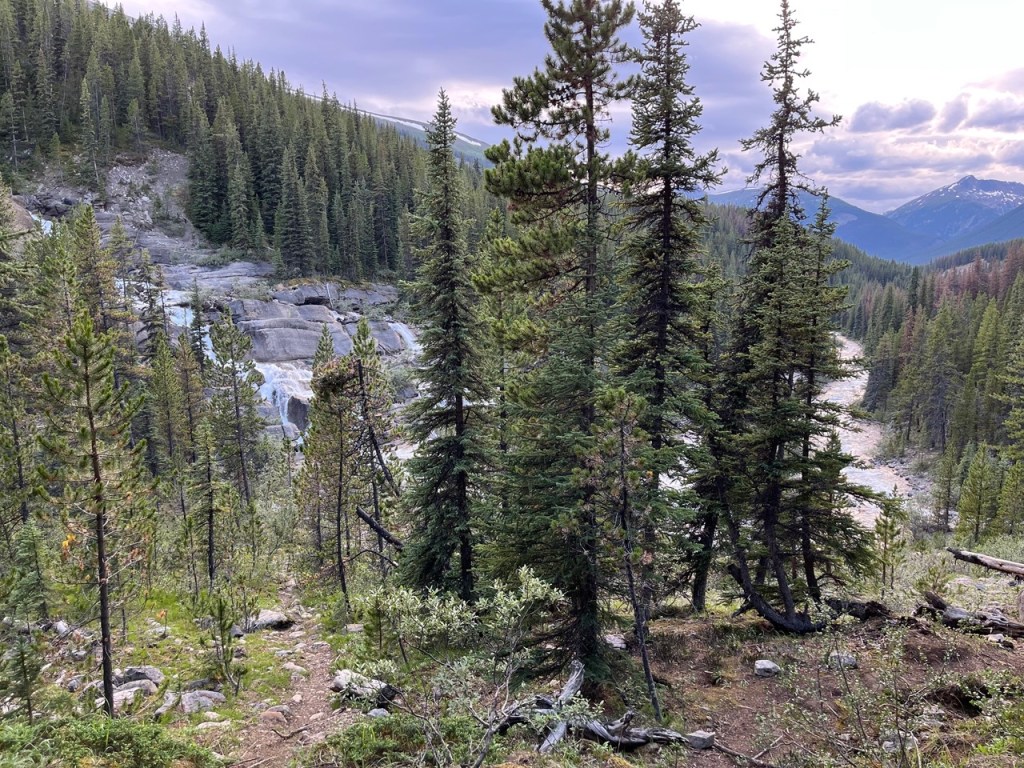
When we arrive at camp it is evening, 12 hours since we left camp this morning. The food area overlooks an outstanding waterfall. As the evening light fades I sit on a picnic table, stretching, listening to the crashing water, thinking about the next two days.
Tomorrow we will leave the well-trod Brazeau and Poboktan and enter the Maligne Valley. Decades ago, in a belated attempt to save the Maligne caribou herd, the park decommissioned the trail. They only let one party through per day, guaranteeing that we will be alone. They let the forest gradually reclaim the trail and campgrounds. And they removed the bridge over the Maligne River.
We’ve talked about the river. How we will get there first thing in the morning when the water should be at its lowest. How another hiker reported bushwacking for kilometers upstream to find a way across because they had arrived too early in the year. Or if we reach the river and we don’t believe we can cross, we could simply turn back and take the Poboktan exit to the highway.
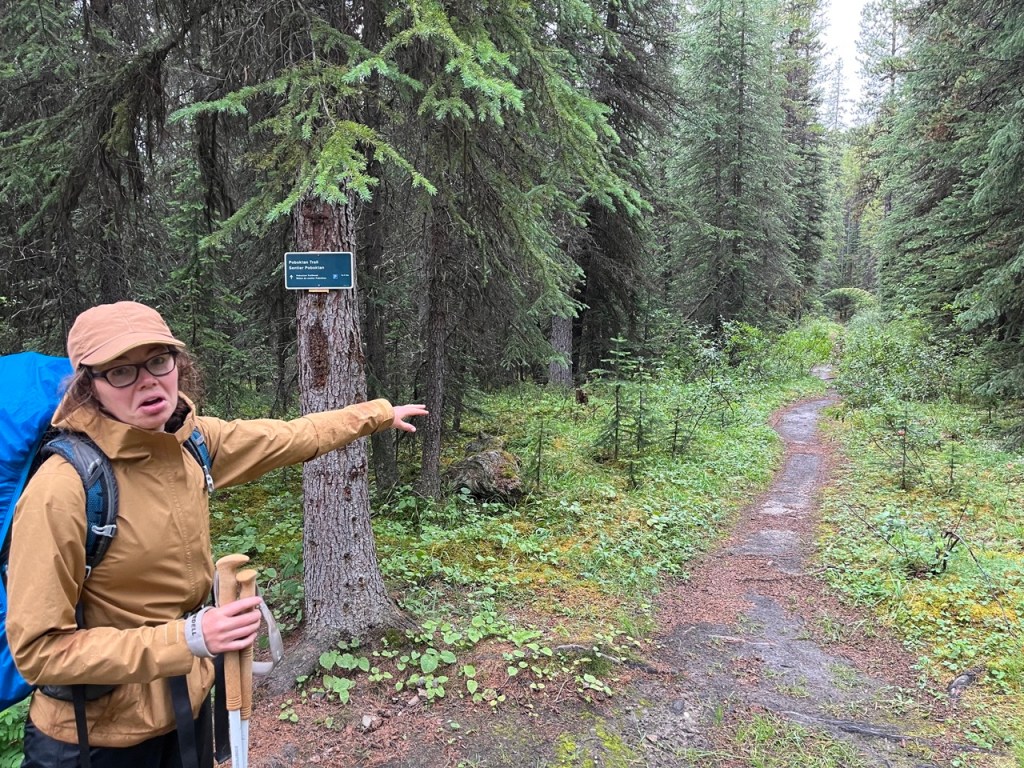
The next morning I think our packs finally feel significantly lighter. We set off downhill and make good time to the Poboktan junction. We are just six kilometers from the highway. We turn our backs to the east way and continue north. Almost immediately, it starts to rain. A cold steady drizzle sets in and our hearts are sodden. There is now the occasional fallen log to climb over or under.
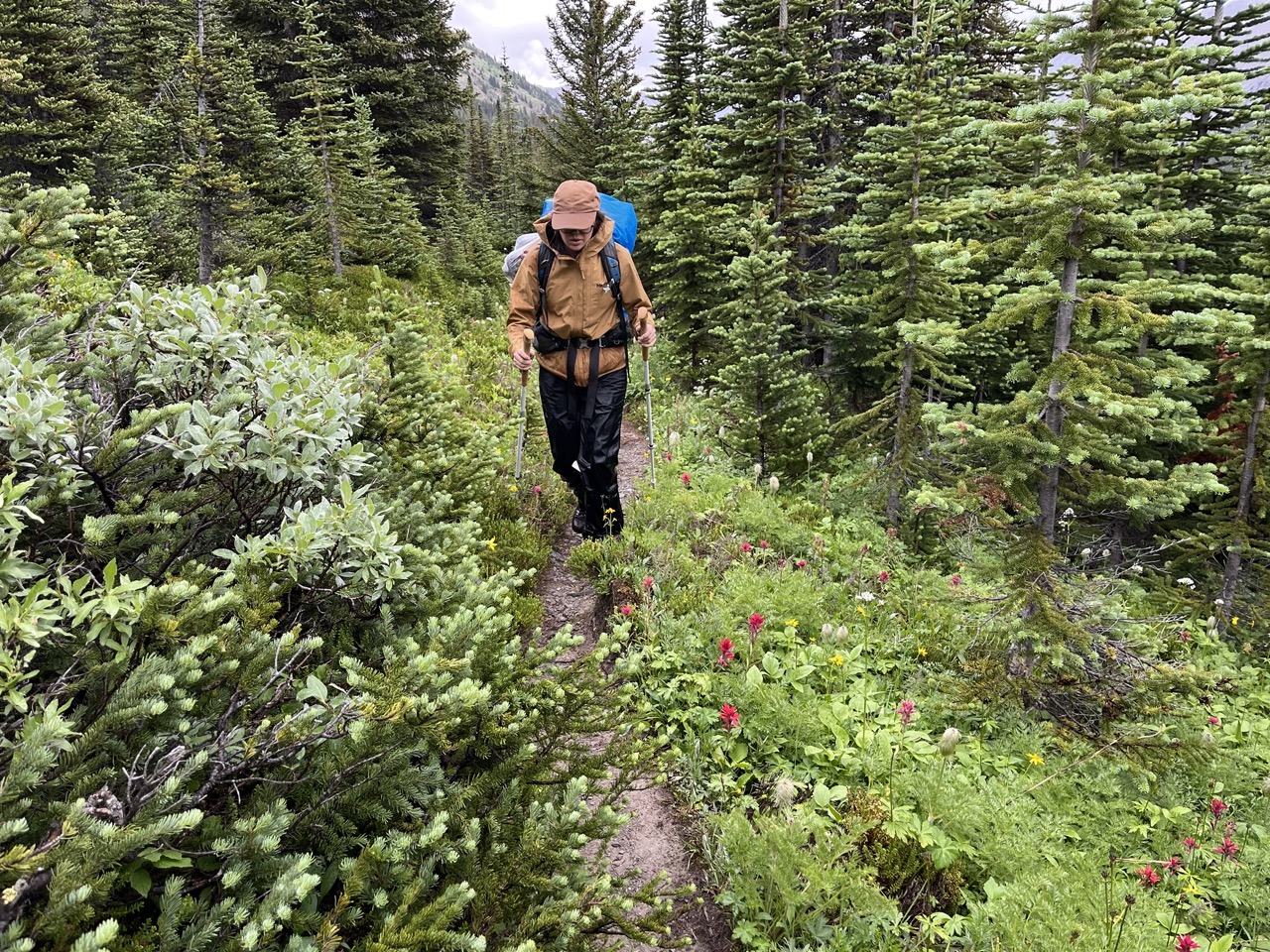
We are climbing and though she doesn’t complain I suspect Sabrina’s blisters are wearing at her. We look at the forest path from under our hoods, our world shrunk to the next 5 meters. We continue beyond Avalanche campground, beyond the last Parks maintenance.
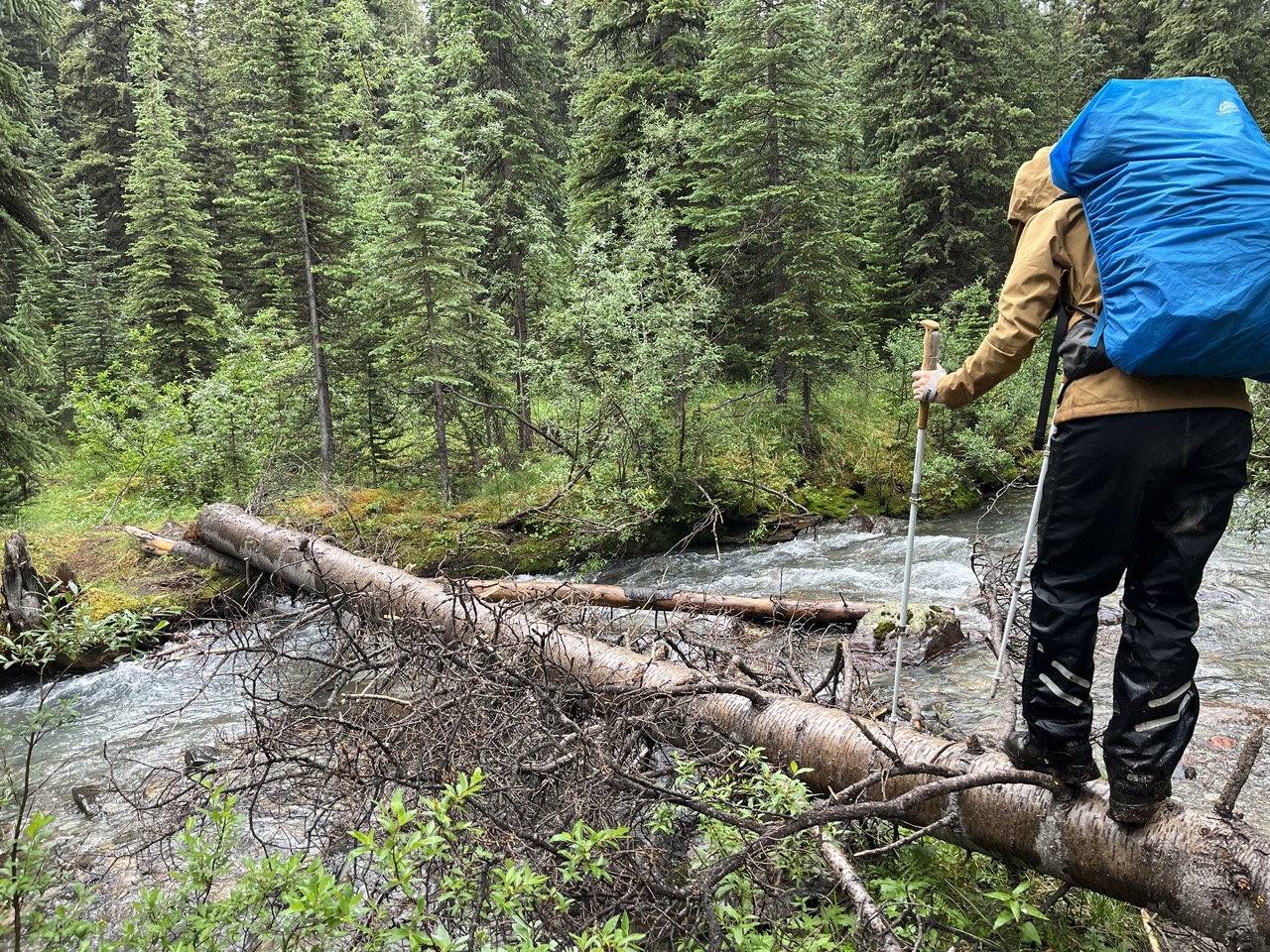
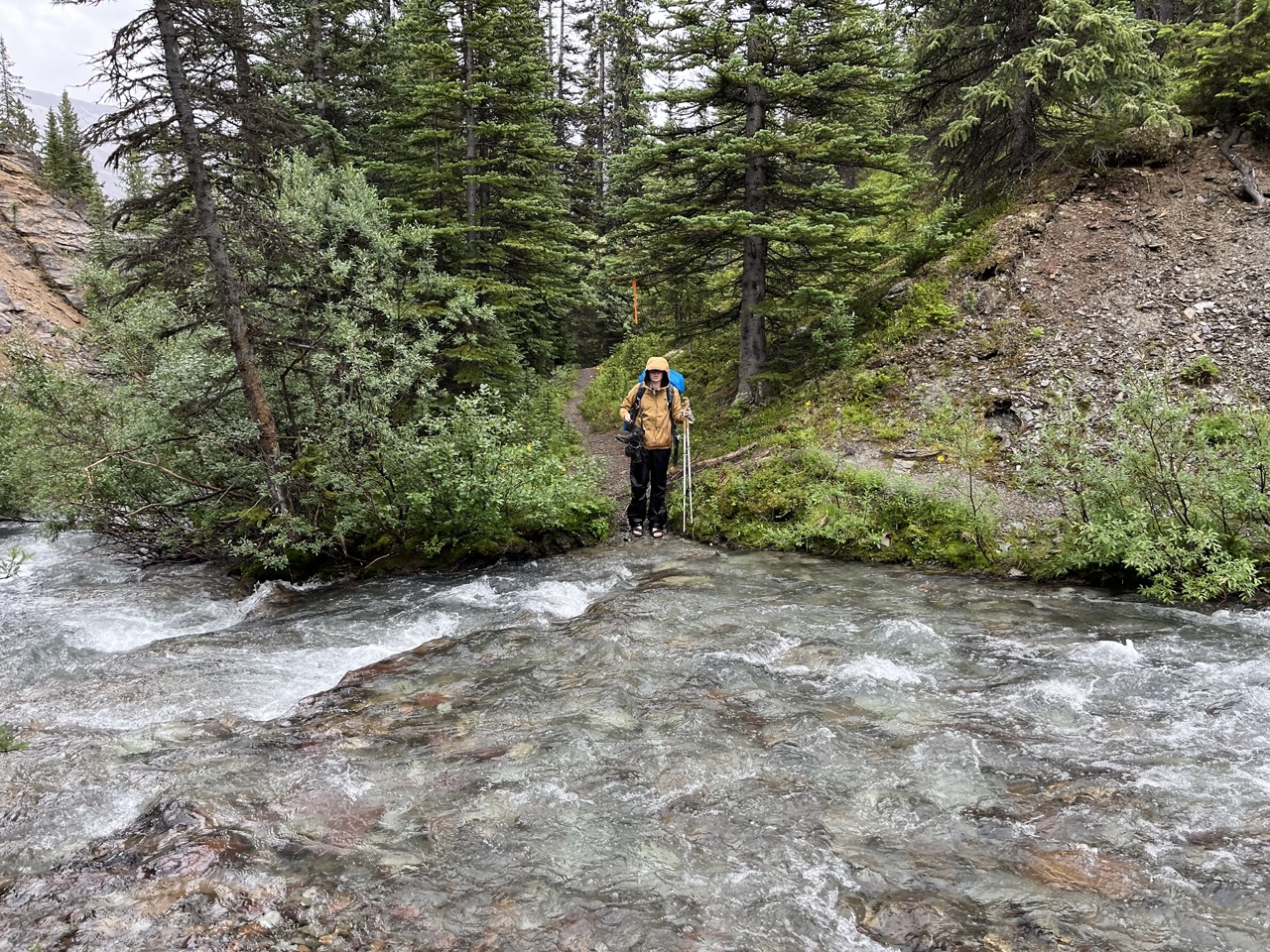
We reach a creek with a half-log bridge, its center sagging into the rushing creek. We inch across. The next bridge is gone, but we can crawl across a fallen tree. The next creek has nothing. We scramble along a high loose bank trying to find a tree that isn’t there. Sabrina takes off her boots and crosses. We try to dry her feet with a small pack towel but it’s futile in the rain. We hit another creek with a log bridge bent down under the swollen current. We both slip trying to cross on its slimy surface, but Sabrina somehow keeps the water out of her boots.
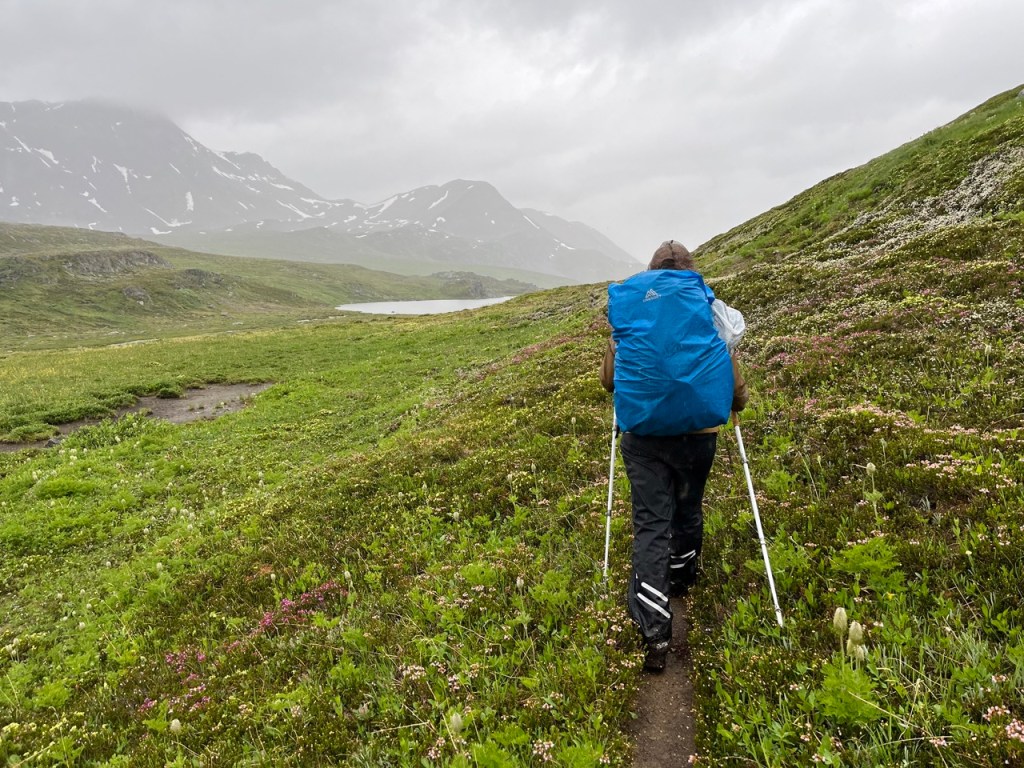
The trail is steep and narrow now. We push through cold wet branches. We know we’re getting closer to the pass from the shrunken trees. We rest and eat, hands white and pruned. Alpine flowers sprinkle colour on the greyness of our mood.
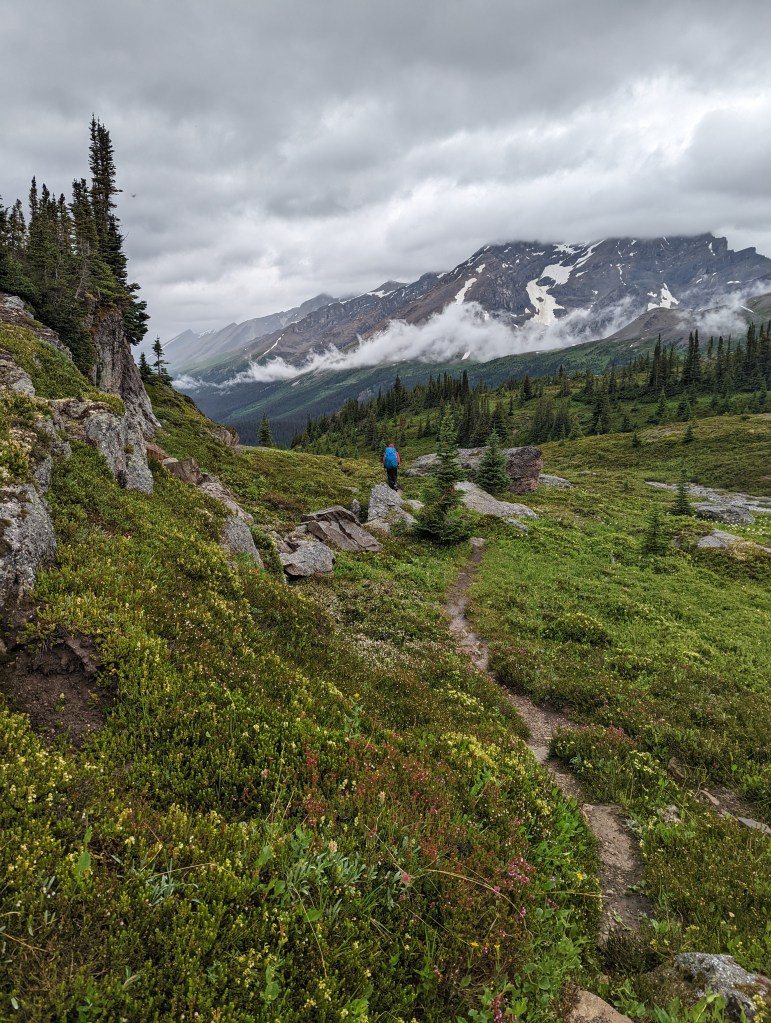
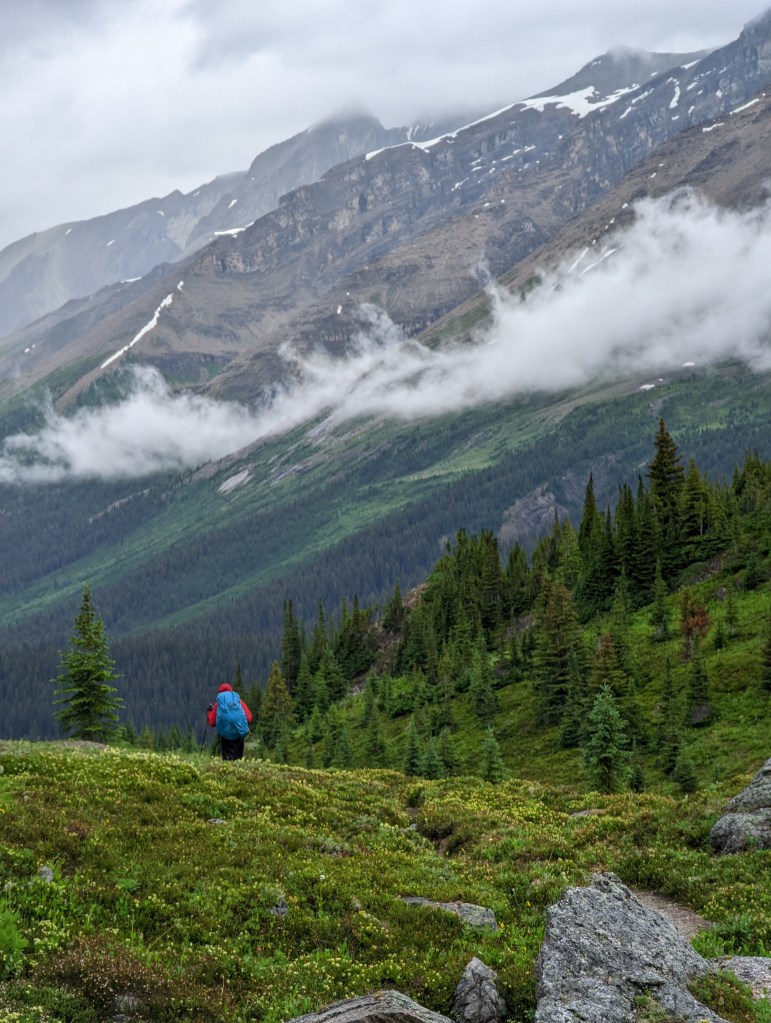
We emerge from the trees on a broad green plateau. Peaks loom in and out of view behind the drifting rain and mist. An aluminum-grey lake crowns the pass. We collect water but I start shivering so we hasten our descent into the lonely hushed valley.
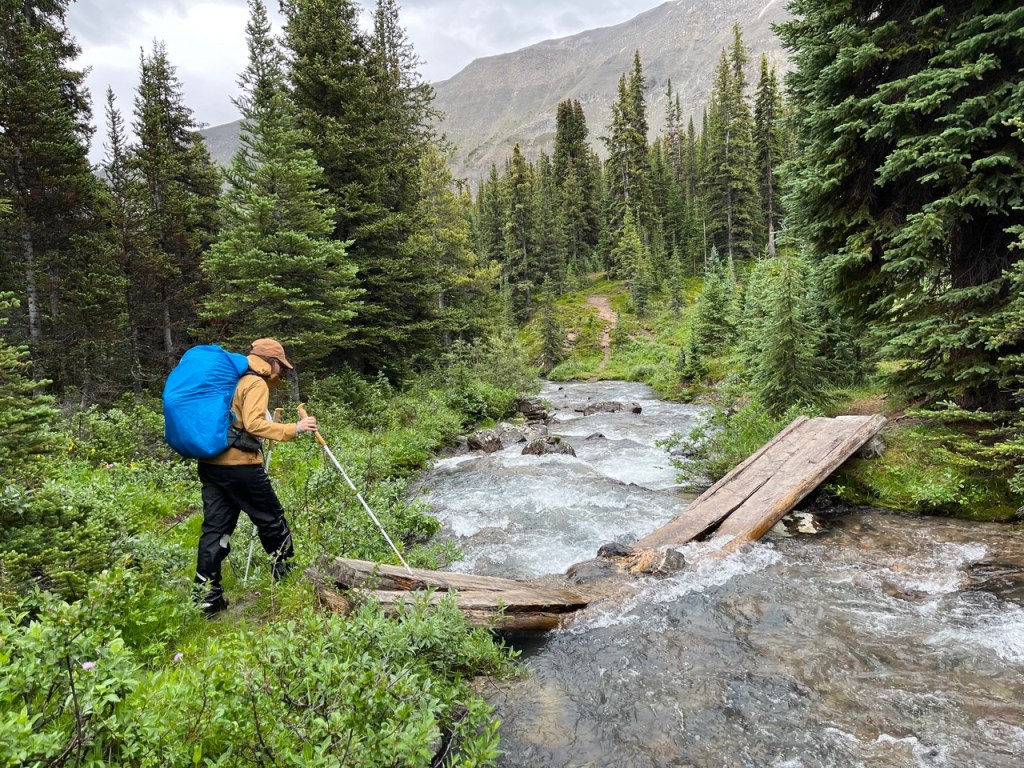
The procession of sad, submerged bridges continues. We avoid them and rock hop where we can. Sabrina takes off her boots when we can’t. We pass two derelict campgrounds, places of patient decay. Though it is mid afternoon in August, the cold and the mosquitoes drive us on. Then we hit our first real willow field: waist high and thick so we can’t see our feet. Their stiff springy stems catch at our legs, resisting our efforts and tripping us up. The water held on the leaves makes it feel like wading through a pond. It soaks into our pack straps, and gradually presses its way through our rain gear.
The trail deteriorates. We alternate between deadfall-tangled forest and more willow fields. Both sap our energy. In one willow patch, we get lost. The groove our feet have been following has started meandering back on itself. We retrace it and find where we went wrong.
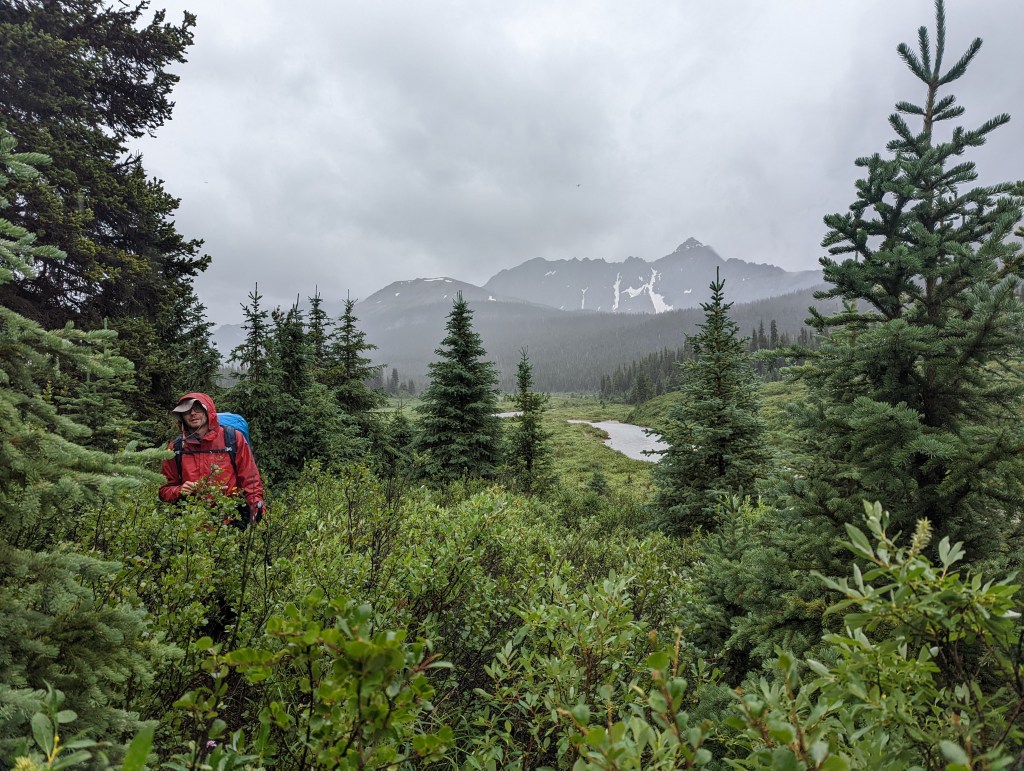
The final two kilometers are brutal. The willows are chest height and now we begin encountering spruce trees blocking the trail. There is nothing to do but force our way through. Our bear callouts have become angry, desperate. As one more sopping wet branch slaps me across the face, I bellow in frustration. Water has run into our sleeves, down our faces and into our rain coats, soaked through our hip belts and into the top of our pants. Our clothes are a clingy damp.
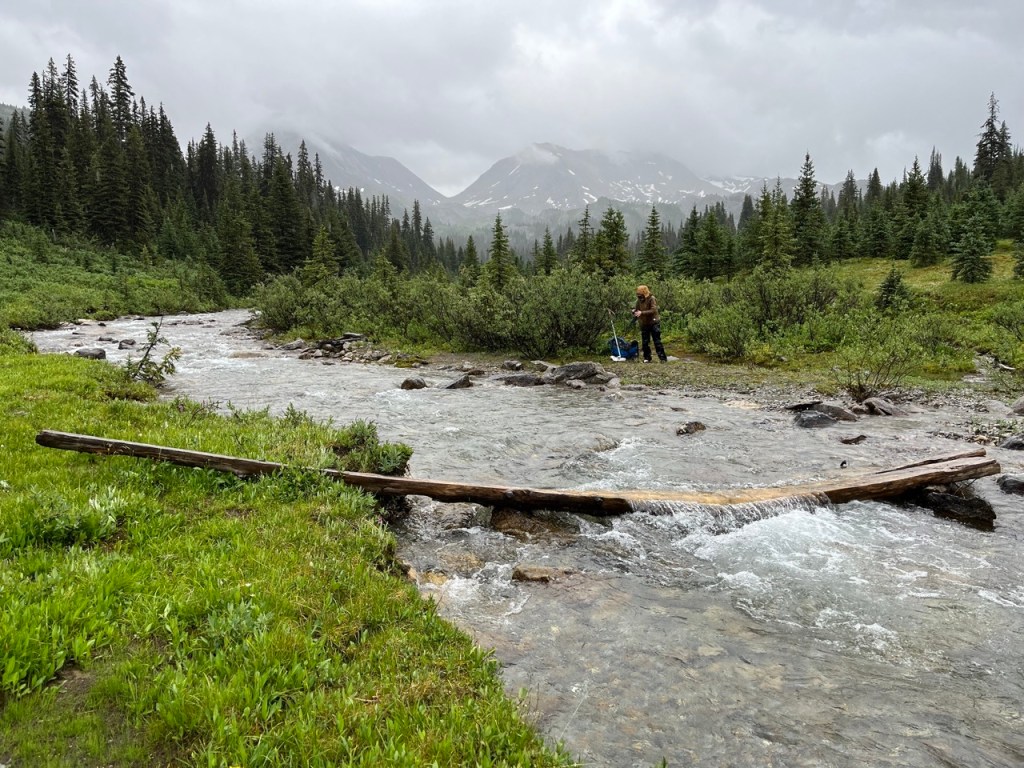
Finally, we reach camp. We understand we are mildly hypothermic. With frozen, fumbling fingers we pitch our tent in a clearing of tall grass, and start cooking our meals. Our teeth chatter against our spoons as we shovel in the steaming food. Still it rains. We climb into our tiny tent, trying to keep our sleeping bags dry. It’s impossible. The damp presses up through the floor, and condensation drips down the inside walls. We call for a weather forecast on our Zoleo. Heavier rain and colder for the next few days. It’s always a borderline survival situation in the backcountry, but today, for the first time this trip, I feel the full vulnerability of our situation. And still there is the river.
As I lie in the tent, listening to the steady pitter of rain, I wonder again if we will make it. If the rain has swollen the river, we are in for the ordeal of going back through those willow fields again. We would probably not make it all the way out to the highway tomorrow. We have the food for it, if we can keep our sleeping gear dry enough. The only really dangerous outcome is attempting the river and it going badly. An injury, or too much water getting into our packs.
We sleep fitfully, the rain increasing and decreasing. At seven it slows to a drip and we hasten to pack up. Our hiking clothes did not even begin to dry. We hold our breath as we put on the near frozen clothes, hoping we will warm them as we walk. Sabrina’s shirt is too wet so she opts to hike only in a sports bra and rain coat.
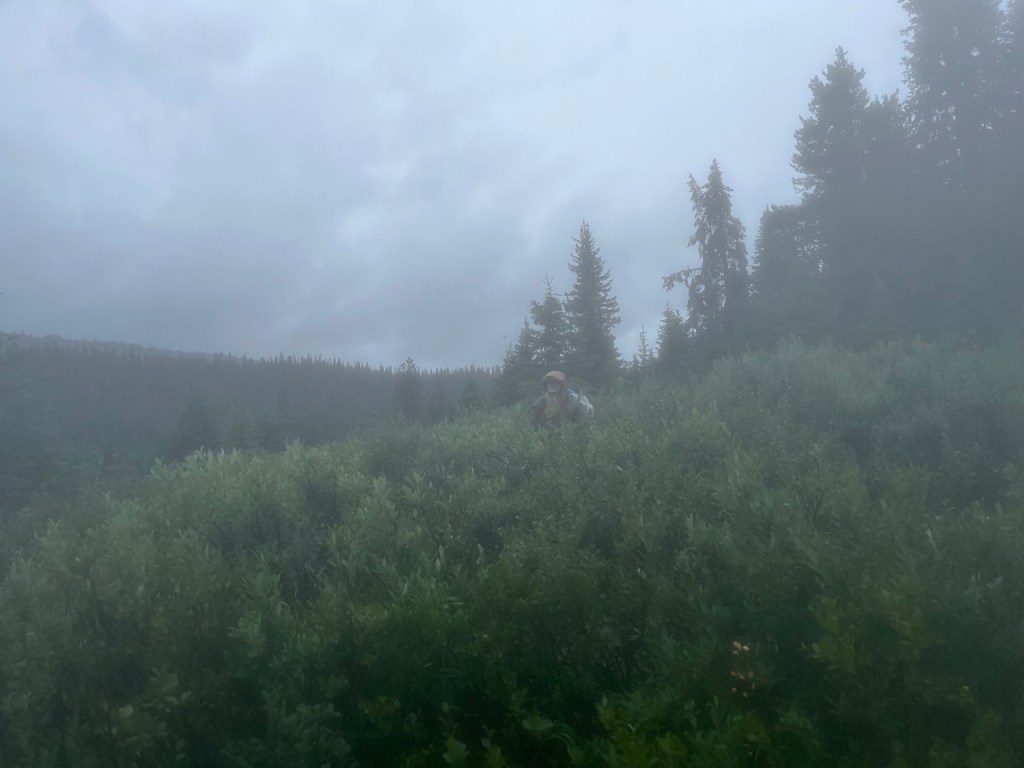
A light rain returns before we finish packing up. It doesn’t matter. The tent is wet inside and out anyway and there will not be a chance to dry it before we finish our hike. Desperate to get warm we start walking. The willows around the camp are thick and we take a couple false trails before we find the right one.
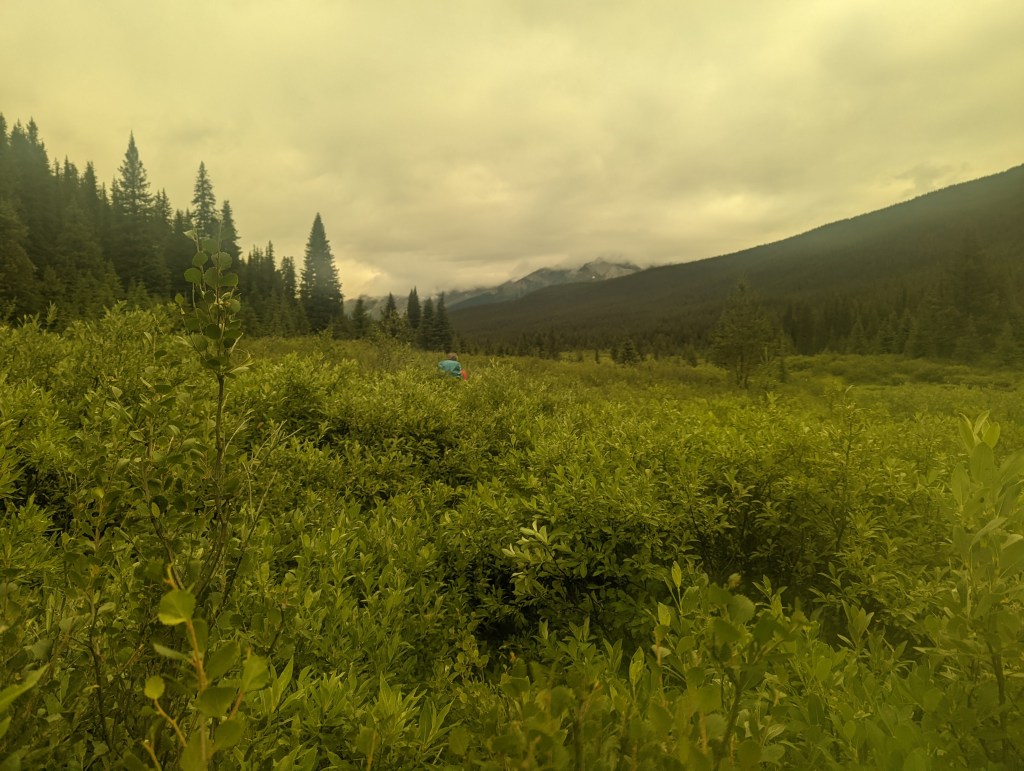
The river is just less than four kilometers from camp, but it is a very overgrown section. I just want to get there and see it, to end the questions and uncertainty. It takes much of the morning and we are just starting to warm up when we find ourselves suddenly on its bank.
It doesn’t look impossible. The dark gray water is moving swiftly. We can only see the bottom for the first couple steps. There is an island closer to our bank. On this island are heaped the remnants of the bridge. We decide to go to the island and see how it looks for the wider crossing after. A few brisk steps and we are standing on the gravel island. It doesn’t look impossible.
I take a few more steps, telling myself that I will turn back if I need to. The other shore feels close. Without thinking about it, I am going for it. It is knee height and powerful. I glimpse large smooth rocks on the river bed and try to keep my balance. I am halfway. My next step plunges deeper, to mid thigh. I brace with my poles. I take a small step with my other leg, the river tugging it downstream forcing my body to turn a little with the current. I take another small step and the rock underfoot slides downstream a little. I feel the cold biting into my legs. I’m not sure. Another step, again I am turned a bit more, leaning hard forward against the current. I’m just a couple meters from safety. Another step, not as deep this time. The force of the water lessens. Step. Step. I wade out, freezing water streaming down my legs.
I look at Sabrina, my face twisted by relief and exaltation mingled with fierce cold. She says it wasn’t even bad. Just knee height for her. Clouds of mosquitoes convince us to talk while we walk.
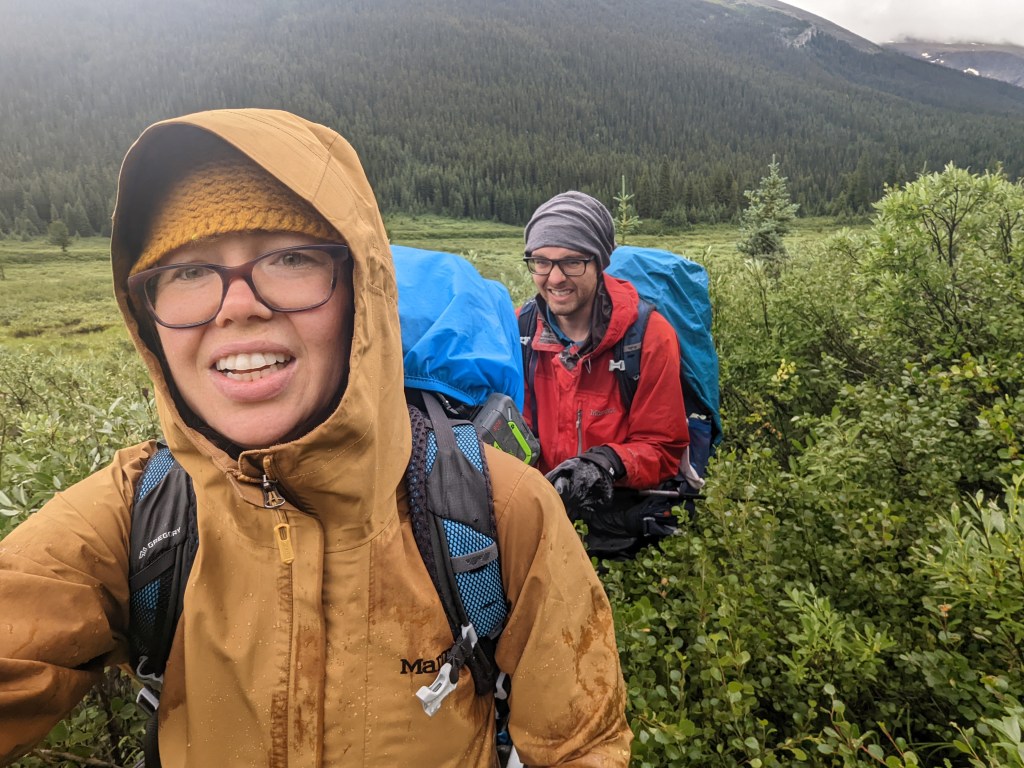
As we alternate between two hundred meter stretches of willow thrashing and deadfall strewn forest, we take stock. Our rain gear and tent have wet through and there will not be a warm afternoon to dry them out. Our sleeping bags are a bit damp but were still warm enough last night. Ahead of us are the last twelve kilometers of the Maligne Valley to Maligne Lake, with its massive parking lots, gift shop, boat launch and waffle house. From there, we are back in very familiar territory: the smooth, well maintained Skyline trail. We’ve both done that trail many times, but never in such a bedraggled state.
We decide not to do it this time. When we stop we shiver uncontrollably. If we could somehow swap our gear for the dry things we started with six days ago, then we might not be greatly at hazard on the Skyline’s high exposed sections even with the foul weather forecast. It wouldn’t be enjoyable hiking but we might be enticed so we can say we have done the whole of Section E in one push.
We use the Zoleo to message our friend, asking her to pick us up at Maligne Lake. Now that the decision is made, any lingering anxiety is gone, but so too is excitement. With the goal now suddenly two days nearer, the fatigue, physical discomfort, and rough trail take up more of my attention. Every pile of logs to climb over feels like a greater nuisance, every branch that flings more water on me is extra aggravating.
We are hiking hard, partly for warmth, partly drawn by the promised comforts of dry clothes and a warm car. Still the kilometers drag on painfully.
And then we hear chainsaws. It is sweeter than any birdsong. We come on a pair of Parks employees. I scream a blessing at them. The four of us are all smiles. One, with an Aussie accent, asks how the river was. Not bad, says Sabrina. Glad you made it across, she says. Thanks again I say. It is all I can say.
We are power hiking now, marveling at the hundreds of cut trees, each pile of sawdust a fresh boost to our gratitude. Soon we reach a campground and another crew, this one fixing a bridge. Again, we sputter our thanks.
We reach a trail junction and have a rare disagreement on which fork to take. I chose one almost at random and soon have to admit it was probably not the fastest way, but it doesn’t matter much. We pass day hikers now, carrying nothing or only a camera, hoping to see moose. Now we are at the lake. Now the path is paved. Now we are at the boat launch and wondering where our friend is parked when a voice calls out our names. It is someone Sabrina knows, an ingeniously helpful person. He has met our friend, understood the situation exactly, and arranged things so that we can’t help but find our ride in the shortest possible time.
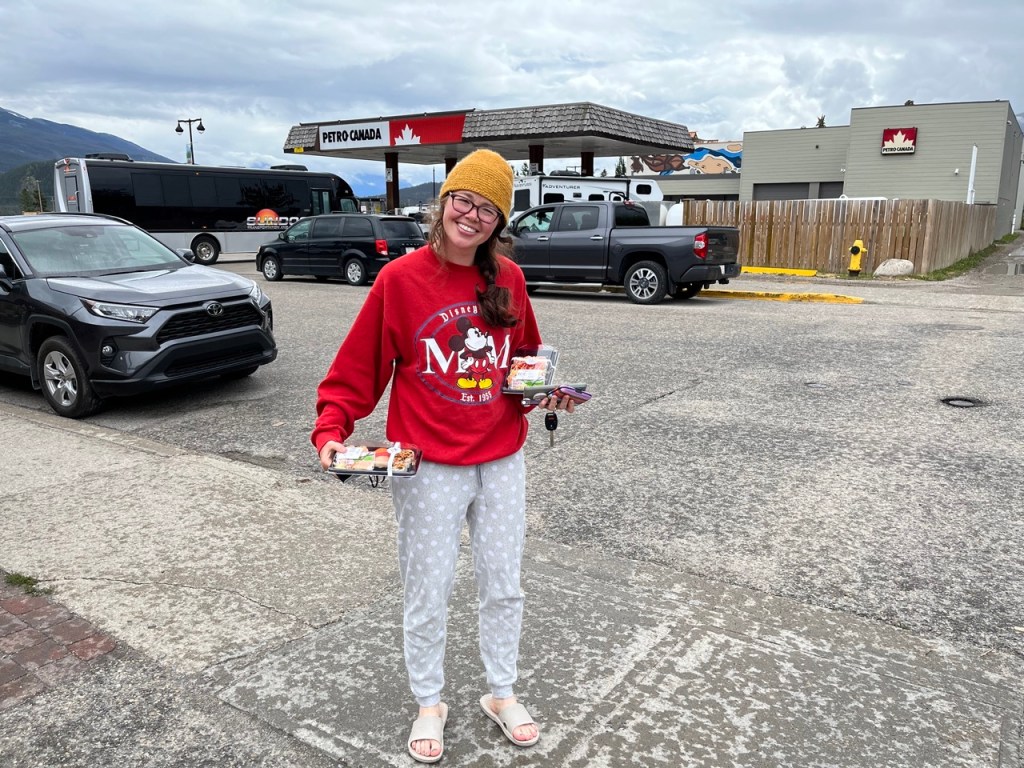
Our friend is ebullient, asking us about our hike, not minding how wet and stinky we are. We’re grateful for such kind people. Back in Jasper we put on warm dry clothes from our own car and decide the first thing to do is eat something fresh. We buy sushi from the grocery and eat it in the car, filled with warm thankfulness, not minding the rain on the roof.


Leave a Reply