Sabriñita. Beño.
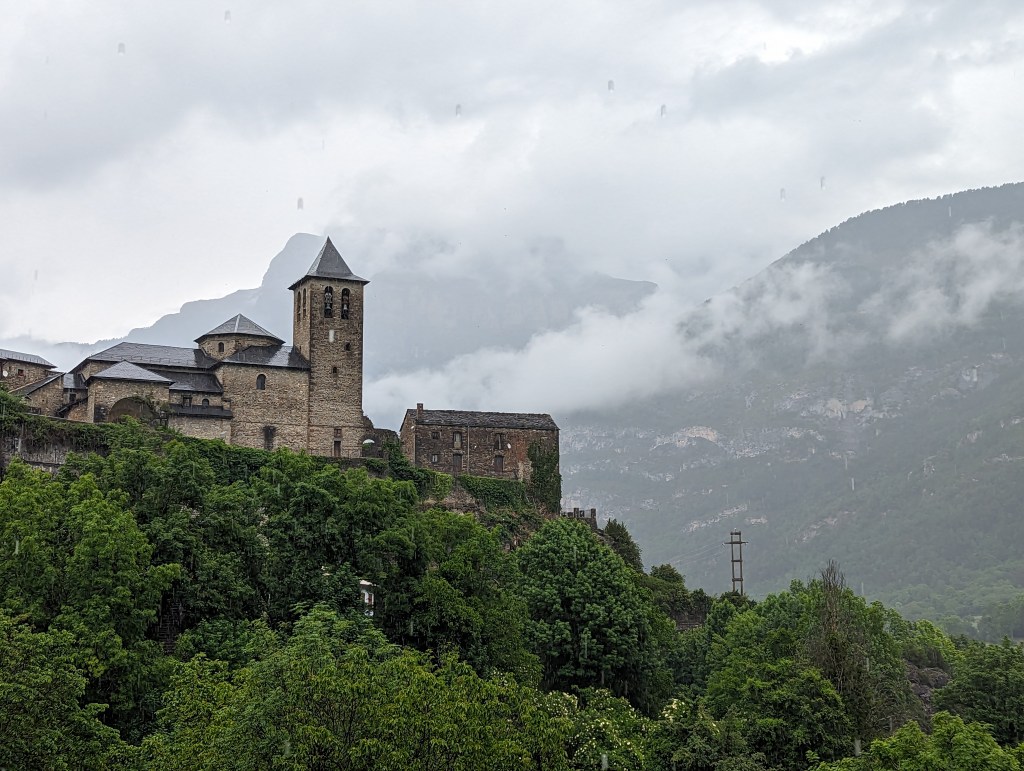
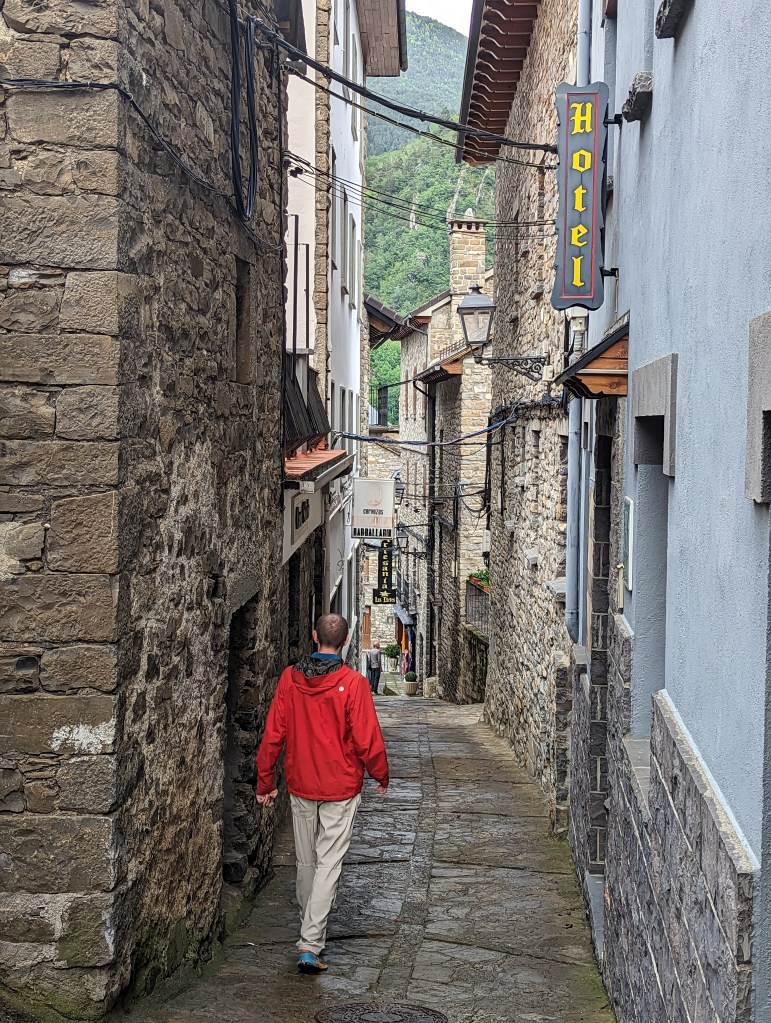
Torla is like a storybook town. Cast entirely in stone, it has a baffling geometry to it that could only have come from the deep recesses of a cartoonist’s imagination. It sits just a few metres higher in the world than Hinton, at 1,032 metres elevation (our house is at 1,022m) and has a whopping 248 residents. During one of our walks, we saw a van careening down the narrow streets and honk loudly at an oncoming car it met around a corner. The two vehicles stopped and we thought we were about to witness an altercation but no — they were all smiles. In a town so small they probably knew each other.
The town plan is truly madcap. A 3-D maze of alleys crossing over and looping around with little passageways that suddenly open up in unexpected places. On our first evening, we took a one-minute detour down a different street that we thought was going in the right direction. We ended up at a large gothic church. From its courtyard, we could see walkers a level below us on another path near where we thought our hotel must be. We tried to find our way down to it but the twisting alley instead came out in front of a large visitor and interpretive centre that we hadn’t seen driving in. Baffled, we looked around and eventually figured out that the main road goes through a tunnel right underneath the church, and though our hotel wasn’t much more than 100 meters away, the hill and church blocks the view entirely.


Ben has almost entirely abandoned Spanish and is now sprinkling some French into his speech. Perhaps a risky move in a town that has a history of fighting with French shepherds over pastureland, but I get it. When compared to our Spanish skills, we’re practically fluent in French. Plus I’m not sure he ever recovered after that time in the Picos when he pre-translated and practiced asking “what is the wifi password,” only to have the hotelier’s face go slack with incomprehension. Ben may as well have been speaking Russian. It wasn’t until the old man looked at me and I cautiously ventured “uh.. weee-feee?” that understanding bloomed. Anyway, that was the last of that.
I did manage to save the day with my terrible spanish, however. More dutch guests were checking in to our Picos posada, and were complaining that the water was off in their room. The husband knew exactly no Spanish at all. He kept repeating, “TAP. DOES. NOT. WORK.” The old gentleman shook his head blankly. The wife timidly tried, “agua?”. The same smile that had lit up the hotelier’s face when he showed us our room’s view again shone out. He understood completely and was delighted to be able to give satisfaction. He strode to a minifridge in the lobby stocked with tonic water and other mixers, and opened it with a flourish. The dutch guest was almost frantic. It was too awkward to bear any longer. I walked over, and to the hotelier, I murmered, “no hay agua en su baño.” To everyone’s amazement, he understood. As a hero, I felt entitled to a bottle of soda from the minifridge to toast my one and only successful Spanish communication. But we have gone far afield of Torla. Take us back, Sabrina.
_insert record scratch as the map zooms back to a tiny valley in the Pyrenees, where rain is spitting upon two umbrellas in search of a place to eat_
It was 5pm, a dangerously in-between time. When we asked about the menú de día at one restaurant, they explained that they’d just barely finished serving lunch, you silly wet geese, but they could slap some meat between some bread if we’d like. Unnecessary. By some miracle, a pizzeria was open and we split a large, cheesy pie that had us sorted ’til morning.
Wisps of low clouds drift down the valley. The peaks fade to a dark grey. Pools of lamplight on the wet cobble streets.

The forecast was for heavy rain today so we selected a short hike and just planned to more thoroughly explore the little town. After a generous breakfast buffet at our cozy hotel, we loped down a path to the Río Ara, a small but mighty stream here. We followed it uphill through a quiet wood covered in vibrant green moss while debating our theories about the hand stencils in El Castile. One thing that struck me during our tour was that we were told that what looked like a left hand was actually a right hand; the palm was facing us, the back of the hand conforming to a concave indentation in the cave wall. I proposed that these might be warnings, as if they are saying HALT. Sabrina was having none of this.
My reasons were many. My reasons were reasonable.

We followed the trail up to a modest lookout over the nearby valleys, then scooted back to town along the road. We got back before the rain started.
We were finally in time for a menú de día. They are often incredible deals. For under €20: a starter dish (often sized to be a meal in its own right), a delicious main course, dessert, bread, wine, and bottled water (if there is a way to just get a cup of tap water for free we haven’t figured it out because when we ask for water, they sell us a bottle). It’s also a simpler way to order, which is a big benefit to us. This one nearly did us in. Huge steaming bowls of chickpea and chorizo stew and creamy spinach and egg had us reeling. Then came the legs of lamb and pork cutlets. We barely finished. Postres delivered the knockout blow,with crème caramel and a custard.
Ben’s eyes grew unfocused and heavy-lidded. I nudged the final dessert his way, having finished my half. “You can do this,” I urged. “You’re so strong.” His skin turned a bit green and for a second there I thought he might lose it all. I pointed out the bathroom, just in case. In the end he admitted defeat and we managed to squeeze through the front door. Behind us, the Spanish continued their revelry and taking their time over each course.

I swear the bed creaked under the strain of our weight when we fell into the room like beached whales. We laid there for hours, the only sound the rain outside and our occasional groan.
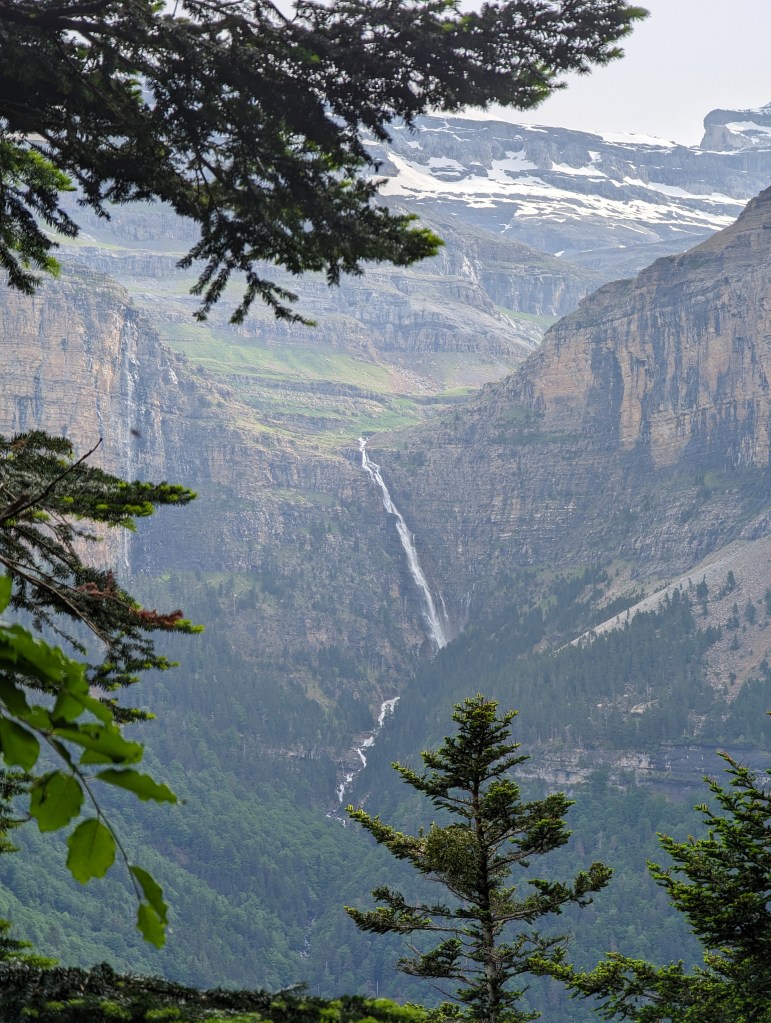
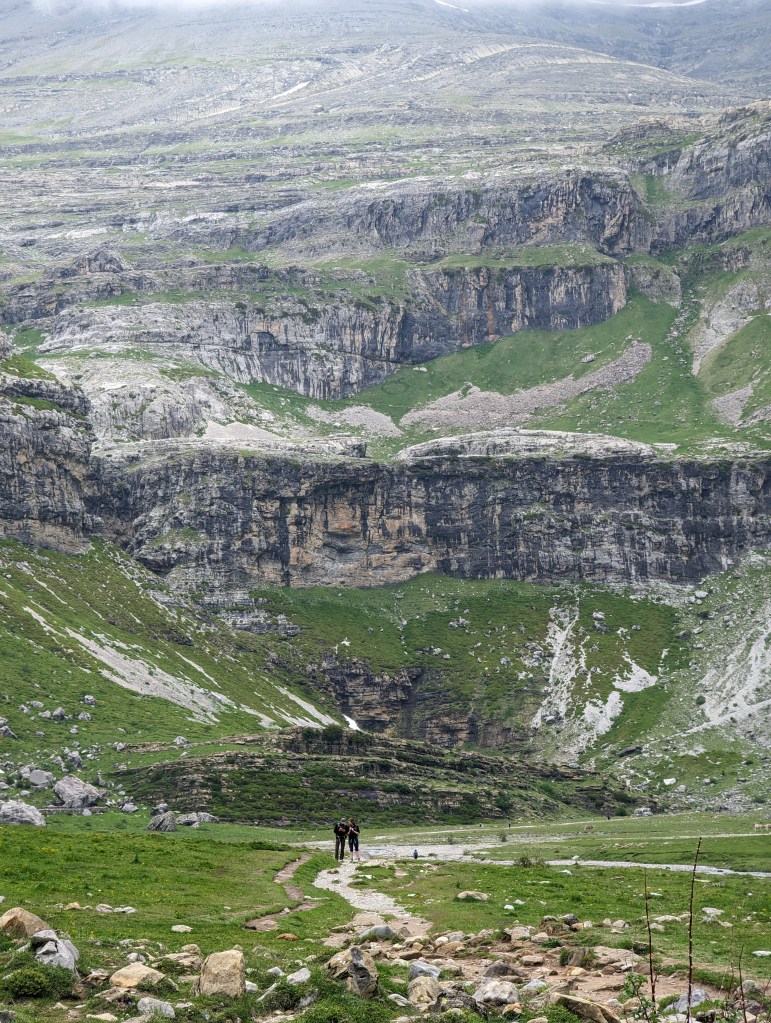
The next morning we drove deeper into the mountains, winding up into the Ordesa Valley. Steep walls completely enclose a fairly wide, flat-bottomed valley. The marketing says it is the Grand Canyon of Europe. It is a very pretty valley, but if it is the closest thing to the Grand Canyon then that does not say much for the rest of Europe’s canyons. From a large parking lot, we started up endless switchbacks to gain the ridge running along one side. Our steady plodding was enough to inch past several other hikers by the time we reached a viewpoint with the tiniest refugio yet. We saw a series of tall, thin waterfalls coming out of the opposite wall of the canyon, plunging down to feed the winding river far below.
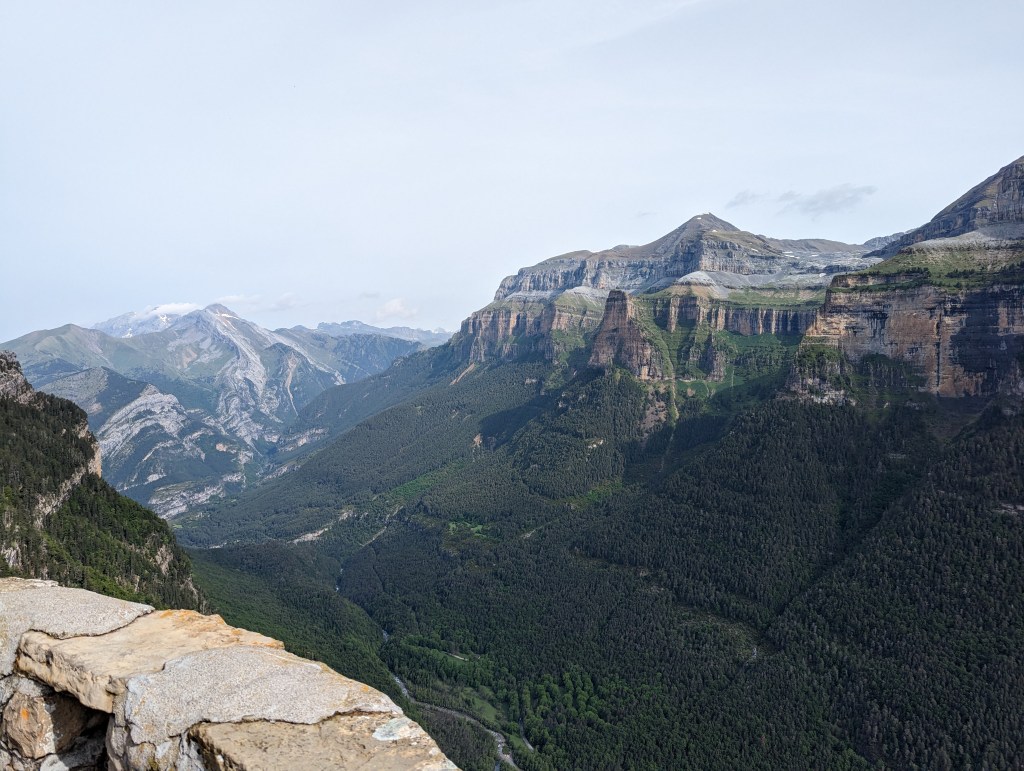
The trail stayed high, offering nice views along the way as we moved down the length of the canyon. There was something about these mountains that felt like home to us. Maybe it was the piney tree cover, or the fact that there were more bugs (though still no mosquitos!) or the shape of the slopes that reminded us of the Icefields Parkway. Whereas the Picos had seemed like low-elevation Dolomites, the Pyrenees seemed very Rocky Mountain-ish.

The descent was a gentle grade and we moved fast. It was a gratifying pace after our slow performance on the Arantzazu hike.
Right at noon, we reached the head of the valley, another splendid waterfall with cows grazing around. We found a nice big rock to stretch out on and eat our lunch before starting back. Rain was forecasted to start around 1pm, getting heavy by 3 so we were looking to make good time. The path was wide and gently downsloping allowing us to again make fast time.
But just how fast? Ben thought we could make it back by 2:30pm (6hr total time). I gave us a bit more credit, guessing we’d reach the car at 2:20. A wager took shape. If Ben won, then during the next day’s drive he could play Radiohead and I had to give the songs a chance. If I won he’d give me a massage. We weren’t allowed to sabotage (no needless dawdling) but neither could we go into the pain cave (if the feet need a break or if a pretty sight presents itself, we take a break).
As we followed the river back to the car, it frequently cascaded down rock steps and small falls. As we got lower, the cow pasture turned to another old beach and poplar forest with a full canopy that would have sheltered us from any light rain, but that never ended up arriving. The soft light that filtered through the leaves showed us a world of dark soil and rock and white-grey tree trunks. The trail, wide enough to be a road and full of people walking both directions, was now and then bordered by mossy stone walls.

As we neared, it started looking more and more like I might be getting a massage. Indeed, victory was mine when we touched the car at 2:10pm. Bonus: we’d handily beaten the rain. We packed up, figuring this was likely the last big hike of the trip so why not collapse the poles.
Just as nice as beating the rain: we also finished before several busloads of school kids had departed from the parking lot. After a good rest at the hotel, we set out for another evening ramble to finish exploring the tiny but confusing town. The roofs are distinct to the region. Like most other pyrenees towns we saw, they have grey slate roofs instead of terracotta tiles. But even more specific are the chimneys, always round and capped by a witch’s hat shaped stone, which, according to tradition, helps keep impish devils out.
The next morning was the first sun we’d had since leaving Basque country. I wasn’t ready to leave these mountains. We dragged out our departure by taking a leisurely breakfast, sitting on our balcony, and getting some bread and pastries at the panadieria for our drive to Barca.
Final big drive! Just four hours separated us from the car rental shop. While I wasn’t ready for the trip to end, I was ready to stop stressing that the car was gonna get scratched or careen through a guardrail. The miles passed without incident, and when we handed in the car they said everything looked good. A giant relief. Then we hupped our packs 40 minutes into the Gothic Quarter, only to find that the reservation I’d made while in San Sebastian was for two weeks later than intended. A huge, non-refundable bummer, but at least they had a room available for that night. It was small and shabby and shared a bathroom, but at least it was reasonably priced (for Barcelona, at least).
We spent the evening hiking up Montjuic for views over the city and grabbing sushi to eat in a skatepark.

The next morning, I woke early to go for a run. I was hoping to get into Park Guell before they started manning the gates, but was a bit too late so just snapped some pics of Gaudi’s architecture along my route back.
At 8:30 we strolled the already lively city, finding one last cafe con leche and pastries. Then it was adios Espana. Over the course of the morning, I gradually came to accept that our vacation was ending. I didn’t dislike Barcelona, but it suffered when placed right before Begur and right after our peaceful balcony in Torla. Also, I think the modern bustle, noise, and smells, were a reminder of the normal routine of our lives.
It was such a good trip. We did everything we wanted to do and we kept to our plan of spending more time in fewer areas in order to not be constantly driving and packing and checking in and out of different places. We added genuinely new experiences to our lives. New landscapes and language and history; something we’ve shared, new memories that can remind us of each other every time we look back.
Even writing this blog together was fun and new. Dare I say one of the best parts of the trip? Jk there’s no way it was better than hiking through the Picos de Europa but good all the same.
 Mostly BS
Leave a comment